
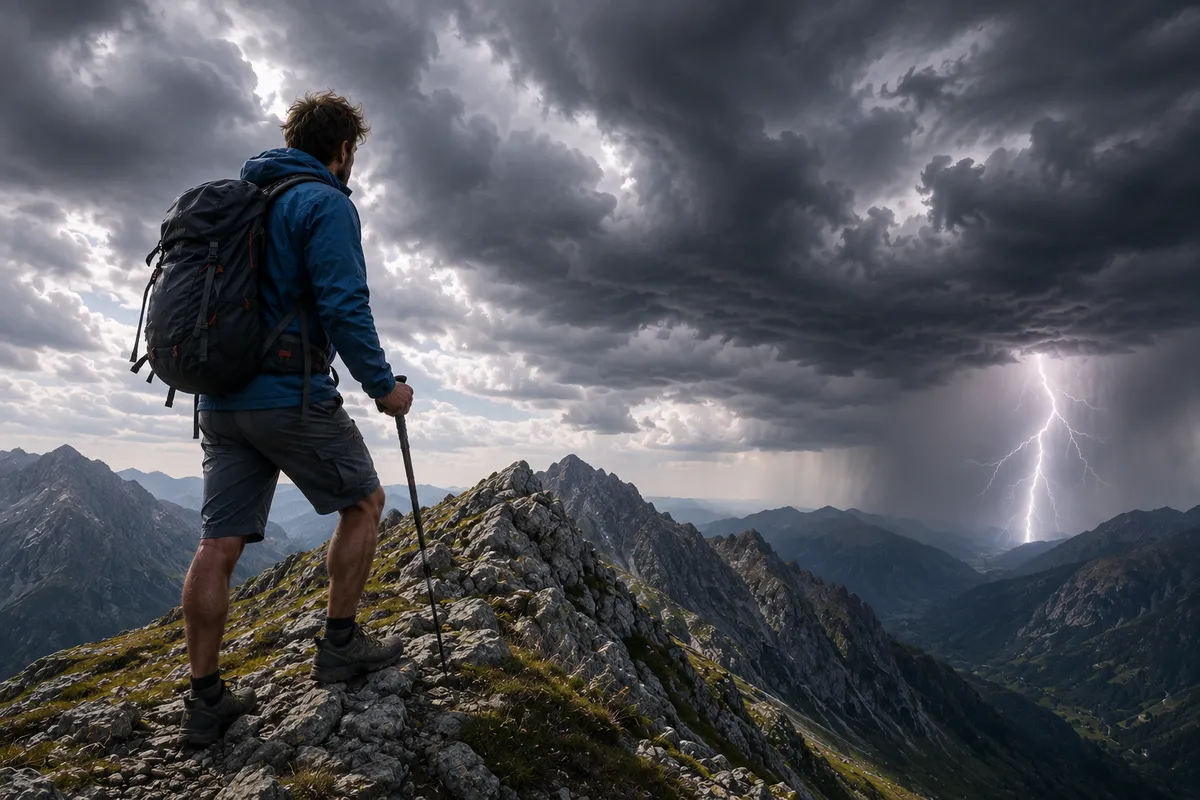
A sky darkening, some distant rumblings of thunder… The signs announcing a storm are generally quite easy to identify. But there is one much less known to hikers: a strange buzzing or crackling that sometimes feels like being surrounded by bees.
The phenomenon is serious enough to be mentioned in official safety recommendations. The Ministry of the Interior indicates that in the mountains, when a mountaineer hears the “buzzing or the sound of bees” characteristic of the corona effect, the ambient electric field is already intense and the ridges must be left immediately.
A bee sound… without any bees
The phenomenon can be particularly disconcerting the first time one encounters it. You are at altitude, sometimes in a mostly mineral environment, and an electrical buzzing or crackling becomes noticeable. No need to look for a hive hidden between two rocks!
This sound can be caused by what physicists call the corona effect. When the electric field becomes intense enough, micro-discharges can appear around certain points or asperities. RTE explains that these phenomena can particularly occur around mountaineers’ ice axes and generate a characteristic crackling comparable to the sound of bees.
This electrical phenomenon is also associated with the famous St. Elmo’s fires, those glows sometimes observed around pointed objects when the electric field is very strong.
Why is this phenomenon particularly worrying in the mountains?
Summits, ridges, and edges are precisely the places where you must not remain when a storm approaches. A hiker moving along a ridge line can be particularly exposed. That is why Météo-France recommends, in case of a mountain storm, to avoid ridges and summits and, when caught on a summit, to descend as low and as quickly as possible.
The “buzzing of bees” must therefore be considered an emergency signal, and not a natural curiosity to observe or film.
Other manifestations can accompany an intense electric field:
- hair standing on end;
- tingling sensations;
- crackling coming from certain objects;
- possibly a faint bluish glow around a metal point.
If several of these phenomena appear, one must react immediately.
What to do if you hear this buzzing?
The priority is to immediately reduce your exposure. If you are still on a summit, ridge, or a particularly open area, leave this position and lose altitude as soon as it can be done safely.
Météo-France also recommends moving away from metallic objects such as ice axes, crampons, carabiners, pitons, telescopic poles, or pylons. It is also necessary to avoid isolated trees and watercourses.
If no solid building is accessible and the storm is over you, official recommendations advise squatting, feet together, without lying down on the ground or leaning against a wall. When possible, an insulating material such as a backpack without metal frame, a sleeping bag, or a rope can be placed between yourself and the ground.
The cave, a bad idea
Facing a storm, the first instinct might be to take shelter in the first available small rock cavity. This is not necessarily a good solution. A small crevice or a shallow cave can be dangerous: near the entrance, an electric arc may form between the ceiling and a person. Leaning against the rock also exposes you to electrical current passing through. The Ministry of the Interior recommends, in such a situation, to remain squatting while keeping as much distance as possible from the ceiling, walls, and back.
The same logic applies to a rock overhang: Météo-France discourages staying there during a storm.
Do not wait for the “buzzing of bees” to descend
The main lesson is elsewhere: if you hear this buzzing, you have already waited far too long to leave an exposed area. The goal is precisely never to reach this situation.
A sky that becomes very dark, rapidly developing cumulonimbus clouds, sudden gusts, and especially the first rumblings of thunder should prompt modifying or interrupting the hike.
In the mountains, waiting until the rain starts to turn back is a bad strategy. Lightning can happen before the first significant drops and strike at a distance from the area where precipitation is heaviest.
Mountain storms: better to anticipate
Before each hike, especially during the summer, consulting only the general weather for the day is not enough. You must look at the forecast changes throughout the day and the storm risk.
Météo-France’s Weather Vigilance system allows identifying dangerous phenomena likely to affect a department in the coming hours. It is updated at least twice a day and more often when the situation requires.
When storms are forecast in the afternoon, leaving early can allow one to be back in a safe area before they develop. If the risk is significant, it is better to change the itinerary or postpone the hike altogether. Government recommendations go in this direction: in case of a storm alert, adapting or postponing your outing is the first preventive measure.
At a time when weather conditions are increasingly extreme due to climate warming, it is important to take this into account, as the number of accidents linked to these storms (and their consequences) is growing.
To read: Storm on a hike: these reflexes that can save your life
The reflex to remember
You are in the mountains and suddenly hear a buzzing like a swarm of bees when no insect is visible? Do not waste time searching for the source of the noise and do not stay put to film the phenomenon.
Immediately leave ridges, summits, and high points, lose altitude if this can be done safely and look for a less exposed position.
This curious “buzzing of bees” is spectacular, but when caused by the corona effect, it mainly indicates one thing: the electric field around you has become intense enough to constitute a serious warning signal.