
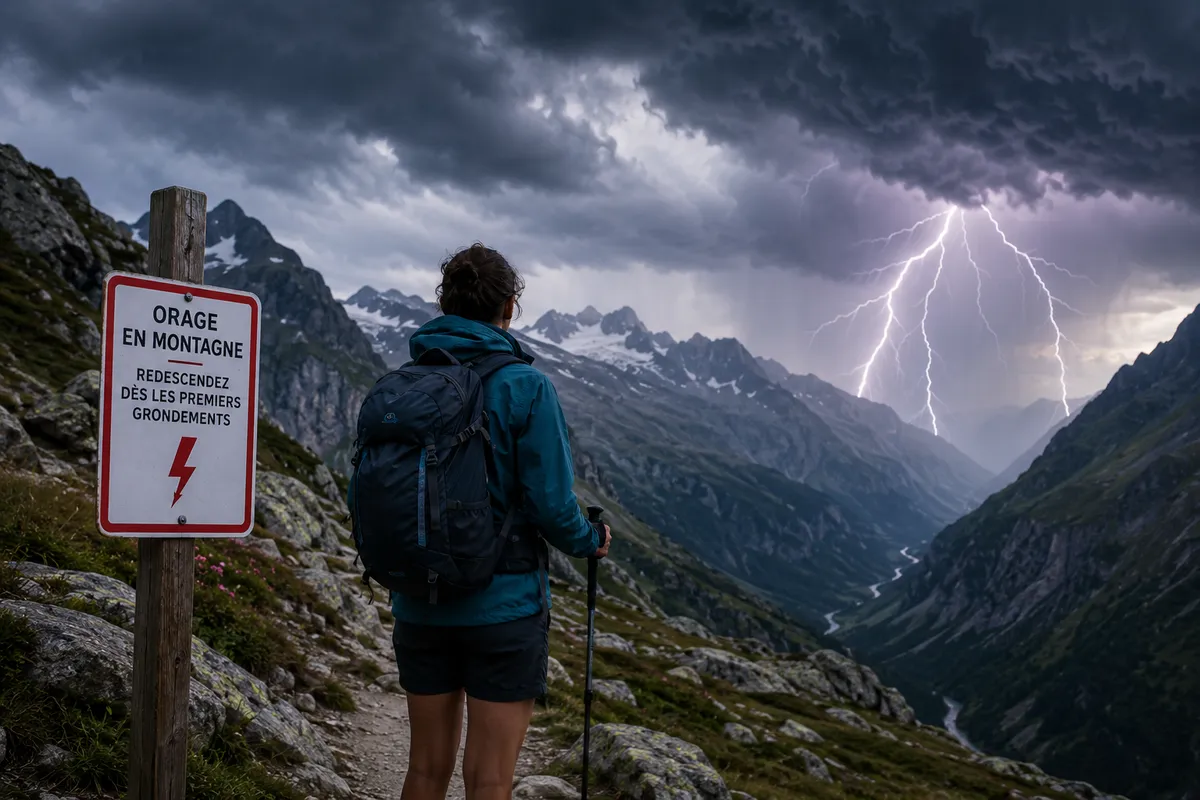
Each summer, mountain storms surprise hundreds of hikers. They sometimes break out in just a few dozen minutes, turning a peaceful outing into an emergency situation. In France, lightning still causes several deaths and many injuries each year, the mountains remaining one of the most exposed environments.
Over my years of hiking, I have faced several storm episodes. Some have left a lasting memory and, above all, taught me that at altitude, a few simple decisions can make all the difference.
The day the storm caught up with me at Aiguillette d’Argentière
It was in the middle of summer, on the heights of Chamonix, during a hike toward Aiguillette d’Argentière. The conditions seemed ideal at the start: a perfectly clear sky, a pleasant temperature in the valley, and weather that only hinted at a risk of showers at the end of the day.
We had left early, convinced we had plenty of time to finish the route before any possible deterioration. Yet, in the early afternoon, the first clouds quickly developed above the peaks.
In less than an hour, the atmosphere completely changed. The wind rose, the rumbles came closer, and visibility began to decrease. We immediately decided to go back down, but the storm caught up with us before reaching the forest. It was the first time I heard the famous “bees” (a crackling created by a high presence of electricity in the air), and I have a rather bad memory of it.
For many minutes, we waited sheltered by a relief, squatting on our backpacks, while several lightning strikes hit the surroundings. This experience definitely convinced me of one thing: a summit is never worth taking a risk.
Since that day, I systematically apply three rules.
Reflex #1: constantly watch the sky
Most storms do not arrive without warning. Signs are often visible several hours before they start.
Certain clues should immediately catch your attention:
- a weather forecast mentioning a storm risk;
- heavy heat from the morning;
- cumulus clouds rapidly growing;
- clouds taking an anvil shape;
- a feeling of electricity in the air.
In the mountains, a simple “risk of showers” can announce a real storm episode in the afternoon. When the weather is unstable, it is better to leave very early to be back down before the hours most favorable for storms.
Experience also shows that you should never ignore the first visible signs in the sky. A cloud that quickly gains height can evolve into a cumulonimbus in very little time.
Reflex #2: go down at the first thunderclap
The first rumble must be considered an immediate alert signal.
Mountain professionals use the so-called “30/30” rule. It consists of counting the seconds between the lightning and the thunder. If the interval is less than thirty seconds, the storm is close enough to become dangerous.
At that point, you must:
- leave the ridges;
- abandon the summits;
- move away from the edges;
- lose altitude quickly.
A few dozen meters of elevation loss can already considerably reduce exposure to lightning. The goal is not to run, but to descend quickly and without rushing.
Panicking is often an additional danger. Falls on wet or rocky ground cause many accidents every year during storm episodes.
It is also advised to put away hiking poles and any unnecessary metal objects during the descent.
Reflex #3: adopt the right position if stuck
Sometimes the storm is already too close to allow a safe descent. In this case, the position you take becomes essential.
Experts recommend:
- squatting;
- keeping feet together;
- isolating yourself from the ground with a backpack or clothing;
- tucking in the head and clasping the knees.
This position limits the effects of electric current that can spread through the ground after a lightning strike.
Conversely, you should never lie down.
Metal objects must be placed several meters away. In a group, each person must also distance themselves from others to avoid a single strike hitting several people.
The most common mistakes
Certain attitudes frequently recur among hikers caught by a storm.
Continuing toward the summit
When the goal is close, it is tempting to carry on despite the clouds. Yet, a few more minutes can be enough to find yourself exposed on a ridge.
Taking shelter under a solitary tree
This is probably the most common bad reflex. A solitary tree acts as a preferred impact point for lightning.
Staying grouped
By instinct, group members tend to gather. But if lightning strikes one person, several victims may be involved.
Taking refuge in a tent
A tent does not provide protection against lightning. When camping, it is often better to move slightly away and adopt a safe position.
Places to absolutely avoid
In case of storm, certain places must be left immediately:
- summits;
- ridges;
- open cols;
- isolated trees;
- lakes and streams;
- metal fences;
- pylons or ski lifts.
The rule remains simple: move away from high points and conductive elements.
Wait for the storm to truly end
A common mistake is to resume hiking as soon as the rain stops.
Experts recommend waiting at least thirty minutes after the last thunderclap before resuming walking. Some storms reactivate very quickly after a lull.
If a person is struck by lightning, you must immediately notify emergency services by calling 112. Contrary to popular belief, a lightning victim is not electrified and can be rescued safely.
Better to give up than regret
The best protection remains anticipation. Leaving early, checking the weather, watching the sky, and accepting to turn back are the true safety rules.
Since my experience at Aiguillette d’Argentière, I have given up several hikes because of a storm risk. Sometimes, the storm never actually arrived. But coming back with a slight feeling of frustration is always better than finding yourself trapped at altitude.
In the mountains, no summit is worth risking your life.