⚠️ Current situation (August 20, 2026): access conditioned by weather conditions
On August 4, 2026, a violent storm caused a major mudslide at the Cirque du Fer-à-Cheval, leading to the temporary closure of the site. A second event, also fatal, occurred a few days later despite an active access ban. Access has since been reopened but remains now conditioned on meteorological vigilance bulletins: in case of yellow or higher alert (thunderstorms, rain-flooding, floods), access to the site is automatically closed as a safety measure. The rest of the Sixt-Fer-à-Cheval municipality, including shops, restaurants, and accommodations, operates normally.
Before any trip, we strongly recommend that you:
- Check the Météo-France vigilance for Haute-Savoie
- Verify the site’s access status with the Sixt-Fer-à-Cheval Town Hall
- Leave immediately the surroundings of the Giffre River and torrents in case of announced storm or heavy rain, even after a nice day
Nestled in the heart of the Haut-Giffre valley, in the village of Sixt-Fer-à-Cheval, at the heart of the Sixt-Passy Nature Reserve, the Cirque du Fer-à-Cheval is an exceptional natural site. This limestone amphitheater impresses with its dizzying cliffs, countless waterfalls, and preserved atmosphere. It is the largest mountain cirque in the French Alps, a must-see for lovers of hiking, nature, waterfalls, and spectacular landscapes.
1. Understanding the Cirque du Fer-à-Cheval
1.1 A unique geological site
The Cirque du Fer-à-Cheval is a glacial cirque more than two kilometers in diameter, located in the Haut-Giffre valley, formed over millennia by glacier activity. Its cliffs, 500 to 700 meters high, outline a horseshoe shape, which gives it its name. Crowned by peaks approaching 3000 meters, such as the Tenneverge peak, the White Horse, or Mont Ruan, it forms a landscape both grandiose and harmonious.
1.2 History and origin of the name
The name “Fer-à-Cheval” comes directly from the shape of this natural amphitheater. The site’s history is closely linked to that of the village of Sixt, once dependent on the abbey of Sixt. Ancient accounts tell of pilgrimages, scientific explorations, and travelers fascinated by the beauty of the place. Today, the site is classified as a Grand Site de France.
2. A paradise for hikers
2.1 Must-see trails
The cirque is a starting point for many walks accessible to all levels. Among the best-known hikes:
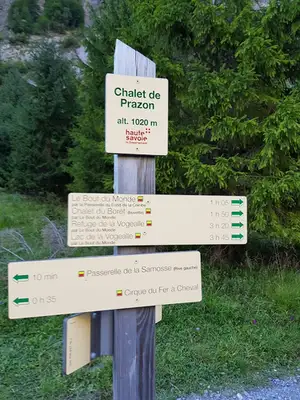
- Le Fond de la Combe: family stroll to the bottom of the cirque.
- Le Bout du Monde: extension of the hike to the Giffre springs.
- Chalet du Boret: steeper trail but offering aerial views.
- Tour du Cirque: full loop for the most enduring.
- Lac de la Vogealle: very beautiful hike for the most athletic.
| Hike | Distance | Duration | Elevation gain | Level |
|---|---|---|---|---|
| Fond de la Combe | 6 km | 2h | +150 m | Easy |
| Bout du Monde | 10 km | 3h30 | +250 m | Medium |
| Chalet du Boret | 7 km | 4h | +500 m | Athletic |
| Tour du Cirque | 12 km | 5h30 | +450 m | Experienced |
| Lac de la Vogealle | 30 km | 7h30 | +1400 m | Experienced |
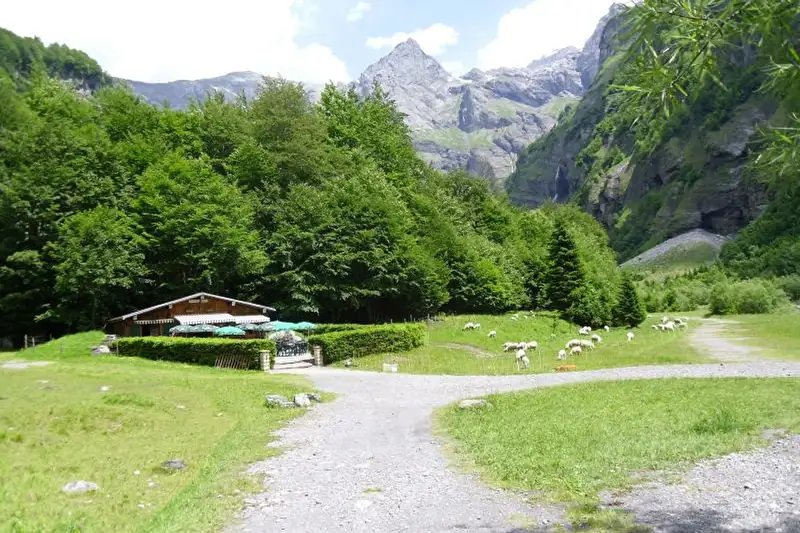
For non-athletes, the walk to the buvette du Prazon is very easily accessible, 35 minutes from the parking lot, with very little elevation gain.
2.2 Le Fond de la Combe: the star hike
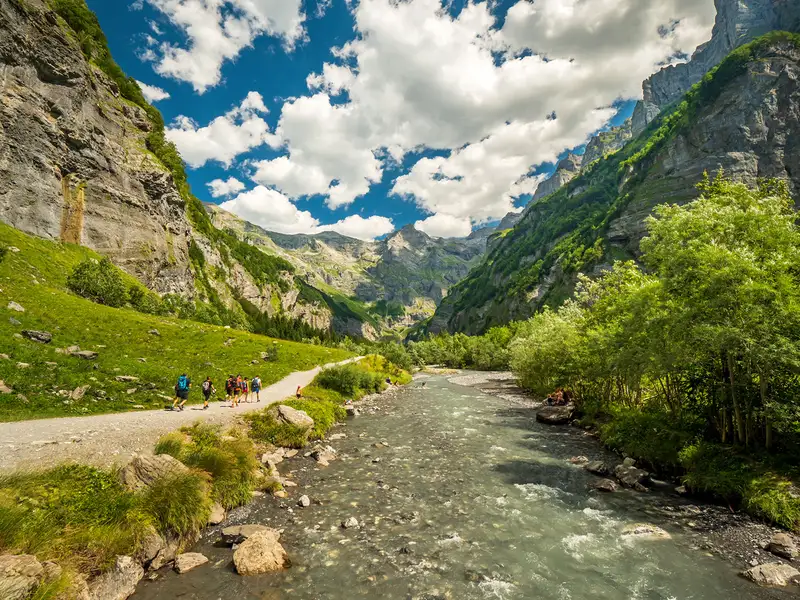
This is the most popular walk on the site. Accessible to the whole family, it runs alongside the Giffre River, crosses meadows, and offers spectacular views of the walls and waterfalls. It ends at the foot of the Bout du Monde, an imposing wall from which the springs of the Giffre gush. In peak season, it is overcrowded, and it is advisable to come early in the morning.
See the walk of the bout du monde
2.3 Practical tips for good hiking
- Bring appropriate hiking shoes, even for family walks.
- Access to the site is regulated: paid parking, dogs must be on a leash.
- Trails are very busy in summer, prefer morning or spring.
- In case of rain, paths may be slippery.
3. The spectacular waterfalls of the cirque
3.1 More than 30 waterfalls listed
In spring, the cirque transforms into a true water theater: more than thirty waterfalls spill down the cliffs. Some, like the Cascade de la Pleureuse, the Sauffaz, or the Pissevache, are visible right at the site entrance.
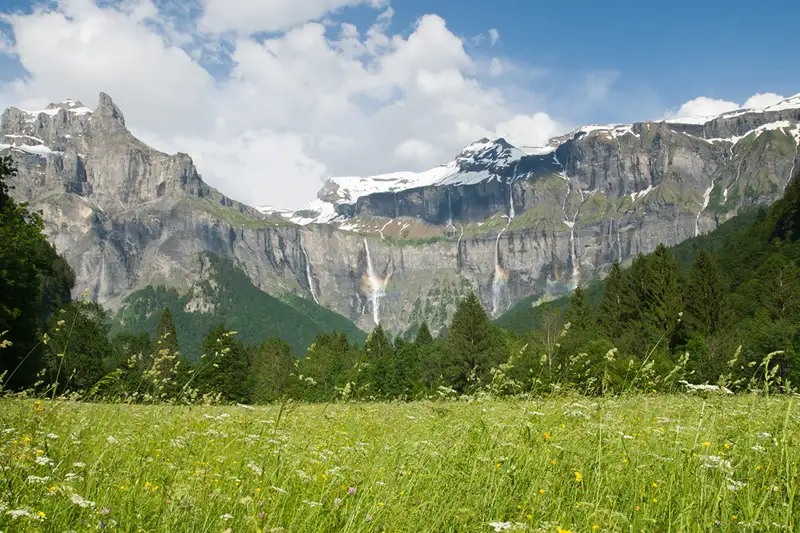
Here are some of these waterfalls:
Cascade de la Pierrette
- Very visible from the cirque entrance
- One of the highest, often the most photographed
- Impressive flow in spring
Cascade du Fond de la Combe
- Located in one of the deepest combes of the cirque
- Very wild environment
- Area sometimes closed during certain periods (nesting)
Cascade de la Vogealle
- At the bottom of the cirque, accessible after 1h30 of walking
- It bursts out of a rocky chaos below the lake of la Vogealle
- Highly dependent on melting conditions
Cascade de la Lyre
- Named for the clear sound it makes as it falls
- Beautiful viewpoint from the main trail
Cascade de la Sauffaz
- Impressive but distant, often “silk thread”-like
- May be invisible in summer if melting is over
Cascade du Tenneverge
- Comes from the foothills of Mont Ruan (over 3000 m)
- Rarely accessible up close, but visible from afar
Cascade de la Pleureuse
- Local name because it “cries” gently in a fine cascade
- Beautiful in spring, near flowering areas
Cascade de la Pissevache
- A common name for very vertical waterfalls in Savoie
- Tall but thin, spectacular after a storm
Cascade du Bout du Monde
- At the very bottom of the valley, after the refuge of the same name
- Accessible only on foot (approx. 1h30 – 2h hiking)
- One of the most photogenic with full panorama
And of course, although it is not part of the Cirque du Fer à Cheval, the famous Cascade du Rouget, about 6 km from the municipality of Sixt-Fer-à-cheval.
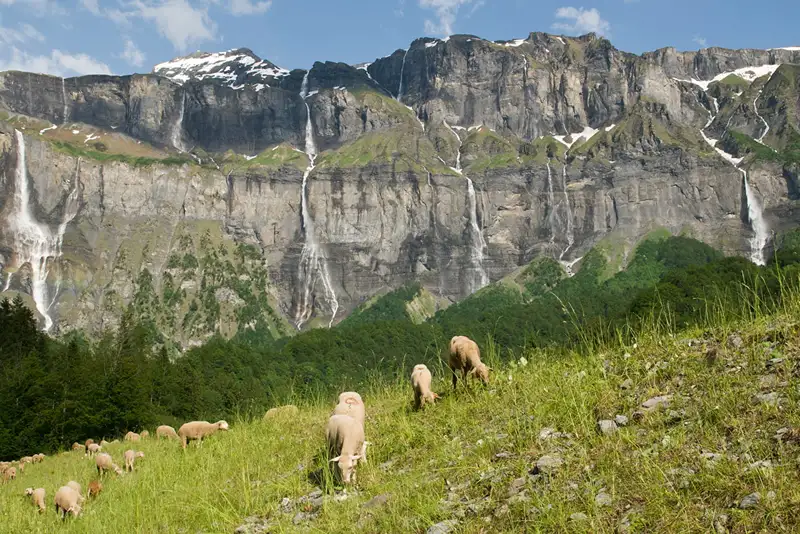
3.2 Waterfall season: when to go?
The best period to observe the waterfalls is between mid-May and late June, when the snow melts at altitude. The flow gradually decreases during summer, but some waterfalls remain visible all year round.
4. Sports activities and events
4.1 The Cirque du Fer-à-Cheval Trail
Recently, a trail event attracts mountain running enthusiasts. The 2024 edition will offer 3 courses between 11 and 32 km, with spectacular panoramas at every turn. The trail crosses steep paths, overlooking the cirque and offering full immersion in nature.
4.2 Other outdoor activities
The site and its surroundings are also suitable for:
- Climbing (nearby climbing school sites)
- Canyoning in the Gorges du Giffre
- Rafting in the Gorges des Tines, on the Giffre (between Sixt and Samoëns).
- Backcountry skiing in winter
- Wildlife observation (chamois, golden eagles…)
- Paragliding, for a 360° view of the cirque from the air. Warning, flying over the cirque is prohibited.
5. Preparing your visit
5.1 Access and parking
The Cirque du Fer-à-Cheval is accessible by car from Samoëns (15 min), Cluses (30 min) or Geneva (1h30). A paid parking lot is available at the site entrance (€7 per day in high season). From the parking lot, allow 20 to 30 minutes walking to reach the start of the trails. See the parking guide for the Cirque du Fer à Cheval
5.2 Accommodations in Sixt-Fer-à-Cheval and surroundings
It is easy to find lodging near the site, in the valley. Nearby options include:
- Chalets for rent
- Rural cottages
- Mountain inns
- Campgrounds and refuges
The villages of Samoëns, Morillon, or Verchaix also offer many lodging options.
5.3 Live weather and webcam
Before leaving, check the live webcam installed on the Haut-Giffre Tourist Office site. It allows verifying weather conditions and snow cover depending on the season.
6. The Cirque du Fer-à-Cheval throughout the seasons
6.1 Spring and summer: the explosion of waterfalls
Snowmelt gives life to a multitude of waterfalls. The green meadows contrast with the white of the still snow-covered peaks: a magical setting for hiking and photography. Beware of overcrowding.
6.2 Autumn: foliage and tranquility
The site is much less crowded, and the autumn colors transform the landscape. It is an ideal period for contemplatives and photographers.
6.3 Winter: a fairy tale scenery
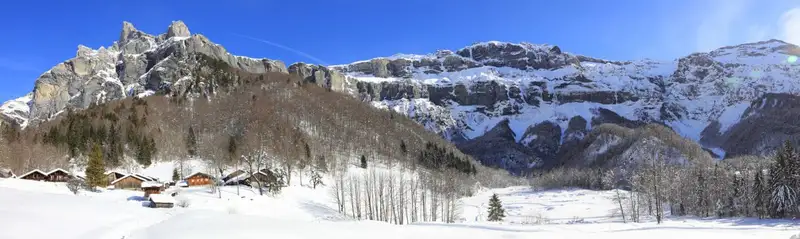
Under the snow, the cirque takes on a whole new dimension. Some areas are accessible by snowshoes or backcountry skiing. The partially frozen waterfalls offer a magical spectacle. Warning, at this time the bottom of the cirque is not accessible because it is too dangerous (high avalanche risk).
7. The Cirque du Fer-à-Cheval, sanctuary of alpine biodiversity
An exceptional mountain ecosystem
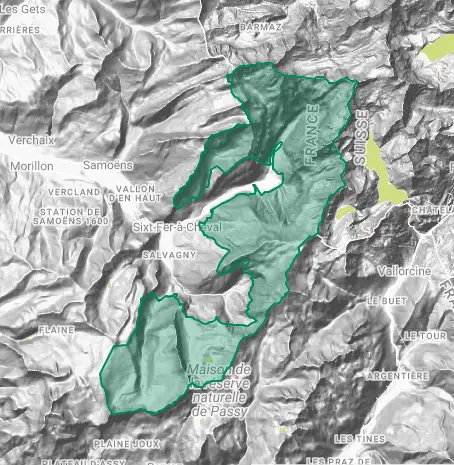
Beyond its spectacular landscape, the Cirque du Fer-à-Cheval is a true ecological refuge. Thanks to its isolated topography, varied altitude (from 900 to 3,000 m), and preservation of its natural environments, it shelters a remarkable biological diversity. It is a core zone of the Natura 2000 site “Sixt-Passy”, also integrated into the Grand Sites de France network, making it a model of environmental conservation in Haute-Savoie.
Protected and discreet fauna
More than 70 protected animal species find refuge in the cirque and its immediate surroundings:
- Chamois and ibex, often observable early in the morning on the walls.
- Golden eagles, nesting in the cliffs, with regulated observation zones.
- Tichodrome échelette, a small rare climbing bird specific to limestone cliffs.
- Eurasian lynx, discreet but occasionally spotted in the area.
- Alpine black salamander, endemic species visible after rain, especially in humid understories.
| Species | Ideal observation period | Preferred area | Recommended discretion |
|---|---|---|---|
| Chamois | March to October | Exposed slopes early morning | ⚠️ Medium: avoid shouting/dogs |
| Ibex | April to September | Cliffs near Fond de la Combe | ⚠️ High: observe from a distance |
| Golden eagle | January to August (except nesting) | High cliffs (binoculars recommended) | ⚠️ Very high: sometimes restricted zones |
| Marmots | April to September | Alpine pastures near Bout du Monde | 🙂 Low: easy to observe |
| Tichodrome échelette | November to April | Vertical cliffs and rocky areas | ⚠️ High: discreet and rare bird |
| Eurasian lynx | All year (rare) | Wooded areas, rarely seen | 🚫 Observation unlikely |
| Alpine black salamander | May to September (after rain) | Humid understories and torrent banks | ⚠️ Medium: do not touch |
| Deer/roe deer | September to March (rutting) | Forest edges | ⚠️ High: silence imperative |
Precious and fragile alpine flora
The flora of the Cirque reflects the richness of mountain environments:
- Opposite-leaved saxifrage, rare and endemic to the Alps.
- Martagon lily, visible in summer at forest edges.
- Wild orchids, such as frog orchid or mosquito orchid.
- Maples and ashes in humid wooded areas.
Floristic diversity is enhanced by the combination of wetlands, alpine meadows, screes, cliffs, and alluvial meadows.
Active conservation challenges
The site is closely monitored by several organizations:
- Conservatoire d’Espaces Naturels de Haute-Savoie (Asters): scientific monitoring of fauna and flora.
- French Office for Biodiversity (OFB): presence of ranger-monitors.
- Haut-Giffre Regional Natural Park (project): promotion of sustainable tourism.
- Installation of awareness panels, marked trails to limit erosion, and temporary access restrictions to protect nesting areas.
How visitors can contribute
Even as a simple hiker, everyone can help protect this natural heritage:
- Stay on marked trails
- Do not pick flowers, nor disturb animals
- Keep your dog on a strict leash to avoid escape or stress to wildlife. Dogs are forbidden beyond the parking/welcome chalet, even on a leash, because it is the core of the reserve.
- Respect silence zones during nesting periods
- Report any anomaly (injured animal, fire, pollution…)
8. Practical information and useful resources
8.1 Regulations and preservation
The Cirque du Fer-à-Cheval is a protected area. Some rules to follow:
- Dogs allowed only on leash. Beyond the welcome chalet, dogs are forbidden, even on a leash
- No fire or bivouac outside authorized zones
- Respect fauna and flora
- Do not leave marked trails
- Drones prohibited
8.2 Additional resources
- IGN map at 1:25000 scale
- Local topo-guides
- Rando-Montblanc app
- Haut-Giffre Tourism Office: haut-giffre.fr
- Webcam: webcam Sixt – Cirque
- Information on the Sixt Nature Reserve: https://reserves-naturelles.org/reserves/sixt-passy/
The Cirque du Fer à Cheval on video
Frequently Asked Questions
Yes, parking is paid all year round. The rate is €7 per day, or €12 for an annual subscription (for passenger vehicles). You can also follow parking occupancy at this link: https://affluences.com/parking-de-sixt-fer-a-cheval
Dogs are allowed on a leash only in the first part. Beyond the welcome chalet, in the core of the reserve, dogs are forbidden, even on a leash.
The snowmelt period is ideal to see the cirque waterfalls at their maximum flow. So spring, early summer.
Article mis à jour le 21 August 2026