
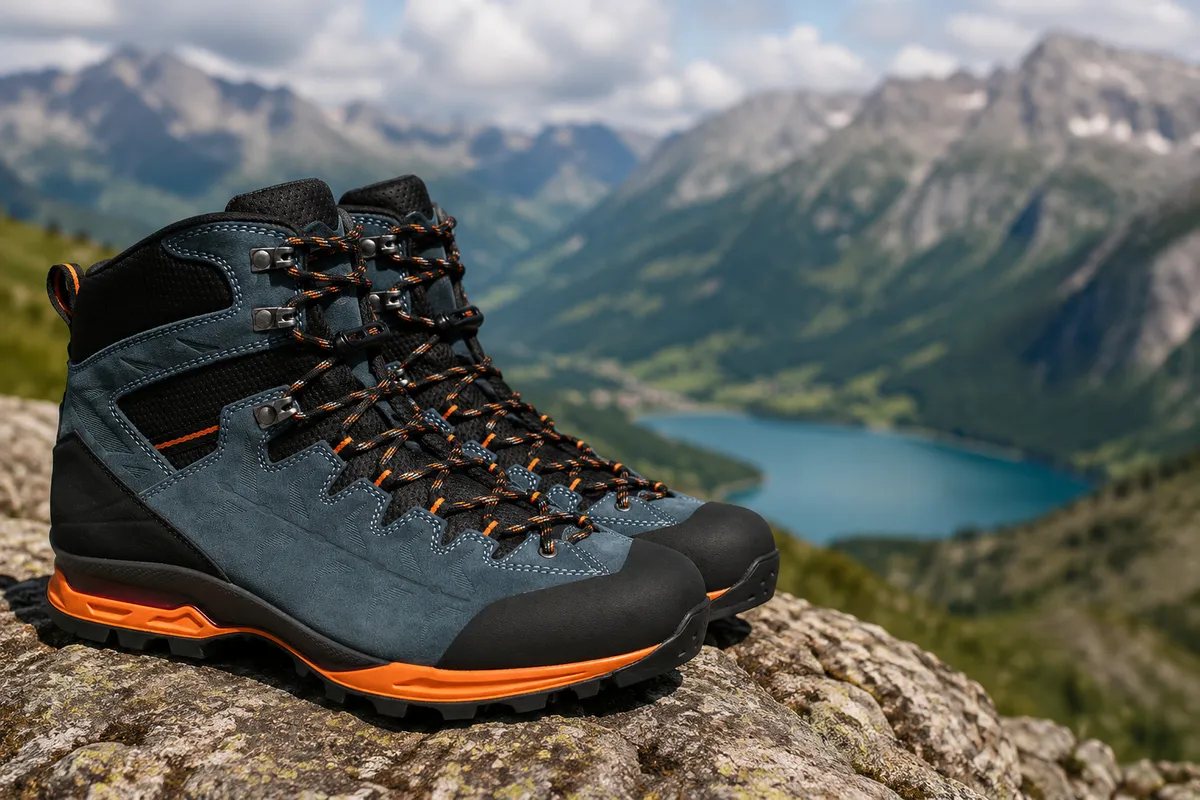
Other technologies are more specialized. Vibram Idrogrip targets wet environments and wet rocks, while Vibram Mont is intended for more demanding activities such as trekking and mountaineering, especially in cold conditions.
The mere presence of the Vibram logo is therefore not enough to determine if a shoe matches your activity: you must especially check the type of sole and its intended use.
Which lugs according to the terrain?
On a relatively dry and compact path, moderate lugs generally provide enough grip while promoting a natural foot roll. When the terrain becomes loose, muddy, or stony, deeper lugs generally allow better penetration into the ground.
The arrangement of the lugs is also important. A properly designed sole facilitates grip during ascents and braking during descents. On very rocky terrain, for example, one will look for more precision, stability, and rubber offering good grip.
For versatile mountain use, it is therefore better to favor a sole with sufficiently pronounced lugs and good grip on dry and wet surfaces rather than an almost smooth sole.
Waterproof shoes: is it always necessary to choose a membrane?
The terms Gore-Tex, GTX, or other waterproof membranes appear on many models. The principle is to limit water penetration while allowing some of the moisture produced by the foot to escape.
For mountain hiking, a waterproof membrane is truly useful when you regularly encounter:
- wet grass;
- rain;
- puddles;
- mud;
- residual snow;
- cool and damp conditions.
A waterproof shoe is thus particularly versatile in spring and autumn. But waterproofness and thermal comfort do not always go hand in hand.
Why a waterproof shoe is not always preferable
In midsummer and in hot weather, a very waterproof shoe may be less breathable than a model without a membrane. For mainly summer hikes on dry terrain, some walkers therefore favor very breathable shoes that quickly wick sweat away.
The choice again depends on usage:
- wet terrain and changing weather: waterproof membrane is interesting;
- dry terrain and high temperatures: breathability is often a priority;
- all-year versatile hiking: a waterproof membrane usually represents a practical compromise.
Also beware of a misconception: a waterproof shoe is not a boot. If water (or snow) enters from the top of the shaft, it will eventually wet the interior.
The stiffness of the sole must correspond to the terrain
A very flexible shoe facilitates foot rolling and generally provides a pleasant feeling on easy trails. But on scree or very rocky terrain, this flexibility can become tiring. The foot feels the roughness more and must constantly work to maintain its stability. Conversely, a stiffer sole better distributes stresses and provides better stability on uneven terrain.
So, a simple rule can be retained: the more technical, mineral, and rugged the terrain, the more some stiffness becomes interesting.
For mountaineering or hikes requiring the use of crampons, however, you should turn to shoes specifically designed for that use. Some compounds aimed at mountaineering are developed to maintain their stiffness and performance at low temperatures and allow compatibility with crampons.
Which shoe to choose according to your type of hike?
For a walk of a few hours on an easy path, a low, light, and relatively flexible shoe will generally be sufficient.
For a classic hike in mid-mountains, a sturdy low shoe or a Mid with a lugged sole offers more versatility.
For a long hike with elevation gain and rocky passages, favor a Mid or high shoe with more rigidity, good lateral protection, and a particularly grippy sole.
For scree and alpine hikes, a stiffer, more protective shoe with a rock plate becomes preferable.
Finally, for terrains including snow and ice, you must choose a model truly designed for these conditions and check its compatibility with the type of crampons planned.
Do not neglect the rock plate
The rock plate corresponds to the protection mainly located at the front of the shoe, sometimes extended to the sides. On an easy trail, its importance remains relatively limited. As soon as you move in scree or on a rocky path, it becomes particularly appreciated. A simple impact with a stone can be very painful after several hours of walking.
The more your activity leads you on mineral terrains, the more it is interesting to look for a shoe that envelops the foot with a genuine rock plate.
Comfort and foot shape remain priorities
A shoe can have an excellent sole, a high-end membrane, and all the desired technical features: if it is not adapted to your foot, it will remain a poor choice. Morphology varies considerably from one person to another (some feet are narrow, others wide, with a more or less pronounced instep), so trying shoes on is indispensable. Ideally, try the shoes with the socks you will actually use for hiking.
The heel must be properly held without excessive slipping. The toes must have a little space, no more, especially to avoid hitting the front of the shoe during long descents. If possible, also test the shoes on an inclined surface.
The weight of the shoe: finding the right balance
A light shoe reduces fatigue and generally provides a more dynamic walk. This is one of the reasons explaining the success of shoes inspired by trail running. But gaining weight savings sometimes means reducing protection or stiffness.
For a short hike with a light backpack, this compromise can be particularly interesting, but on a multi-day hike with a heavy backpack and difficult terrain, a few hundred extra grams can be justified by better stability and more protection.
You should thus avoid systematically looking for the lightest shoe: instead, look for the lightest shoe truly suited to the constraints of your activity.
Shoes are only part of mountain equipment
A successful outing obviously depends on the entire equipment. Shoes must be complemented by suitable socks, comfortable pants, several layers to manage temperature variations, and a jacket protecting against wind and bad weather.
The principle of three layers is particularly interesting in the mountains: a first layer wicks away moisture, a middle layer provides warmth, and an outer layer protects against wind and precipitation.
This logic does not only concern hiking. Whenever you practice an activity at altitude, you must anticipate temperature variations and wind exposure. This is especially the case when hiking and aerial activities complement each other during a day in the mountains. To learn more about this part of the equipment, you can consult this guide on how to dress for paragliding. The three-layer principle, wind protection, and the choice of closed, grippy shoes also hold an important place there.
Mistakes to avoid when choosing
The first mistake is to buy shoes only based on their appearance or reputation. An excellent mountaineering shoe can be unpleasant for a summer walk, just as an ultralight hiking shoe may show its limits on scree.
Personally, I have 3 pairs of shoes for my mountain activities: a light trail running shoe for my walks on easy paths and trails, a semi-rigid mid with vibram sole for my mountain hikes and paragliding, and a pair of “big” rigid ones for my high mountain outings or mountaineering.
Also avoid choosing a too tight size. After several hours of walking, feet tend to swell slightly and descents naturally push the toes forward.
Finally, do not set off for a long hike with a new pair without having tested them beforehand. A few short outings allow checking the support, lacing, and absence of rubbing points.
In the end, which hiking shoes to choose?
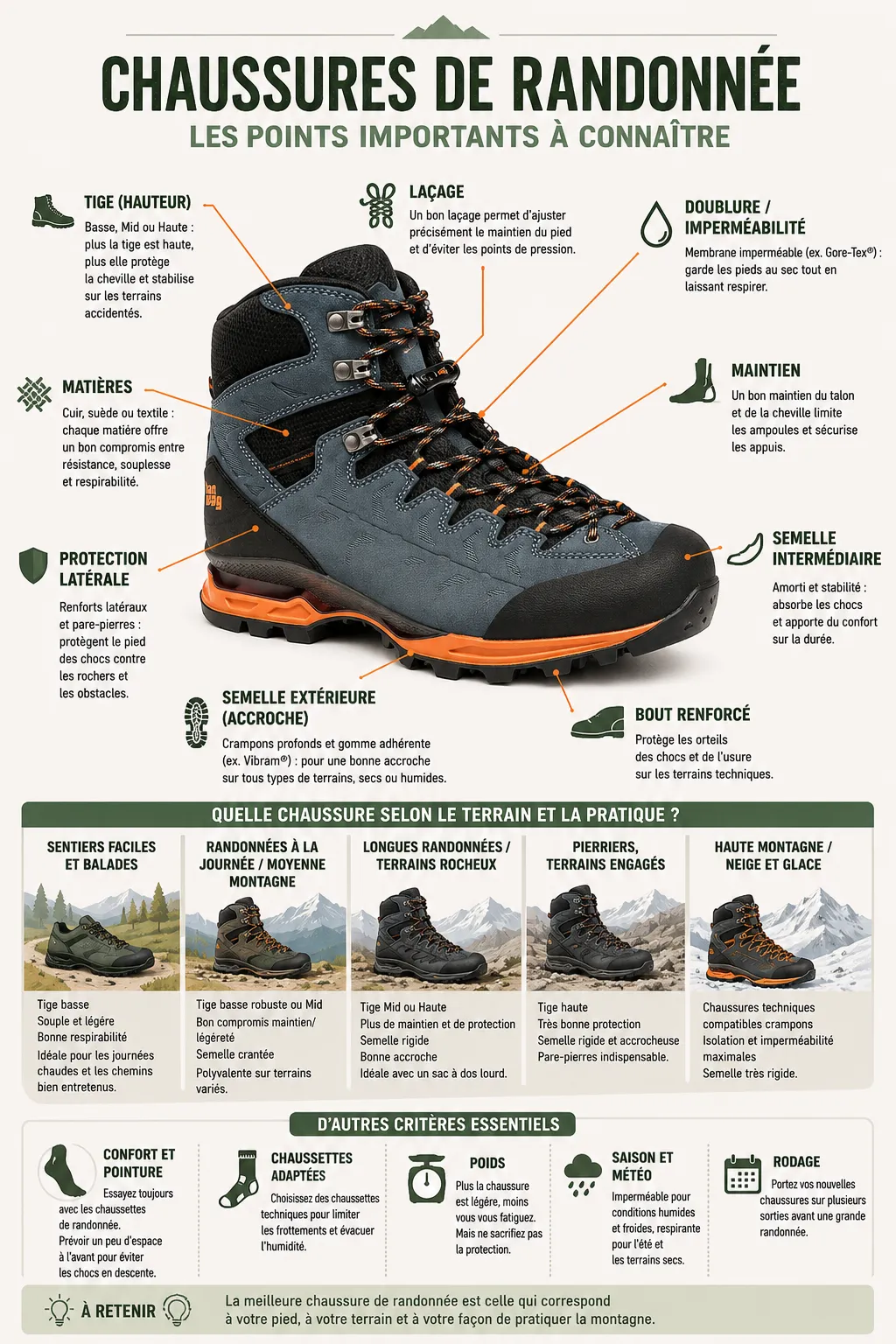
The choice must above all be dictated by your terrain of use. For easy and dry paths, favor lightness, flexibility, and breathability. For mid-mountains, look for a compromise between support, grip, and protection. Finally, for rocky terrains, scree, and alpine hikes, a more protective shaft, a stiffer sole, a good rock plate, and suitable rubber become priorities.
A Vibram sole can provide excellent performance, but not all technologies from the brand meet the same uses: some favor dry/wet versatility, others wet rock or cold, alpine conditions.
The best model is ultimately neither the most expensive nor the most technical: it is the one that fits your foot, your terrain, and your way of practicing mountain activities.
Shoes are probably one of the most important pieces of hiking equipment. A perfectly suitable pair for an easy trail walk can become uncomfortable, even unsuitable, as soon as you venture onto rocky or wet terrain.
Low, mid, or high shaft, sole stiffness, grip, waterproof membrane: here are the main criteria to know to choose your hiking shoes depending on the terrain and your activity.
Why is the choice of shoes essential in the mountains?
In the mountains, feet are subjected to very different stresses than those encountered during a regular walk. Unstable stones, roots, mud, steep slopes, scree, or wet passages may occur during the same outing.
A good shoe must therefore fulfill several functions: provide enough grip, stabilize the foot, protect against shocks and rough terrain, while maintaining a level of comfort suited to the duration of the hike.
However, there is no ideal shoe for all situations. A light and flexible shoe may be perfectly suitable for quickly covering maintained trails, while alpine hiking will generally require more support and protection.
The first criterion is therefore to determine on which terrains and for which hikes the shoes will mainly be used.
Low, mid or high shaft: which one to choose?
The shaft height is one of the most visible differences between hiking shoes.
Low shaft shoes
They stop below the ankle and generally favor lightness and freedom of movement.
They are particularly suitable for:
- easy walks and hikes;
- well-maintained trails;
- day trips with a light backpack;
- summer hikes;
- walkers seeking lightness and dynamism.
They are also often more breathable and comfortable when temperatures are high. In return, ankle protection against stones and shocks is more limited.
Mid shoes: the versatile compromise
So-called “Mid” models rise slightly above the ankle. They are an excellent compromise for many hikers. They provide more protection than a low shoe while generally maintaining good flexibility.
For regular hikes in the mid-mountains, on paths alternating soil, stones, roots, and more technical sections, a Mid shoe often represents the most versatile choice.
High shaft shoes
More rigid and protective, they are intended for demanding terrain and long hikes. They are most useful when moving through scree, very rugged trails, or carrying a relatively heavy backpack. They also protect the ankle better against shocks.
On the other hand, they are generally heavier and less flexible. Therefore, they may seem disproportionate for a simple walk of a few kilometers on a forest path.
The sole: a decisive element for grip
When choosing mountain shoes, people often look at the shaft and waterproof membrane before considering the sole. However, the sole plays an essential role. The outsole must provide enough grip on encountered terrains and contribute to the walker’s stability.
Several elements should be observed: the rubber used, the depth and shape of the lugs, the stiffness of the sole, and the presence of a sufficiently pronounced heel to facilitate braking on descents.
What does the presence of a Vibram sole mean?
The Vibram name appears on many hiking shoes. However, it does not correspond to a single sole model. The manufacturer develops different compounds tailored to specific uses and terrains. The Vibram Megagrip technology, for example, is designed to offer grip on both dry and wet terrains while maintaining a balance between stability and flexibility.
Other technologies are more specialized. Vibram Idrogrip targets wet environments and wet rocks, while Vibram Mont is intended for more demanding activities such as trekking and mountaineering, especially in cold conditions.
The mere presence of the Vibram logo is therefore not enough to determine if a shoe matches your activity: you must especially check the type of sole and its intended use.
Which lugs according to the terrain?
On a relatively dry and compact path, moderate lugs generally provide enough grip while promoting a natural foot roll. When the terrain becomes loose, muddy, or stony, deeper lugs generally allow better penetration into the ground.
The arrangement of the lugs is also important. A properly designed sole facilitates grip during ascents and braking during descents. On very rocky terrain, for example, one will look for more precision, stability, and rubber offering good grip.
For versatile mountain use, it is therefore better to favor a sole with sufficiently pronounced lugs and good grip on dry and wet surfaces rather than an almost smooth sole.
Waterproof shoes: is it always necessary to choose a membrane?
The terms Gore-Tex, GTX, or other waterproof membranes appear on many models. The principle is to limit water penetration while allowing some of the moisture produced by the foot to escape.
For mountain hiking, a waterproof membrane is truly useful when you regularly encounter:
- wet grass;
- rain;
- puddles;
- mud;
- residual snow;
- cool and damp conditions.
A waterproof shoe is thus particularly versatile in spring and autumn. But waterproofness and thermal comfort do not always go hand in hand.
Why a waterproof shoe is not always preferable
In midsummer and in hot weather, a very waterproof shoe may be less breathable than a model without a membrane. For mainly summer hikes on dry terrain, some walkers therefore favor very breathable shoes that quickly wick sweat away.
The choice again depends on usage:
- wet terrain and changing weather: waterproof membrane is interesting;
- dry terrain and high temperatures: breathability is often a priority;
- all-year versatile hiking: a waterproof membrane usually represents a practical compromise.
Also beware of a misconception: a waterproof shoe is not a boot. If water (or snow) enters from the top of the shaft, it will eventually wet the interior.
The stiffness of the sole must correspond to the terrain
A very flexible shoe facilitates foot rolling and generally provides a pleasant feeling on easy trails. But on scree or very rocky terrain, this flexibility can become tiring. The foot feels the roughness more and must constantly work to maintain its stability. Conversely, a stiffer sole better distributes stresses and provides better stability on uneven terrain.
So, a simple rule can be retained: the more technical, mineral, and rugged the terrain, the more some stiffness becomes interesting.
For mountaineering or hikes requiring the use of crampons, however, you should turn to shoes specifically designed for that use. Some compounds aimed at mountaineering are developed to maintain their stiffness and performance at low temperatures and allow compatibility with crampons.
Which shoe to choose according to your type of hike?
For a walk of a few hours on an easy path, a low, light, and relatively flexible shoe will generally be sufficient.
For a classic hike in mid-mountains, a sturdy low shoe or a Mid with a lugged sole offers more versatility.
For a long hike with elevation gain and rocky passages, favor a Mid or high shoe with more rigidity, good lateral protection, and a particularly grippy sole.
For scree and alpine hikes, a stiffer, more protective shoe with a rock plate becomes preferable.
Finally, for terrains including snow and ice, you must choose a model truly designed for these conditions and check its compatibility with the type of crampons planned.
Do not neglect the rock plate
The rock plate corresponds to the protection mainly located at the front of the shoe, sometimes extended to the sides. On an easy trail, its importance remains relatively limited. As soon as you move in scree or on a rocky path, it becomes particularly appreciated. A simple impact with a stone can be very painful after several hours of walking.
The more your activity leads you on mineral terrains, the more it is interesting to look for a shoe that envelops the foot with a genuine rock plate.
Comfort and foot shape remain priorities
A shoe can have an excellent sole, a high-end membrane, and all the desired technical features: if it is not adapted to your foot, it will remain a poor choice. Morphology varies considerably from one person to another (some feet are narrow, others wide, with a more or less pronounced instep), so trying shoes on is indispensable. Ideally, try the shoes with the socks you will actually use for hiking.
The heel must be properly held without excessive slipping. The toes must have a little space, no more, especially to avoid hitting the front of the shoe during long descents. If possible, also test the shoes on an inclined surface.
The weight of the shoe: finding the right balance
A light shoe reduces fatigue and generally provides a more dynamic walk. This is one of the reasons explaining the success of shoes inspired by trail running. But gaining weight savings sometimes means reducing protection or stiffness.
For a short hike with a light backpack, this compromise can be particularly interesting, but on a multi-day hike with a heavy backpack and difficult terrain, a few hundred extra grams can be justified by better stability and more protection.
You should thus avoid systematically looking for the lightest shoe: instead, look for the lightest shoe truly suited to the constraints of your activity.
Shoes are only part of mountain equipment
A successful outing obviously depends on the entire equipment. Shoes must be complemented by suitable socks, comfortable pants, several layers to manage temperature variations, and a jacket protecting against wind and bad weather.
The principle of three layers is particularly interesting in the mountains: a first layer wicks away moisture, a middle layer provides warmth, and an outer layer protects against wind and precipitation.
This logic does not only concern hiking. Whenever you practice an activity at altitude, you must anticipate temperature variations and wind exposure. This is especially the case when hiking and aerial activities complement each other during a day in the mountains. To learn more about this part of the equipment, you can consult this guide on how to dress for paragliding. The three-layer principle, wind protection, and the choice of closed, grippy shoes also hold an important place there.
Mistakes to avoid when choosing
The first mistake is to buy shoes only based on their appearance or reputation. An excellent mountaineering shoe can be unpleasant for a summer walk, just as an ultralight hiking shoe may show its limits on scree.
Personally, I have 3 pairs of shoes for my mountain activities: a light trail running shoe for my walks on easy paths and trails, a semi-rigid mid with vibram sole for my mountain hikes and paragliding, and a pair of “big” rigid ones for my high mountain outings or mountaineering.
Also avoid choosing a too tight size. After several hours of walking, feet tend to swell slightly and descents naturally push the toes forward.
Finally, do not set off for a long hike with a new pair without having tested them beforehand. A few short outings allow checking the support, lacing, and absence of rubbing points.
In the end, which hiking shoes to choose?
The choice must above all be dictated by your terrain of use. For easy and dry paths, favor lightness, flexibility, and breathability. For mid-mountains, look for a compromise between support, grip, and protection. Finally, for rocky terrains, scree, and alpine hikes, a more protective shaft, a stiffer sole, a good rock plate, and suitable rubber become priorities.
A Vibram sole can provide excellent performance, but not all technologies from the brand meet the same uses: some favor dry/wet versatility, others wet rock or cold, alpine conditions.
The best model is ultimately neither the most expensive nor the most technical: it is the one that fits your foot, your terrain, and your way of practicing mountain activities.