
In summary:
- Snoring is often the scapegoat, but the real nuisances usually come from habits that everyone can correct.
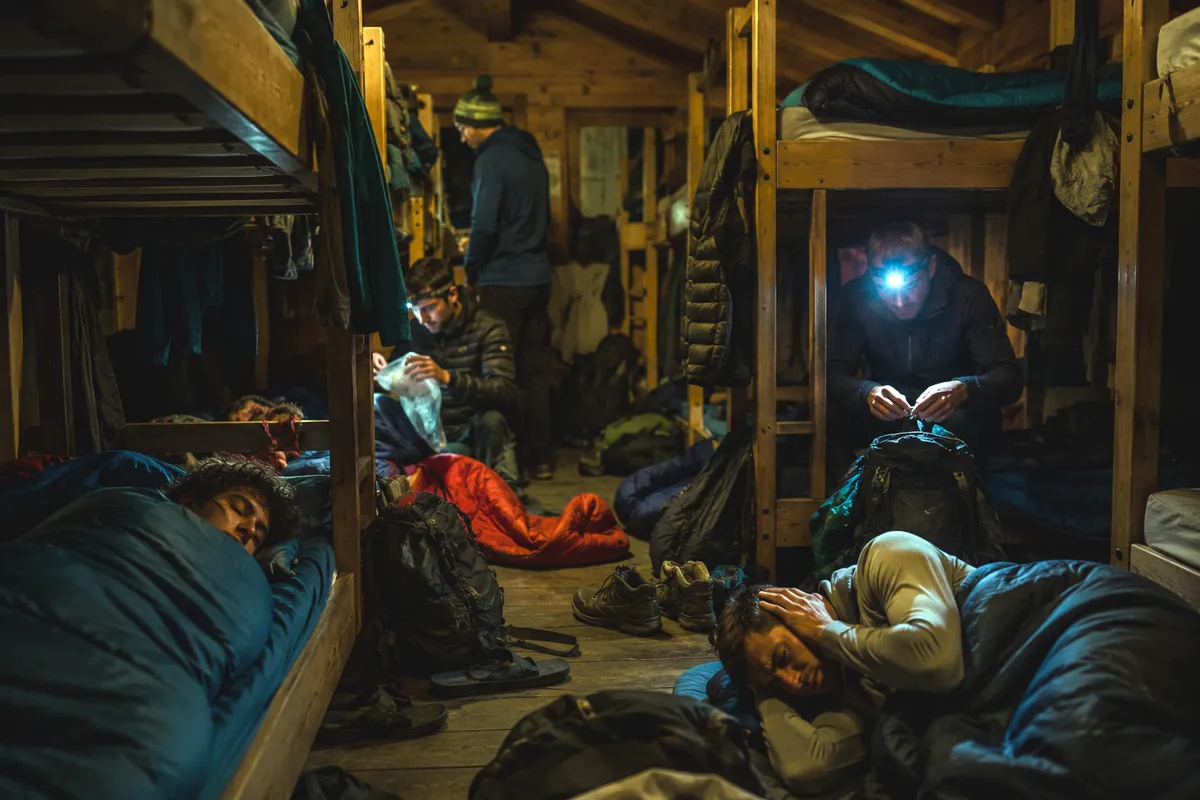
- Headlamp in white mode, plastic bags early in the morning, body odors, late arrivals at dinner… every action counts in a shared space.
- Life in a refuge is based on a tacit pact: respect for schedules, nighttime discretion, and participation in communal life.
- Some simple reflexes are enough to turn a nightmare night into an unforgettable memory.
It seems that snoring is the number one enemy of the dormitory. That it is he alone who sabotages nights in a refuge. That earplugs, noise-cancelling headphones, or even a sleeping bag tightly sealed over the head would be needed to protect oneself from it. Yet, ask any seasoned hiker what really kept them from sleeping the last time they set their bag down in a dormitory: they will tell you about a headlamp shining in their eyes at 4:30 am, the noise of twenty zippers being opened in cascade, or the smell of fermented socks defying all laws of physics by concentrating exactly at their sleeping berth. At least snoring is not a choice.
The behaviors we’re about to review, however, are entirely avoidable. And that’s precisely why they are so annoying.
Headlamp in white mode: the worst wake-up in the world
It is undoubtedly the most widespread and most destructive fault for the serenity of a dormitory. It’s 3:45 am. Everyone is finally asleep, after overcoming the usual snoring. And then, a dazzling white light sweeps across the ceiling, faces, and wide-open eyes in astonishment. The culprit? A hiker getting up for an early departure who never bothered to set their headlamp to red light mode.
The red mode is exactly made for this: it preserves the night vision of the user and does not blind the people around. All headlamp models sold in the last ten years are equipped with it. It’s a fundamental rule in all mountain dormitories, reiterated by the wardens, posted on the walls, yet violated every night with disconcerting consistency.
What to do: set your headlamp to red mode even before going to bed, and prepare all your belongings the day before to avoid rummaging at the bottom of your bag in the middle of the night.
The concert of zippers and plastic bags
Second classic of nights in a refuge: the hiker who decides to prepare their backpack at 4 am in the dormitory. Every zipped pocket becomes a sonic aggression. Every crumpled plastic bag a micro-torture. In the silence of the altitude, noises travel with surgical clarity.
This phenomenon is worsened by those who store their food provisions in plastic bags instead of cloth bags or rigid containers. The difference in noise nuisance is considerable.
The golden rule, repeated in all refuge etiquette guides: fully prepare your bag the evening before, before lights out. Night items are taken out and placed on the bunk. The next day’s bag is ready. You only have to dress quietly and leave on tiptoes.
Odors: not changing upon arrival, a collective fault
A dormitory of ten hikers who have not showered, some still wearing damp hiking clothes and their socks from the day… The atmosphere can quickly become difficult to breathe, especially with windows closed to fight the cold of the altitude.
The customary practice is to change immediately upon arrival at the refuge, putting dirty and wet clothes in a hermetic bag inside one’s own backpack. This is not superfluous comfort: it is a basic act of respect towards other occupants.
Similarly, hiking boots stay at the entrance. Most refuges have a dedicated shoe area and provide clogs or slippers. Entering a dormitory with muddy shoes brings mud, moisture, and mountain odors into a space where others are trying to sleep.
Arriving after service: the silent chaos
Refuges operate on a very particular rhythm, about two hours offset from life in the valley. Dinner is served at a fixed time, often 7 pm or 7:30 pm, to allow everyone to go to bed early and get up before dawn. The wardens, who sometimes get up as early as 3 am to prepare breakfast for climbers, have days unlike any other.
Arriving after dinner service forces the warden to keep dishes warm, rearrange tables, and often delay lights out in common areas. This disrupts the collective mechanism of the refuge, to the detriment of others.
The solution is simple: plan your itinerary accordingly. If you know you will be late, inform the warden by phone. Refuges are living communities, not hotels open continuously.
Speaking loudly after 9 pm: the fault always minimized
Evenings in the refuge are often convivial. Meetings among hikers, stories shared around a table, hiking plans exchanged over mulled wine… All that is part of the magic of the place. But there comes a moment when conversations must stop, or at least be hushed.
After 9 pm, sometimes 10 pm depending on the refuge, silence is mandatory in dormitories and nearby. This doesn’t mean talking is forbidden, but that exchanges should be held in low voices, in common areas designed for that purpose. Whispering with your hiking partner directly in the dormitory, thinking you are discreet, is an illusion that the silence of the mountain immediately destroys.
If your group wants to continue the evening, choose a refuge equipped with a common room and withdraw there as soon as the first sleepers settle in.
Not participating in collective life
The refuge is not a hotel. It’s a temporary community with implicit rules and collective functioning. Paying for your night does not exempt you from participating in the life of the place. Helping to set the table, clearing after the meal, not leaving your belongings scattered in shared spaces: these are expected, appreciated gestures that contribute to the atmosphere of kindness that makes guarded refuges renowned.
Conversely, the one who remains idle while the warden and some improvised volunteers clean the dining hall creates an invisible but real friction. At altitude, in such a confined space, individualistic behaviors are quickly noticed.
Dry toilets: a space to absolutely respect
This is a point that cannot be stressed enough. Mountain refuges are equipped with dry toilets or special water treatment systems adapted to altitude constraints and the absence of access to conventional sewage networks. These systems are fragile. Throwing toilet paper into the bowl, and even more any other object, can block the system for several days.
Some refuges provide paper baskets next to the toilets. Others supply biodegradable paper. In all cases, read the instructions posted in the restrooms and follow them to the letter. Not out of punitive spirit: but out of practical sense. A refuge whose toilets are out of order is a collective experience turning into a disaster.
Wasting scarce resources
At altitude, everything that arrives at the refuge has been carried by man’s back, mule, or helicopter. Hot water is not unlimited. Electricity often comes from solar panels sized to the bare minimum. Firewood has a considerable logistical cost.
Taking a twenty-minute shower, leaving the lights on in an empty dormitory, or monopolizing the only available electrical outlet to recharge phone, camera, and power bank simultaneously: these are behaviors that exhaust shared resources. The unwritten rule is simple: use only what you need, not what you would in town.
Summary table: problematic behaviors vs good practices
| Problematic behavior | Good practice to adopt |
|---|---|
| Headlamp in white mode at night | Set to red mode before going to bed |
| Preparing bag at 4 am | Prepare everything the evening before lights out |
| Keeping damp hiking clothes | Change immediately on arrival, store wet laundry in hermetic bag |
| Entering with hiking shoes | Use slippers or clogs provided at the entrance |
| Arriving after dinner service | Plan itinerary or notify warden by phone |
| Speaking loudly after 9 pm in the dormitory | Continue the evening in the common room |
| Being passive during communal meals | Help set the table and clear away |
| Throwing paper in dry toilets | Respect instructions posted in restrooms |
| Long showers and energy wastage | Consume minimally, prefer a quick wash |
| Not booking and arriving unexpectedly | Book in advance via refuges.info or CAF |
What refuge wardens think
Refuge wardens have a front-row seat to observe these behaviors. Behind their counter, they see the same mistakes each season with a nearly endearing regularity. Many emphasize that the most recurrent problems do not come from inexperienced hikers, often attentive to instructions because they are unsure what to expect, but from regulars who think they know the codes and allow themselves liberties at the expense of others. This is nevertheless changing with the arrival of new “practitioners” (more “consumers” than practitioners) who often behave inappropriately simply out of selfishness.
FAQ
Is it possible to sleep well in a refuge despite noises?
Yes, with good preparation. Earplugs are strongly recommended. Choosing a refuge with small dormitories (4 to 8 people) greatly improves acoustic comfort. Arriving early, settling properly, and preparing your belongings before lights out reduce night stress.
Is it mandatory to bring a sleeping bag liner?
In the vast majority of guarded refuges, the sleeping bag liner is mandatory for hygiene reasons. It goes between you and the blankets or duvets provided by the refuge. Some refuges offer them for rent, but it is better to bring your own.
When do the lights go out in a refuge dormitory?
Lights out generally happens between 9 pm and 10 pm depending on the refuge. Some climbers leave as early as 2 or 3 am, which explains this shifted rhythm. It is advisable to arrive at the refuge in the mid-afternoon to adapt gradually.
How to report behavioral problems to a refuge warden?
Most wardens are accessible and used to handling such situations diplomatically. Do not hesitate to discreetly inform them if behavior disrupts the dormitory. They usually have the authority and know-how to correct situations without causing conflict.
Can we recharge electronic devices in a refuge?
It entirely depends on the refuge. Some offer outlets, others don’t — electricity often comes from solar panels and is primarily reserved for lighting. It is advisable to bring a fully charged external battery to avoid depending on the refuge or creating conflicts over scarce available outlets.
Are snorers really the biggest problem in dormitories?
No, and that is the entire purpose of this article. Snoring is involuntary and inevitable. The behaviors detailed here — morning prep noise, white light, odors linked to basic hygiene neglect, late arrivals — are entirely avoidable and stem from consideration for others.
Conclusion: the refuge, a school of collective life at altitude
A night in a refuge is a unique experience. The silence of the altitude, stars glimpsed from the dormitory window, warmth shared around a simple meal after a long day of walking… All this exists only because dozens of people agree to live together for one night, according to rules that transcend their individual habits.
The behaviors that make these nights unbearable do not come from ill will. They stem from a lack of information or inattentiveness to the signals that the collective environment clearly sends. Preparing your bag the evening before, setting your headlamp, changing upon arrival, respecting schedules: none of these gestures is difficult. Together, they make all the difference between a endured night and a successful night.
And your neighbor’s snoring? With your earplugs well in place, you won’t even hear it.