
Article updated on 07/27/2026
The weather changes quickly in the mountains, that’s well known. But even if it is perfectly sunny, the passing of a cloud or the shadow of a peak or a somewhat strong wind, the cold can quickly be felt! And temperature variations are significant in the mountains, especially at altitude. Without reaching extreme temperatures, learning to withstand the cold is quite easy.
The human body does everything to regulate its internal temperature around 37°C. On one hand, it eliminates excess heat (through sweating), and on the other hand, it protects (within certain limits) against the aggression of the cold. The caloric excess is evacuated by evaporation over the whole body and mainly through the head, hence the necessity to cover well with a hat or hood in very cold weather.
Conversely, to protect itself from the cold, our body seeks to protect vital organs at the expense of peripheral areas. Blood circulation is therefore reduced at the extremities: hands, feet, ears, nose. Extremities are thus the first to be affected by common ailments: frostnip and mild frostbite. At the extreme, the body can no longer protect itself against very intense and prolonged cold. This leads to hypothermia, the most serious consequence of cooling.
Minor lesions
Frostbite
From mild frostnip to painful frostbite, it is better to avoid them or to prevent the consequences.
Frostnip
Who has never felt numbness followed by tingling at the fingertips or toes? These become first temporarily insensible and pale, then eventually warm up and redden thanks to restored blood flow: this is when sometimes quite sharp and irritating tingling appear. Accompanied by slight swelling or chapping, frostnip remains mild for most hikers or skiers. A return to normal occurs within a few minutes, at worst in a few hours.
Frostnip (or chilblain) represents the first degree of frostbite. Some people are more sensitive to it because they have an increased vulnerability of the microcirculation from the first sensations of cold (acrocyanosis). In this specific case, it is a chronic disease, harmless and little known, but whose definitive remission can be spontaneous.
More severe lesions
At the second degree of frostbite, clear or blood-filled blisters (phlyctenes) may appear. Deep tissues can then necrose, blacken, and fall off. Cold acts like a burn and can cause irreversible damage to muscle tissues. A deeply frostbitten finger, toe, or tip of the ear can die and have to be amputated! This is a major risk mainly concerning athletes facing extreme situations (voluntarily or accidentally).
Prevention
As soon as you plan to go into snowy areas, even for a simple hike in good weather, it is essential to take a good pair of socks, a hat, and a pair of technical gloves. When conditions could be harsher, a second hat and a second pair of gloves as a backup at the bottom of the backpack can be very useful. In general, always remember to cover your extremities!
Emergency treatment
In case of a fairly marked lesion, it is very important not to warm the affected part too quickly nor to hit it too hard! Rather, try to warm the affected part gradually by rubbing it. If conditions allow, a warm water bath (around 37 °C) remains the best solution. You will then need to apply a mild antiseptic without alcohol, as infection risks are encouraged by this type of lesion. This should be repeated several times a day and, in the meantime, protect the frozen area with a sterile dressing (not too tight).
Hypothermia
Hypothermia corresponds to a very serious state of weakness and results from a kind of malfunction of the body’s temperature regulation function. Hospitalized hypothermia cases represent less than 10% of mountain accidents. In reality, hypothermia very often is a complication of an accident: avalanche, fall into a crevasse, getting lost in a storm or fog.
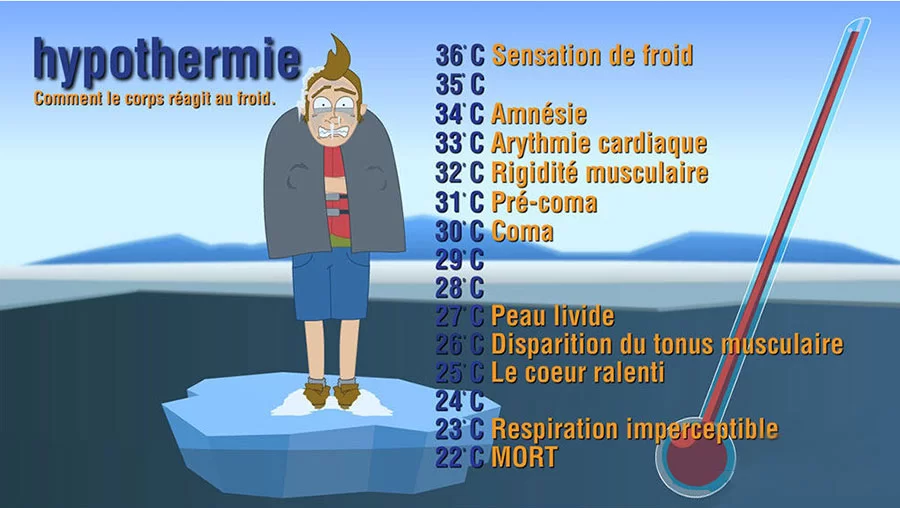
Three pathological stages are distinguished:
- Mild hypothermia (body temperature has dropped to 35 or 34 °C): the first symptoms are goosebumps, repeated and uncontrollable shivering, pale or mottled skin. It has no consequence if it is not accompanied by other trauma (for example, a leg fracture immobilizing the subject) or does not occur in a hostile context (bad weather). The affected person must be warmed up, covered with dry clothing, given hot drinks, and rapid evacuation considered. It is absolutely forbidden to give alcohol!
- Moderate hypothermia (body temperature between 34 and 32 °C).
- Severe hypothermia (temperature has dropped to 32 °C, even 28 °C): In a comatose state, the subject can, however, be resuscitated under medical supervision.
Buried for nearly an hour under an avalanche, a person whose internal temperature has dropped to 25°C can be resuscitated in hospital and may not have any sequelae, but this is not certain! Do not trust appearances if you take part in a search operation for avalanche victims or an emergency evacuation of an injured person because it is not always too late.
Prevention
It is obvious that one protects oneself from the cold by being well covered! It is therefore necessary to always anticipate bad surprises and carry warm clothes in your backpack, even if the weather forecast is excellent. Some equipment such as gloves or a hat, for example, must be doubled, the second set kept safe at the bottom of the bag (remember to protect them from moisture).
Good physical shape and good morale also help better withstand somewhat harsh conditions. If you are lost or stuck in a storm, you must make a makeshift shelter. Igloo (if you master the technique), pits in the snow, among large rocks, under the cover of a tree… In all cases, remember to isolate yourself from the ground (at worst, lie on your bag) and adopt a fetal position. Also, remember to signal your presence with a clearly visible mark.
Acclimatization
It is possible, to some extent, to acclimatize to the cold. If you plan to go on an expedition to very cold regions, prepare yourself for it some time before. Personally, before a trek in Nepal, I spent my nights on my balcony in a good sleeping bag. My neighbors laughed a lot, some thought I was crazy, anyway, I was not cold during the trek, even at -25°C. Another technique is to practice cold water baths for the extremities: dip your hands (and feet) in very cold water until the first pains appear. Repeat every day and after a while you will have acquired some skill and resistance to the cold that you will appreciate.
Article mis à jour le 27 July 2026