
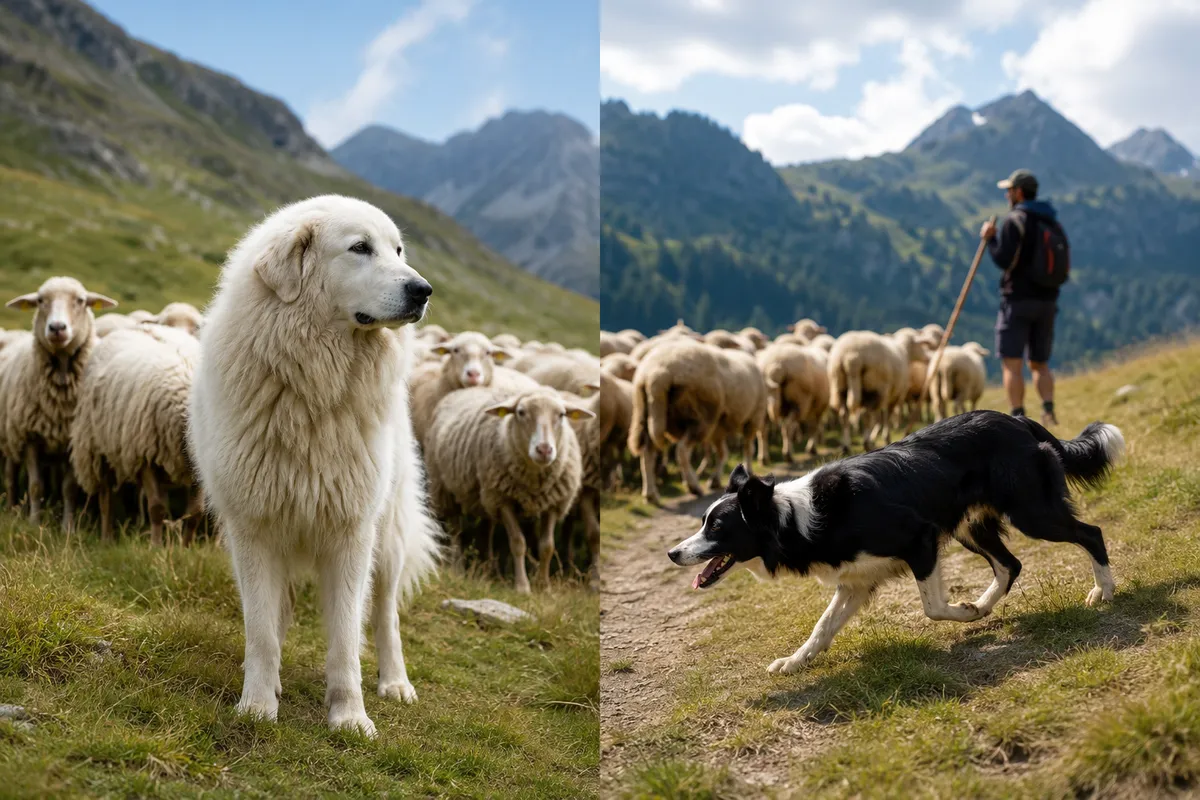
When encountering a herd in the mountains, all dogs seem to have the same role. However, there is a fundamental difference between protection dogs and herding dogs. The former live with the animals to defend them against predators, while the latter work alongside the shepherd to guide the herd. Knowing how to distinguish them helps better understand their behavior… and adopt the right reflexes during a hike.
Two very different missions
Although they often operate in the same environment, protection dogs and herding dogs do not have the same function or behavior.
The protection dog is responsible for defending the herd against external threats such as wolves, stray dogs, or any other animal likely to approach the sheep.
The herding dog, meanwhile, is the true partner of the shepherd. Its role is to move, gather, or direct the animals according to its master’s instructions.
In other words, one protects the herd, the other leads it.
The protection dog: an autonomous guardian
Protection dogs live permanently with sheep or goats. From an early age, they grow up within the herd, which they consider their social group.
Their work does not depend on constant orders from the shepherd. They themselves make the necessary decisions to ensure the animals’ safety.
Among the breeds most commonly used in France are notably:
- the Pyrenean Mountain Dog (Patou);
- the Maremma and Abruzzo Sheepdog;
- the Anatolian Shepherd (Kangal);
- the Caucasian Shepherd;
- the Tornjak.
These dogs often impress with their size, power, and barking. When a hiker approaches a herd, they usually come to meet them in order to assess the situation and ensure no danger is posed.
Their main goal is to deter, much more than to attack.
The herding dog: the shepherd’s ally
By contrast, herding dogs remain constantly attentive to their master’s orders. Their mission is to move the animals precisely, sometimes over several kilometers, or to drive them into an enclosure. They use their intelligence, speed, and sense of observation to anticipate the herd’s movements.
The most well-known breeds are:
- the Border Collie;
- the Australian Shepherd;
- the Beauce Shepherd;
- the Australian Kelpie;
- some Pyrenean Shepherds.
Unlike protection dogs, they are generally not very interested in hikers. Their full attention is focused on the shepherd and the animals they herd.
How to recognize them on a trail?
Some hints often make it possible to tell the difference. The protection dog is generally large, sturdy, often light-colored, and stays in or around the herd. It may spontaneously approach walkers, barking to identify them.
The herding dog is more agile, livelier, and moves quickly around the sheep. It is frequently seen running from one side of the herd to the other or responding immediately to the shepherd’s whistles and commands.
In summary:
| Protection dog | Herding dog |
|---|---|
| Defends the herd | Guides the herd |
| Works autonomously | Obeys the shepherd’s orders |
| Lives with the animals | Works with the shepherd |
| May approach hikers | Generally ignores walkers |
What behavior should you adopt when facing a protection dog?
When approaching the herd:
- Slow down: Stop or walk calmly as soon as you see animals.
- Make yourself known: Speak loudly so the dog detects your human presence.
- Go around: Move as far as possible away from the animals, even if it means leaving the trail.
- If you are on a bike: Get off before crossing the area.
Facing the protection dog:
- Stay calm: Don’t shout or run, as this would excite its instinct.
- Stay neutral: Avoid staring directly into its eyes, which it would take as a challenge.
- Let it sniff: If it approaches to identify you, stay still with arms at your sides.
- Lower your arms: Never threaten it with hiking sticks or stones.
- Step back: Once the dog is calm, calmly continue on your way, turning your back to it at an angle.
With very rare exceptions, the incidents reported between hikers and protection dogs are mainly caused by a lack of knowledge about how to behave in their presence and/or by fear. Indeed, an 80kg Patou rushing at you barking, even if “just” to identify and deter you, can be scary and provoke a reaction that the dog will interpret as an attempt to attack its herd. And that’s when trouble starts! In short, stay calm in the presence of protection dogs.
On the other hand, it is generally not necessary to change your behavior when facing a herding dog, which remains focused on its work with the shepherd.
An indispensable presence in the mountains
The return of the wolf in many French mountain ranges has reinforced the use of protection dogs, which have become essential to secure flocks in summer pastures. Herding dogs, for their part, continue to accompany breeders daily in managing the animals.
These two categories of dogs thus fulfill complementary missions. Knowing them not only helps better understand pastoralism but also helps share the mountains in good conditions, respecting the work of breeders, the peace of the herds, and everyone’s safety.