
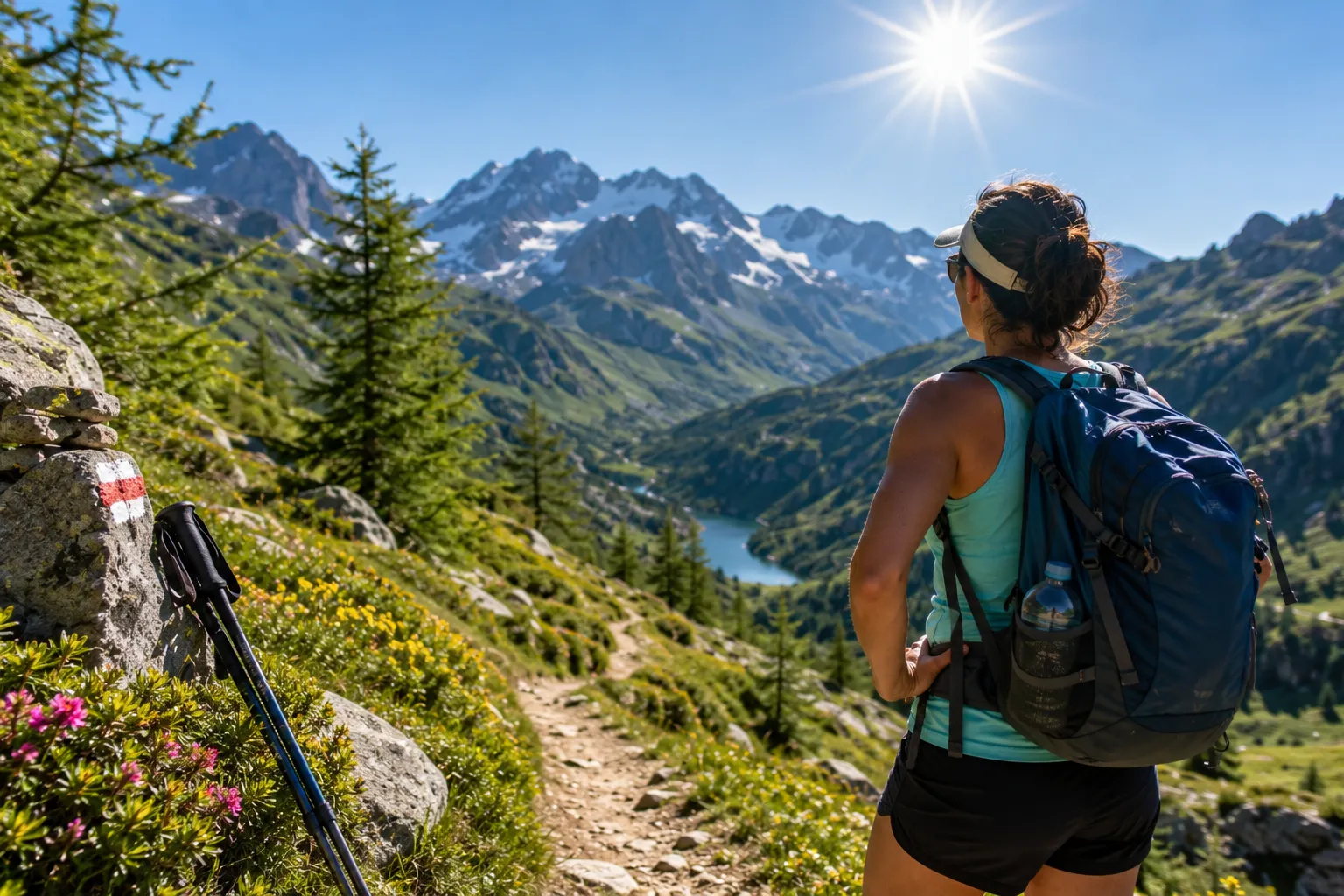
With the heatwave currently affecting much of France, many mountain lovers ask themselves the same question: is it still reasonable to go hiking when the thermometer exceeds 35°C? Guides, mountain leaders, and rescuers remind that hiking remains possible, but only on the condition of seriously adapting one’s habits.
The mountains are often seen as a natural refuge from the heatwave. Yet every summer, rescue teams respond to cases of fainting, dehydration, or heatstroke on the trails of Haute-Savoie. The problem is not always the difficulty of the route. Often, it is the heat that turns a family hike into a risky situation.
Yes, it is still possible to hike… but not just any way
Contrary to common belief, professionals do not systematically recommend giving up the mountains during heat waves.
Haute-Savoie benefits from a considerable advantage: altitude. As you gain height, temperatures gradually decrease. On average, a drop of about 6 to 7°C is estimated every 1,000 meters of elevation gain. When it is 35°C in Annecy, Annemasse, or Cluses, it can be less than 25°C on certain high-altitude routes. But this does not mean that all trails become safe.
The main danger: starting too late
It is probably the most common mistake observed by professionals. Many hikers start their outing around 10 or 11 am, precisely at the moment when temperatures begin to rise quickly. Mountain guides rather recommend:
- a departure between 6 and 8 am;
- an arrival at the summit before noon;
- a return before the hottest hours.
This strategy not only avoids the heat but also allows enjoying magnificent light and often lower crowds.
Exposed routes quickly become exhausting
Not all trails react the same way to heat. Routes located on exposed ridges, scree slopes, or south-facing slopes quickly accumulate heat. In some areas, the perceived temperature can far exceed that announced by weather forecasts.
Professionals then recommend favoring:
- forest routes;
- shaded valleys;
- trails alongside torrents and waterfalls;
- high-altitude hikes benefiting from air currents.
Mountain lakes are not always the miracle solution
When the heat becomes overwhelming, many imagine finding some coolness by a high-altitude lake. The idea is attractive but deserves some precautions.
Mountain lakes often remain very cold, even in midsummer. Water temperatures rarely exceed 10 to 15°C at certain sites. A plunge after several hours of walking under the sun can cause a potentially dangerous thermal shock.
Rescuers therefore recommend avoiding sudden immersions and favoring a gradual cooling down.
Hydration starts before the hike
Drinking when thirsty is already too late. Professionals emphasize the importance of anticipatory hydration. Even before departure, it is advised to drink regularly in the preceding hours.
During exertion, needs increase greatly. Depending on the duration and conditions, a hiker can lose several liters of water per day. In strong heat, setting out with less than two liters often becomes insufficient.
For long outings, mineral-rich drinks also help to compensate for losses linked to sweating.
Signs that require immediate alert
A heatstroke does not always occur suddenly. Certain symptoms should prompt an immediate stop to the hike:
- severe headaches;
- nausea;
- dizziness;
- shivering despite the heat;
- unusual fatigue;
- difficulty walking normally;
- confusion or loss of concentration.
In this case, one must quickly seek a shaded place, cool down, and hydrate.
The most beautiful cool routes of Haute-Savoie
During heatwaves, certain areas become particularly attractive.
Among the most appreciated destinations:
The Cirque du Fer-à-Cheval
The many waterfalls create a permanent feeling of freshness.
The Cascade du Rouget
The spray and forest environment offer a particularly pleasant setting during strong heat.
The Plateau de Sales
Located at altitude, it often benefits from temperatures much more bearable than those observed in the valleys.
The trails of the Bornes and Aravis massif
From 1,500 meters of altitude, conditions often become noticeably more comfortable.
The mountains remain a refuge, but require greater caution
Haute-Savoie remains one of the best destinations to escape the heatwave. However, strong heat changes the rules of the game.
Leaving early, adapting one’s route, drinking more, and accepting to shorten an outing are now essential reflexes. Mountain professionals regularly remind us: the summit is never an obligation. During episodes of extreme heat, knowing how to give up or modify one’s plan is often the best decision an experienced hiker can make.