
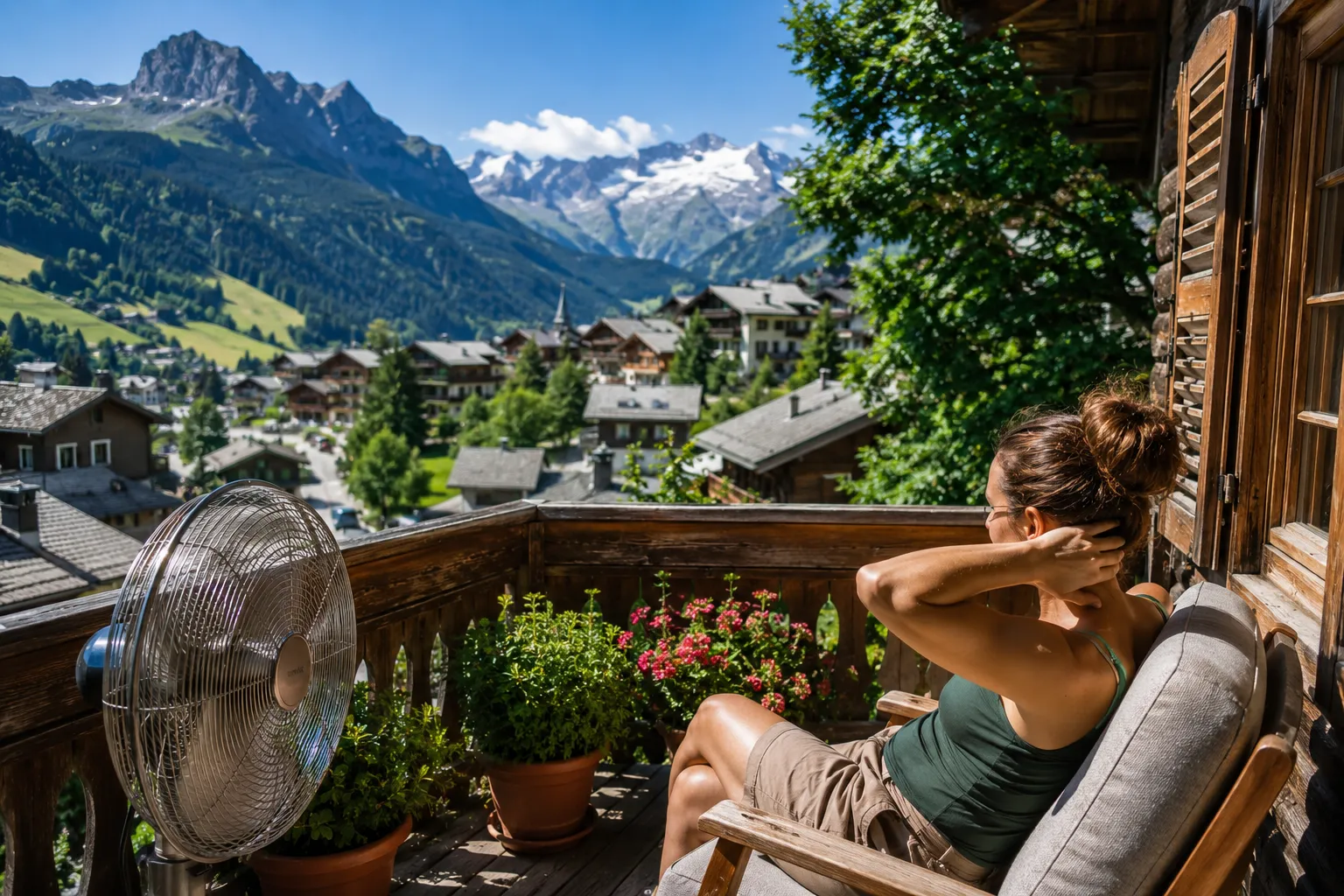
Long considered natural refuges from intense heat, mountain resorts are now seeing thermometers climb to unusual levels. At 1,000, 1,500, or even 2,000 meters altitude, days regularly exceed 30 °C and nights sometimes remain surprisingly mild. Facing this change, one question arises: can the inhabitants of these resorts still live without air conditioning?
The mountain is no longer the refuge it once was
For decades, the villages of Haute-Savoie have benefited from a natural advantage: cool nights allowing easy cooling of homes. Even after a hot day, it was often enough to open the windows for a few hours to regain a pleasant temperature.
But the residents of resorts like Chamonix, Morzine, Les Gets, Megève, La Clusaz, or Samoëns observe a change. Heatwaves are more frequent, longer, and especially more intense than they were about twenty years ago. Maximum temperatures now regularly exceed 30 °C in the valleys, while mid-altitude resorts are also experiencing unusual temperatures.
This phenomenon is sometimes accompanied by tropical nights, where the mercury no longer drops enough to cool the dwellings.
Mountain housing shows its limits
Unlike cities in the south of France, mountain buildings were never designed to withstand heatwaves.
Large south-facing bay windows, much appreciated in winter to benefit from solar gains, sometimes become true greenhouses in the middle of summer. Recent apartments, very well insulated to limit heat loss, also tend to retain heat when it settles in for several consecutive days.
In some residences, occupants report temperatures exceeding 28 to 30 °C in the evening despite an altitude above 1,200 meters.
Air conditioning remains very rare
Despite these heat episodes, air conditioning remains exceptional in Alpine resorts.
Several reasons explain this situation:
- heatwave episodes are limited to a few weeks per year;
- nights often remain cooler than in the lowlands;
- the installation cost is high in homes rarely designed to accommodate air conditioning;
- electricity consumption and environmental impact concern many residents.
Unlike large cities, most residents still favor simpler solutions.
Residents adapt their habits
In resorts, everyone now develops their own reflexes to keep interiors bearable.
Shutters remain closed during the hottest hours, airing is done very early in the morning or late at night, and physical activities are shifted to the coolest hours.
Some condominiums are also beginning to green their surroundings to limit heat islands, while municipalities are increasing tree planting in public spaces.
Tourists discover a new reality
For many vacationers, booking a week in the mountains still means escaping the heat.
The reality is sometimes different. While the summits still offer pleasant coolness, villages located between 800 and 1,200 meters can experience particularly hot days during heatwave episodes.
The good news remains that a few hundred meters of elevation gain often suffice to find much more breathable air. Cable cars, ski lifts open in summer, and high-altitude trails quickly allow gaining several degrees.
Resorts are already thinking about their adaptation
Local authorities know that these episodes will likely become more frequent. The focus is now on sustainable solutions: greening public spaces, thermal renovation also designed for summer comfort, materials limiting overheating, creating shaded areas, and improving natural air circulation in buildings.
The goal is not to turn resorts into air-conditioned cities, but to preserve what makes their main asset: a pleasant living environment despite a changing climate.
Air conditioning will probably remain the exception
If the mountain is warming, it still retains a considerable advantage compared to large urban areas. Nights are generally cooler, altitude allows quickly regaining comfortable temperatures, and nature offers many shaded spaces.
For the inhabitants of the Haute-Savoie resorts, air conditioning is therefore not yet indispensable. However, habits are evolving, housing must adapt, and municipalities are already anticipating the effects of a climate changing faster than imagined. This summer, even at altitude, coolness is no longer a given: it becomes a precious asset to preserve.