
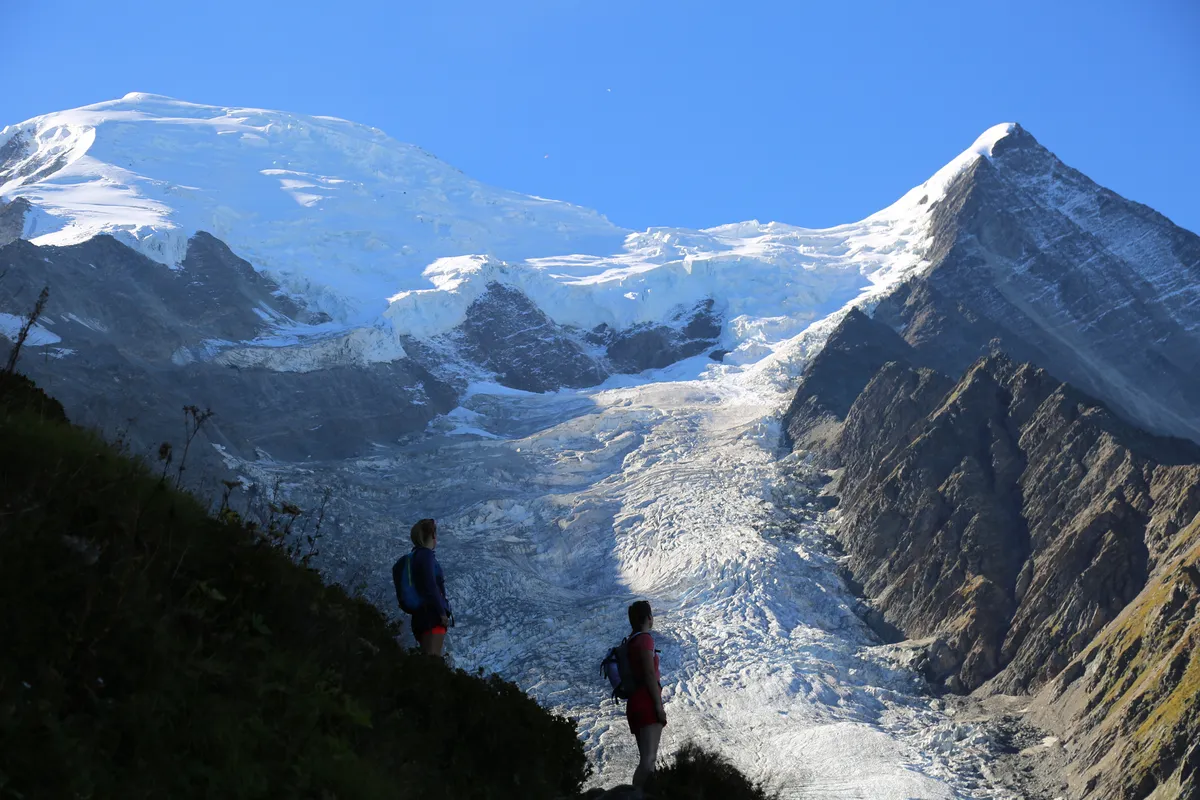
For decades, it was one of the most spectacular symbols of the Chamonix valley. Visible from the bottom of the valley, the Bossons glacier impressed with its size and proximity. Yet, year after year, its retreat is accelerating. To such an extent that some scientists believe it could lose nearly half of its mass by 2035. A transformation that goes far beyond the simple landscape and is already beginning to alter the tourist future of Chamonix.
A glacier changing before visitors’ eyes
For those who haven’t visited Chamonix in about ten years, the shock is often immediate. The Bossons glacier no longer occupies the same place in the landscape. Its glacial front is gradually moving upwards in altitude, revealing vast rocky areas that were once covered by ice.
Old photos displayed in some refuges or valley restaurants make it possible to measure the scale of the phenomenon. Where ice once descended close to the forests, today one can see moraines, scree slopes, and newly uncovered terrains.
And the phenomenon is not isolated. The famous Mer de Glace is also retreating, while several small glaciers in the Mont Blanc massif are rapidly losing volume.
Glacial lakes are multiplying
One of the most visible changes in 2026 concerns the emergence or enlargement of lakes formed by the melting glaciers. These new bodies of water sometimes attract photographers and hikers, fascinated by their turquoise colors. But they also bear witness to a profound transformation of Alpine landscapes.
For mountain guides in the valley, these developments have now become a daily topic of discussion with visitors. “Many clients arrive with photos taken fifteen or twenty years ago. They are often surprised by what they discover today,” explains a Chamonix guide familiar with glacier routes.
A mountain becoming more unstable
The progressive disappearance of ice also has less visible consequences. Permafrost, this permanently frozen soil layer that stabilizes certain rocky walls, is also gradually thawing. Result: rockfalls are becoming more frequent in several areas of the massif.
Some historic mountaineering routes must be adapted, while certain periods for practice become less favorable than before. For mountain professionals, this evolution requires constant adaptation. Routes are regularly reassessed based on conditions observed on the ground.
What impact for tourism in Chamonix?
Contrary to popular belief, local professionals do not observe a massive decrease in attendance linked to glacier melting.
On the contrary. Many visitors specifically want to discover these changing landscapes. However, the tourist offer is evolving.
In summer
Activities related to hiking, mountain biking, trail running, and high mountain observation continue to grow. Educational excursions about climate change also attract an increasing audience. Visitors want to understand what is happening before their eyes.
In winter
The situation is more complex. Mid-altitude resorts are more exposed to snowfall variations. Even though the Chamonix domain remains largely focused on high mountain activities, professionals are gradually diversifying their activities.
Well-being, gastronomy, culture, sporting events, and four-season activities are taking an increasingly important place.
A valley already adapting
Local accommodation providers also notice an evolution in expectations. Tourists no longer come just to ski or climb a summit. They seek a global experience combining nature, discovery, heritage, and environmental awareness.
Several hotels and tourist structures now offer conferences, exhibitions, or guided outings dedicated to glaciers and the evolution of the Alpine climate. This adaptation could become one of the major economic challenges of the coming years.
The Bossons glacier, symbol of a mountain in transformation
The Bossons glacier remains today one of the most impressive sites in the Chamonix valley. But it has also become the visible witness of a mutation affecting the entire Alps.
Every summer, thousands of visitors come to observe it, often fascinated by its spectacular beauty. For many, the discovery now comes with an awareness: the mountain we admire today will probably not be exactly the same in ten or twenty years. And that is precisely what makes the visit even more striking.
Observing the Bossons glacier in 2026 means contemplating both the history of the Alps and their future being written before our eyes.
Photo Source: Chamonix Mont-Blanc Valley Tourist Office – MR