
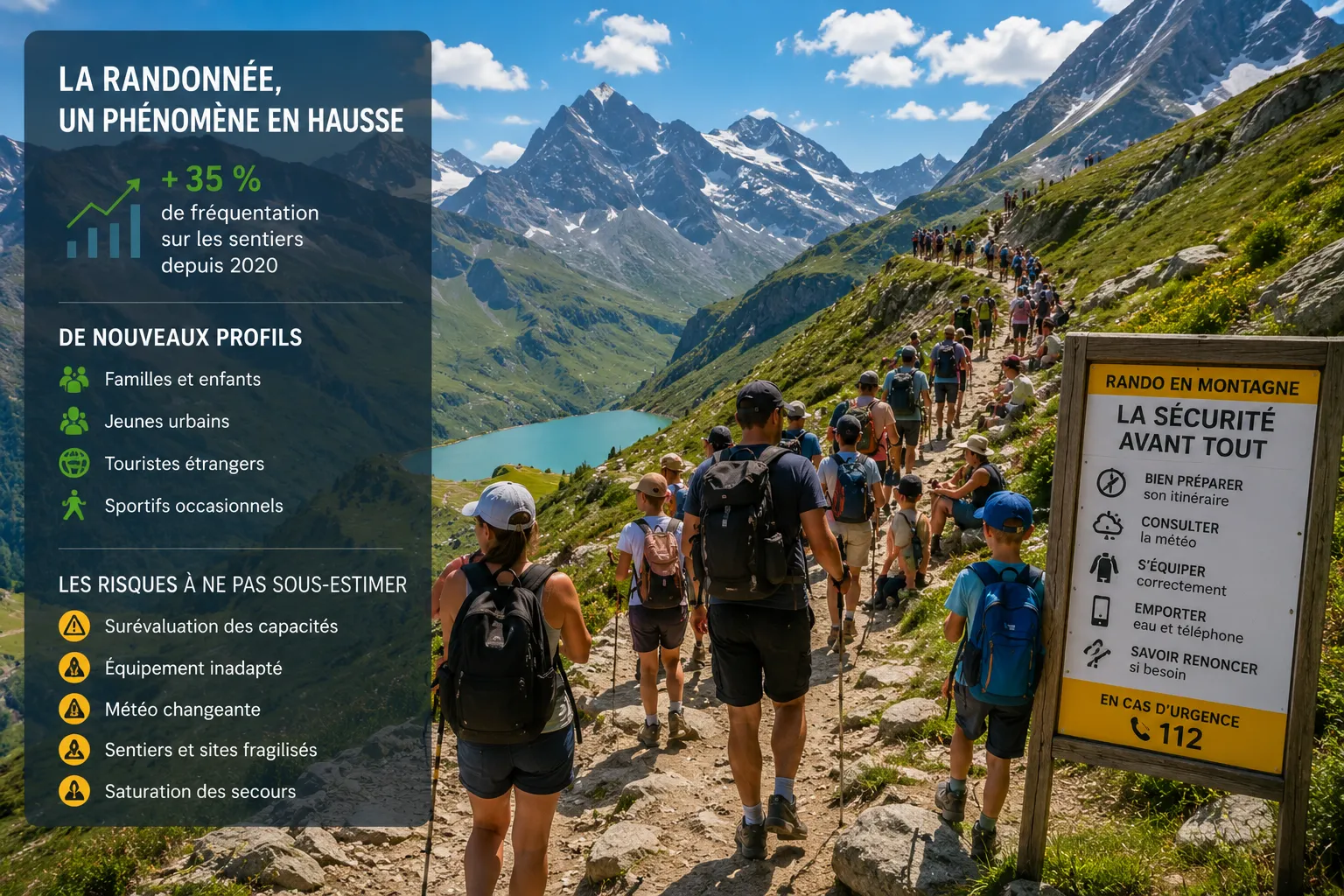
On the trails of Haute-Savoie, regulars notice every summer: the profile of hikers has profoundly changed. Where one used to mainly encounter mountain enthusiasts, today we meet families discovering the peaks for the first time, visitors drawn by social networks, or holidaymakers seeking coolness during heatwave episodes. A spectacular democratization that is transforming the mountains… but which also raises new safety questions.
The mountain has never been so popular
Since the Covid-19 health crisis, outdoor activities have enjoyed unprecedented success. Hiking has become one of the French people’s favorite activities during their vacations. Accessible, low-cost, and compatible with an increasing desire for nature, it now attracts audiences who would never have considered going to the mountains just a few years ago.
In Haute-Savoie, some emblematic routes regularly break attendance records:
- Le lac Blanc;
- Le lac de Lessy;
- Le lac de Darbon;
- Le plateau des Glières;
- Le lac d’Anterne;
- The trails of the Aravis massif.
Social networks play a major role in this evolution. A spectacular photo published on Instagram or TikTok can turn a relatively unknown route into a must-see destination within a few weeks.
A new generation of hikers
Mountain professionals notice the arrival of particularly varied profiles. We now find:
- Families not used to the mountains;
- City dwellers discovering altitude for the first time;
- Remote workers temporarily settled in the Alps;
- Foreign tourists attracted by alpine landscapes;
- Athletes primarily practicing trail running or fitness in the city.
This diversification is generally seen as excellent news for local tourism. But it sometimes comes with a lack of knowledge about the mountain environment.
Rescue teams note increasingly frequent mistakes
Every summer, rescue services intervene in situations that could often have been avoided. Guides and accompanying professionals regularly mention several recurring mistakes:
Inappropriate equipment
It is no longer rare to see visitors wearing city sneakers on technical trails or light clothing above 2,000 meters altitude.
Poor estimation of distances
On social networks, some hikes seem easy and quick. Reality is often different. A route showing three hours of walking can become much more demanding when it is 30 °C or when the elevation gain exceeds 800 meters.
Underestimated weather
In the mountains, conditions change quickly. Violent thunderstorms can form in less than an hour, even on a day forecast as sunny.
Professionals adapt
Faced with this evolution, local actors are multiplying prevention actions. In several tourist offices, safety advice is taking an increasingly important place.
Mountain guides also note an increase in requests for supervision. For many visitors, going with a professional now represents a way to discover the great outdoors while limiting risks. A guide from the Chamonix valley sums up the situation as follows:
“People want to discover the mountains, which is a great thing. But they do not always realize that the mountains remain a demanding environment, even on trails considered accessible.”
Attendance also changes the landscapes
This growing popularity also has consequences on some natural sites. Trail erosion accelerates on several heavily frequented routes. Parking lots fill up from early morning during summer weekends. Some high-altitude lakes now welcome several hundred visitors per day in mid-summer.
Local authorities are progressively investing in access development, signage, and public awareness to preserve these fragile spaces.
The mountain remains accessible, but it demands respect
The democratization of hiking is undoubtedly one of the major tourist transformations of the decade in Haute-Savoie. It allows new audiences to discover exceptional landscapes and better understand the alpine environment.
But this openness comes with responsibility. Preparing one’s itinerary, checking the weather, taking enough water, adapting equipment, and knowing when to turn back when conditions worsen remain the basics of a successful outing. Because while the mountain welcomes more visitors today than ever, it retains an immutable rule: it is not the mountain that adapts to us, it is us who must adapt to the mountain.