
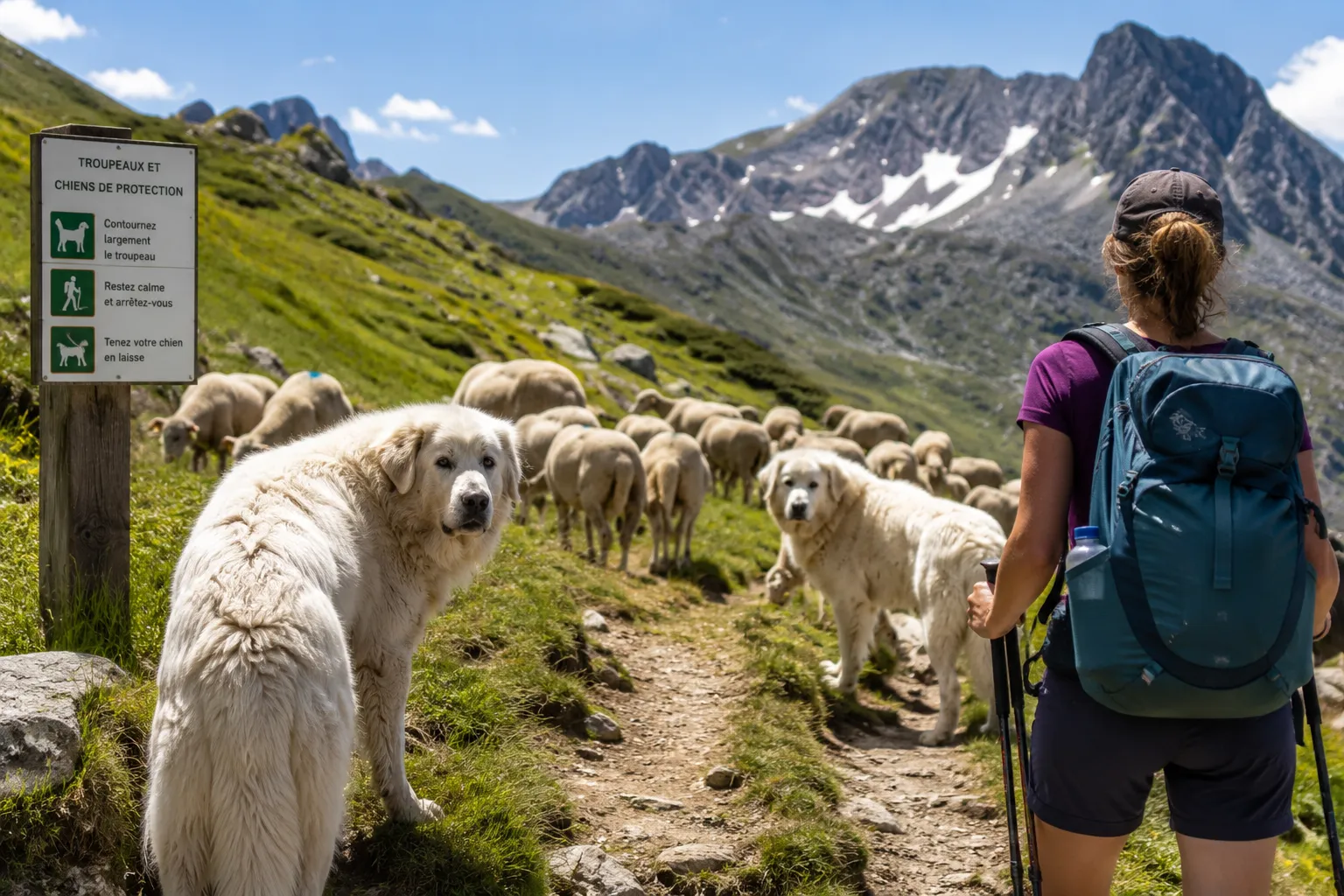
Every summer, thousands of hikers return to the trails of Haute-Savoie. But with the return of herds to the alpine pastures, encounters with patous and shepherds become more frequent. A few simple gestures can, however, prevent most delicate situations and allow you to fully enjoy the mountains.
Why herds are everywhere in the mountains in summer
From June to September, herds move up to the alpine pastures to take advantage of the vast high-altitude grazing areas. This ancient practice, called transhumance, plays an essential role in maintaining alpine landscapes. Without it, many open spaces would gradually disappear in favor of the forest.
But these herds also attract predators, especially the wolf, whose presence has significantly increased in the Alps in recent decades. To protect their animals, farmers increasingly rely on guard dogs called patous.
The patou is not a pet dog
The first reflex is to understand the role of the patou. Unlike the herding dog that guides the animals, the guard dog lives permanently with the herd it considers its family. Its job is to detect any unusual presence and to ward off potential threats.
When it barks or approaches a hiker, it is generally not looking to attack. It is performing an identification phase to check that the person represents no danger to the sheep.
What to do when a patou comes towards you?
Even if the situation can be intimidating, a few reflexes allow you to quickly defuse the encounter.
Stop
When a guard dog approaches barking, the worst reflex is often to keep moving forward or to run. Pastoralism specialists recommend instead slowing down then stopping for a few moments so that the dog can identify you.
Stay calm
Avoid sudden gestures, shouting, or aggressive movements. Do not try to push the dog away with your hiking poles or throw stones. These behaviors risk being interpreted as a threat.
Do not try to pet it
Even if it sometimes looks like a huge white plush toy, the patou remains at work. Feeding it, touching it, or trying to interact with it is strongly discouraged.
The most important reflex: largely go around the herd
When a herd occupies a trail, the best solution is to move away from it as much as possible. Crossing directly through the animals disturbs the sheep, complicates the shepherd’s work, and often triggers the intervention of the guard dogs. Alpine pasture managers recommend going around the herd widely, even if this means temporarily leaving the marked trail.
If no secure passage is possible, it is sometimes better to wait a few minutes or give up continuing the route.
Be careful if you hike with your dog
This is one of the most sensitive situations in the mountains. For a patou, an unknown dog is often perceived as a potential predator. Incidents happen much more frequently when hikers travel with their animal.
In pastoral areas, it is essential to keep your dog on a leash and remain particularly vigilant when approaching herds. In some alpine pastures, dogs are even prohibited to avoid disturbing the local wildlife.
Respecting the alpine pastures also means preserving the mountains
High-altitude pastures are fragile environments. Staying on trails whenever possible, closing gates after passing through, and avoiding polluting water points used by the herds are all simple gestures that facilitate farmers’ work. An open gate can cause a herd to scatter and several hours of extra work for the shepherd.
Bivouac: where to pitch your tent without disturbing shepherds?
Bivouacking is increasingly popular in the Alps. However, pitching your tent at random can quickly create problems. Specialists recommend avoiding the surroundings of pastoral huts, night enclosures, and areas frequently crossed by herds. At night, guard dogs remain particularly vigilant and may react to any unusual presence near the animals.
It is also advisable to observe signs of animal presence before settling down: tracks, droppings, areas of intensive grazing, or paths regularly used by herds.
The mountain is a shared space
Most encounters with patous happen without difficulty when hikers adopt the right behaviors. Understanding the shepherd’s role, respecting the work of guard dogs, and sometimes accepting to slightly alter one’s route help preserve the fragile balance of the alpine pastures.
For behind every herd you meet on the trails hides a demanding profession that helps maintain the exceptional landscapes we are here to admire.