In brief :
- Annecy hosts such dense crowds every summer in the old town that some visitors compare the experience to a theme park queue.
- The city exceeds 2.5 million tourists per year, for about 130,000 inhabitants in the Greater Annecy area.
- Residents denounce the disappearance of local shops in favor of ice cream parlors, fast-food outlets, and tourist shops.
- Faced with the pressure, Greater Annecy caps tourist rentals and seeks to spread flows across the year and the territory.
A Postcard Under Siege
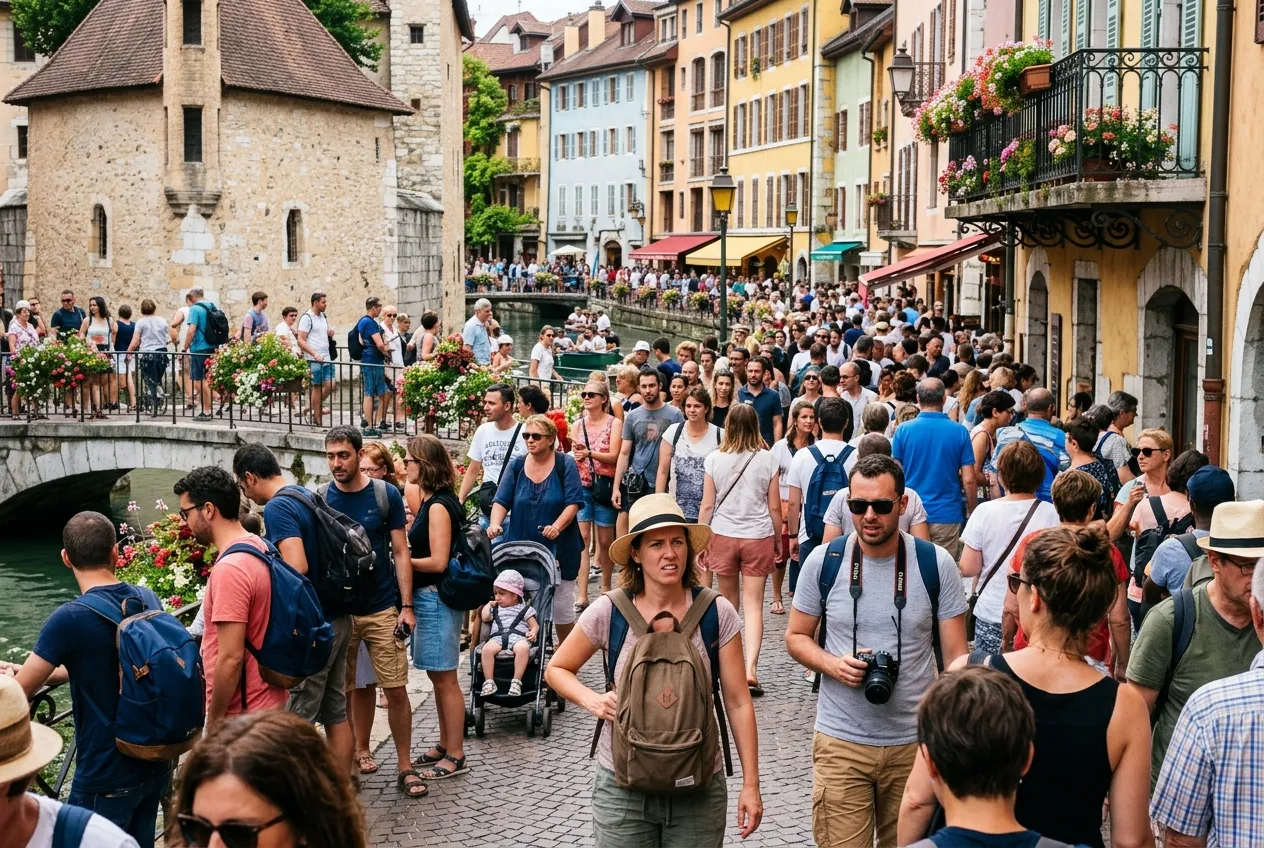
Cobblestone alleys, turquoise canals, colorful facades reflected in the water: Annecy’s old town looks exactly like a postcard. It is precisely this setting that poses a problem. During summer peak hours, the streets of Perrière or Sainte-Claire turn into a slow parade of strollers, selfie sticks, and guided groups, where everyone moves at the pace of the crowd rather than their own.
On social media and travel forums, the comparison keeps coming back: visitors say they feel more like they are in a theme park queue than in an Alpine town. A review posted on a famous travel site sums up the atmosphere of the old Annecy market by mentioning strong odors, stifling heat, and crowds that spoil the visit, especially during summer heatwaves. Other testimonies, however, remain enthusiastic and describe the city as a magical place worthy of a fairy tale, showing that the same street can be experienced as an enchantment or a trial, depending on the day and time.
Annecy by the Numbers: A Territory Under Pressure
Annecy’s success is not new, but its scale increasingly raises questions among residents and local officials.
| Indicator | Data | Source |
|---|---|---|
| Tourists and visitors per year | About 2.5 million | Annecy Lake Tourist Office |
| Estimated overnight stays | Up to 5 million | Territorial Big Data Study |
| Share of local economy related to tourism | About 1 in 3 workers | Les Anneciens.fr |
| Tourist rentals capped from June 2026 | 2,660 authorizations | New municipal regulation |
| Concentration of tourist flows in France | 80% of activity on 20% of the territory | Government figures, entire France |
The last figure is enlightening: Annecy exemplifies at the local scale a national phenomenon. France surpassed 100 million visitors in 2024, including local tourists, but this attendance remains very unevenly distributed, concentrated on a few flagship destinations, among which Lake Annecy undeniably belongs.
Why Tourists Themselves Get Irritated
The paradox is striking: those seeking the calm of an Alpine lake are often the first to complain about the crowd they help create. Several reasons explain this weariness felt both by visitors and residents:
- Geographical concentration. Most visitors crowd into a limited area, old town, lake quays, castle, while the rest of the territory remains largely spared.
- Temporal concentration. July-August, spring weekends, and major events like the Lake Festival or winter sports events create unmanageable peaks on roads designed for a much smaller town.
- Perceived loss of authenticity. Visitors themselves notice that shops in the old town all look alike. A local resident, co-president of a residents’ association, observes that most storefronts in tourist streets only offer cafés, ice cream shops, and fast fashion stores, interrupted only by a few tourist dining signs.
- Logistical saturation. Finding a parking space, a table on a terrace, or even a bench by the lake becomes a challenge during high season, feeding visitors’ feeling of artificiality, almost staging.
Residents, the First Victims of Success
Behind tourists’ annoyance hides a harsher reality for Annecy’s residents. Mass tourism has transformed the urban fabric: housing converted into seasonal rentals, rising rents, local shops replaced by businesses exclusively targeting transient visitors. A study based on several waves of interviews with the Annecy basin population notes an accumulation of nuisances, notably noise pollution caused by bars and restaurants overflowing onto public spaces, sometimes beyond regulated hours.
This exasperation even caused Annecy to drop sharply in rankings of the best cities to live in, recently falling from first to seventh place in a national ranking, symbolizing a living environment perceived as degraded by its own inhabitants.
Public Authorities’ Responses?
Faced with pressure, Greater Annecy has started to act, without yet deciding between strict regulation and flow management:
- Capping of tourist rentals. From June 2026, the city limits the number of short-term rental authorizations to 2,660, with permits valid for four years, non-transferable, and limited to one authorization per person.
- Deconcentration of flows. The Tourist Office relies on diversifying the offer—business tourism, longer stays, off-season events—to smooth attendance over the year rather than just the two summer months.
- Mobility improvement. Free buses have been set up to ease travel and reduce car pressure on the historic center.
- Debate on direct regulation. Some local stakeholders mention more radical options—visitor quotas, access tolls—modeled after other French sites like Porquerolles or the island of Bréhat, which already cap their number of daily visitors in summer.
The issue divides opinion. Some local tourism officials downplay the extent of the phenomenon, rather seeing it as a punctual concentration in the old town rather than a true widespread saturation of the territory.
Annecy Compared to Other Overtourism Destinations
The Annecy case fits into a broader European trend. Venice has introduced a day visitor tax, while several French islands strictly limit their summer attendance. Annecy has not yet taken the step of capping entries, relying more on regulating accommodation and spreading flows over time and space.
Frequently Asked Questions about Overtourism in Annecy
Is Annecy really in a situation of overtourism? The city hosts about 2.5 million visitors per year for a metropolitan area of about 130,000 inhabitants, with a very strong concentration on the old town during high season. The term “overtourism” remains locally debated, with some seeing it more as a flow management issue than an absolute number of visitors.
Why do tourists compare Annecy to Disneyland? The crowd density in narrow alleys, the queues to photograph the same viewpoints, and the proliferation of standardized shops give some visitors the impression of a paved and artificial route rather than spontaneous discovery.
What is the best time to avoid crowds in Annecy? Spring (April-June) and autumn (September-October) offer pleasant weather with significantly lower attendance than in July-August. Weekends remain busier than weekdays, even off-season.
What measures has the city taken against overtourism? Greater Annecy now caps tourist rentals (2,660 authorizations from June 2026), develops free transport, and seeks to diversify its offer to spread attendance throughout the year rather than concentrate it in summer.
Does overtourism threaten Annecy’s local economy? No, in the short term: tourism supports about one in three workers in the metro area. The debate is less about eliminating tourism than balancing it with residents’ quality of life and diversifying the local economy.
Editor’s note : Article written based on public sources (Annecy Lake Tourist Office, France Info, The Conversation, Les Anneciens.fr, local press). Figures up to date at publication; some regulatory measures mentioned will come into effect in 2026.