
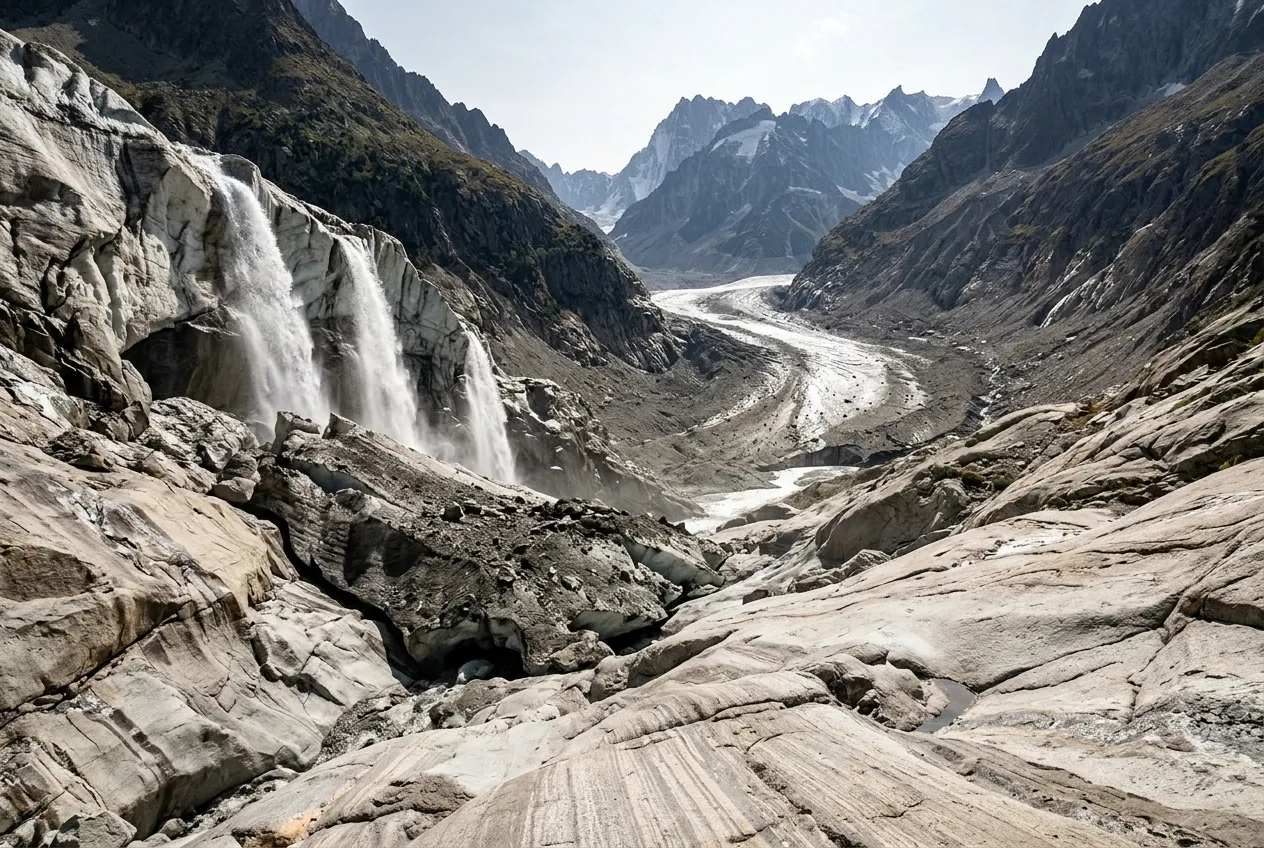
Series of collapses, refuges closed as a precaution, iconic glaciers retreating very high up the mountain: the summer of 2026 will remain one of the most critical in recent history for the Mont-Blanc massif. Behind the spectacular images of falling stones and bare ice, scientists highlight the same observation: it is not only the extent of the melting that worries them, but its speed, now out of proportion with anything that has been observed so far.
An extraordinary summer 2026
From July onwards, the situation rapidly deteriorated in the massif. Successive heat waves weakened the walls, causing several deadly rockfalls and pushing the mayor of Saint Gervais to close two refuges granting access to the ascent of Mont-Blanc, due to a too high risk of collapses. In mid-August, a geomorphologist from the CNRS alerted to a situation that could resemble the already catastrophic one of the year 2022.
The season’s toll is impressive: up to 450 significant collapses could be recorded in the massif in 2026, a figure that far exceeds the previous records of 2022 and 2023, years when about 350 then 250 such events were counted. Among the notable events of the summer, the collapse of about 15,000 m³ of rock near the Aiguille du Midi particularly marked minds.
Iconic glaciers laid bare
The best-known glaciers of the massif also bear the marks of this acceleration. The Bossons glacier, which still descended to the bottom of the Chamonix valley in the 1980s, shows in 2026 new signs of marked melting, with significant water flows visible over its entire surface and a continuous retreat of its front.
The Mer de Glace, the most famous glacier of the massif, alone illustrates the magnitude of the phenomenon over the long term. Since 1850, it has lost nearly three kilometers of length, with a retreat rate now reaching 30 to 40 meters per year. Under the Montenvers station, it has thinned by 170 meters since 1990. A trajectory which, according to some scenarios, could lead to its near disappearance by the end of the century.
Even glaciers perched above 2,100 meters altitude, long considered relatively protected by the cold of altitude, are no longer spared. A CNRS study highlighted losses of several meters of thickness in a single season during the 2022 episode, a phenomenon that repeated with the same intensity during the early heat waves of 2026.
Why the melting accelerates so much
For Ludovic Ravanel, geomorphologist at CNRS and member of the Chamonix Guides Company, it is not so much the extent of the degradation that surprises scientists as its speed. He mentions a succession of critical thresholds since the early 2000s .. 2003, 2015, 2022, then the early heat of 2026, which have gradually plunged the massif into an advanced degradation state. The researcher sums up the situation by explaining that “we are at a degradation level that is still very advanced.”
Two combined mechanisms explain this acceleration. On the one hand, the melting period lengthens each year: it now starts as early as spring and lasts late into autumn, while being more intense in the heart of summer. On the other hand, the air warms and becomes more humid, which favors the condensation of water vapor directly on the ice, a phenomenon that speeds up melting much more than warm but dry air, where ice can simply evaporate without additional energy transfer.
Added to this is the degradation of permafrost, this ice cement that holds rock walls at high altitude. When it melts, combined with the “post-glacial decompression” that frees slopes from the weight of the ice disappearing, the walls lose cohesion. This phenomenon explains the multiplication of collapses observed this summer. A striking example: in 2023, the ice apron of the Tacul triangle, whose deepest layers dated back more than 6,000 years, totally disappeared; an event which, according to scientists, exceeds all melting recorded during the warm periods of the last six millennia.
A mountain that defies predictions
On the ground, this acceleration results in a sharp reduction of the safety window for climbers. Where it once took several weeks for a well-snowed wall to become unstable, it now only takes a few days for a mountain to shift from a stable to a dangerous state. Historic routes of the massif, such as certain legendary routes of the Drus, have seen their tracks literally erased by successive collapses, forcing climbing parties to take safer variants.
This instability also pushes climbers and guides to rethink their practices completely: shifting ascents to spring, autumn or even winter, earlier starts to benefit from the nocturnal cold, increased responsiveness to conditions that evolve in just a few days. A CNRS geomorphologist alerted as early as mid-August to the risk of a year as critical as 2022, evoking a possible “catastrophic year for the massif’s glaciers.” Reality is likely to be even worse!
A phenomenon exceeding the Mont-Blanc massif alone
What Mont-Blanc is experiencing in 2026 is part of a broader trend impacting the entire Alps. According to Météo-France, half the ice volume of the Alps has already disappeared since 1900, and the current melting rate is unprecedented in the recent history of these massifs. Comparable instabilities have also been observed this summer on the side of the Cervin (Matterhorn) and Monte Pelmo, a sign that the phenomenon affects the whole Alpine arc and not only its most frequented summits.
Since 1850, the glaciers of the Mont-Blanc massif have lost more than half their volume, and just between 1980 and today, an additional 10 to 20% have disappeared, with a particularly sharp acceleration in recent years.
What prospects for high mountains?
Faced with this degradation, scientists are unanimous on one point: the mountain will never be made completely safe. Only monitoring, information and awareness can limit risks today for practitioners, without being able to prevent the ongoing transformation. The coming decades are expected to see traditional summer mountaineering become rarer in favor of practices shifted to colder seasons, while the massif’s iconic glaciers will continue to retreat and thin year after year.
Mont-Blanc is not going to disappear. But the face it has presented for generations to those who climb it is, itself, already fading before their eyes.
Article written from scientific and journalistic sources: CNRS, Météo-France, franceinfo, Vertige Media, Euronews and The Ski Guru (data and testimonies collected in 2026).