
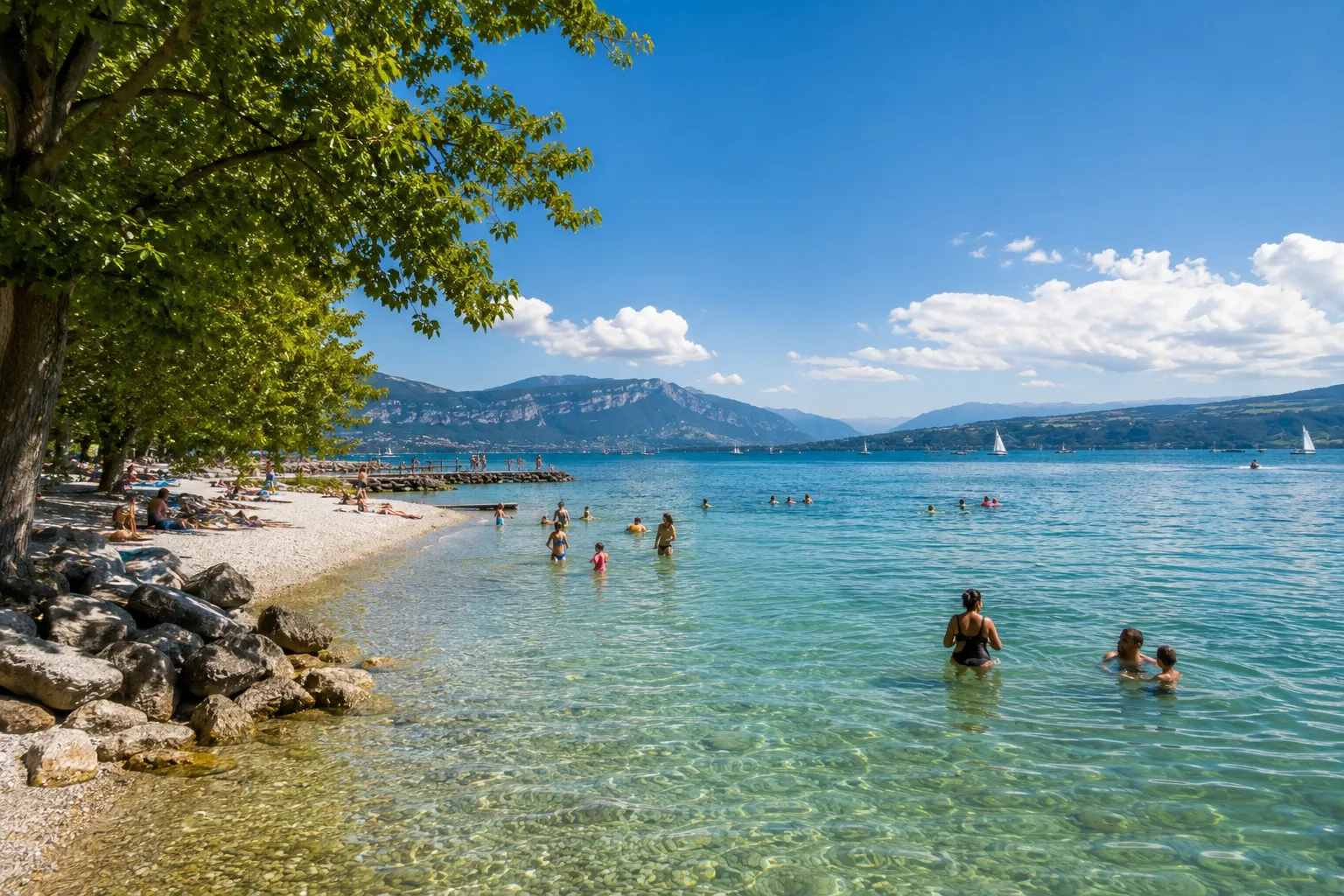
Each summer, the beaches of Lake Geneva attract thousands of swimmers looking to enjoy its waters and exceptional setting. However, after several episodes of heatwaves, storms, or localized pollution, one question frequently arises: is swimming still safe? The latest controls show a generally very reassuring situation, but some precautions remain essential before jumping into the water.
Water monitored throughout the summer
Contrary to some common misconceptions, the quality of Lake Geneva’s water does not rely on simple visual observations. Throughout the bathing season, samples are regularly taken at the main French beaches to analyze the microbiological quality of the water.
Laboratories specifically look for the presence of bacteria such as Escherichia coli and intestinal enterococci, two indicators used to assess potential health risks for swimmers.
These results are then published by health authorities and allow each bathing site to be classified.
Overall excellent quality
The good news is that the vast majority of Lake Geneva’s beaches have enjoyed water quality rated as excellent or good for several years.
In Thonon-les-Bains, Évian-les-Bains, Excenevex, Anthy-sur-Léman, Sciez, and Yvoire, the controls carried out each summer generally allow swimming to be authorized throughout the season.
This excellent quality is explained by the significant investments made over several decades in wastewater treatment and watershed protection.
Why some beaches sometimes close temporarily

This does not mean, however, that the risk is non-existent. After very heavy rains, sanitation networks can become temporarily saturated. Agricultural or urban runoff can also cause a temporary increase in bacteria in certain areas.
In these situations, authorities prefer to temporarily close the swimming areas until new analyses confirm a return to satisfactory quality.
These closures are usually short-lived but highlight the importance of sanitary monitoring.
Cyanobacteria under surveillance
Another topic that regularly raises concerns: cyanobacteria, sometimes mistakenly called “blue-green algae.” When conditions are favorable — heat, low water mixing, and strong light — they can develop locally.
Some species produce toxins that can cause irritation or digestive disorders if exposure is significant.
However, these episodes remain limited on Lake Geneva and are subject to specific monitoring. In case of risk, signs are quickly installed on the beaches concerned.
Do heatwaves change the situation?
Warmer and warmer summers promote a gradual warming of the lake’s surface. While this makes swimming more pleasant, it may also favor certain biological phenomena, particularly the development of cyanobacteria or the proliferation of microorganisms in shallow areas.
Scientists therefore closely observe Lake Geneva’s evolution in a climate change context, without, to date, questioning the general good quality of its waters.
Good habits before swimming
Even when analyses are excellent, some precautions help limit risks:
- check for any closure notices displayed on the beach;
- avoid swimming immediately after a severe storm;
- do not swim in water showing unusual coloration or greenish clumps;
- watch young children who are more likely to swallow water;
- rinse off after swimming if possible.
These simple gestures allow you to enjoy the lake under the best conditions.
The real danger is sometimes elsewhere
On Lake Geneva, the main risks are actually not always linked to water quality.
Each summer, rescue services intervene more frequently for fainting due to cold water shock, heat strokes, difficulties swimming long distances, or accidents involving boats.
The water temperature can remain noticeably cooler in depth, even after several days of heatwave, increasing the risk of thermal shock when entering the lake too quickly.
So, can we swim with confidence?
Yes, in the vast majority of cases. Sanitary analyses show that Lake Geneva’s beaches offer very good quality water and that precautionary closures remain exceptional and temporary.
The best protection simply consists of respecting the information posted on the beaches and adapting your behavior to current conditions. This vigilance makes it possible to fully enjoy one of Europe’s most beautiful lakes throughout the summer.
My advice
Before heading to the beach, check your municipality’s information or the notices on site. A few seconds are enough to verify that swimming is allowed and to enjoy Lake Geneva in complete peace of mind.