
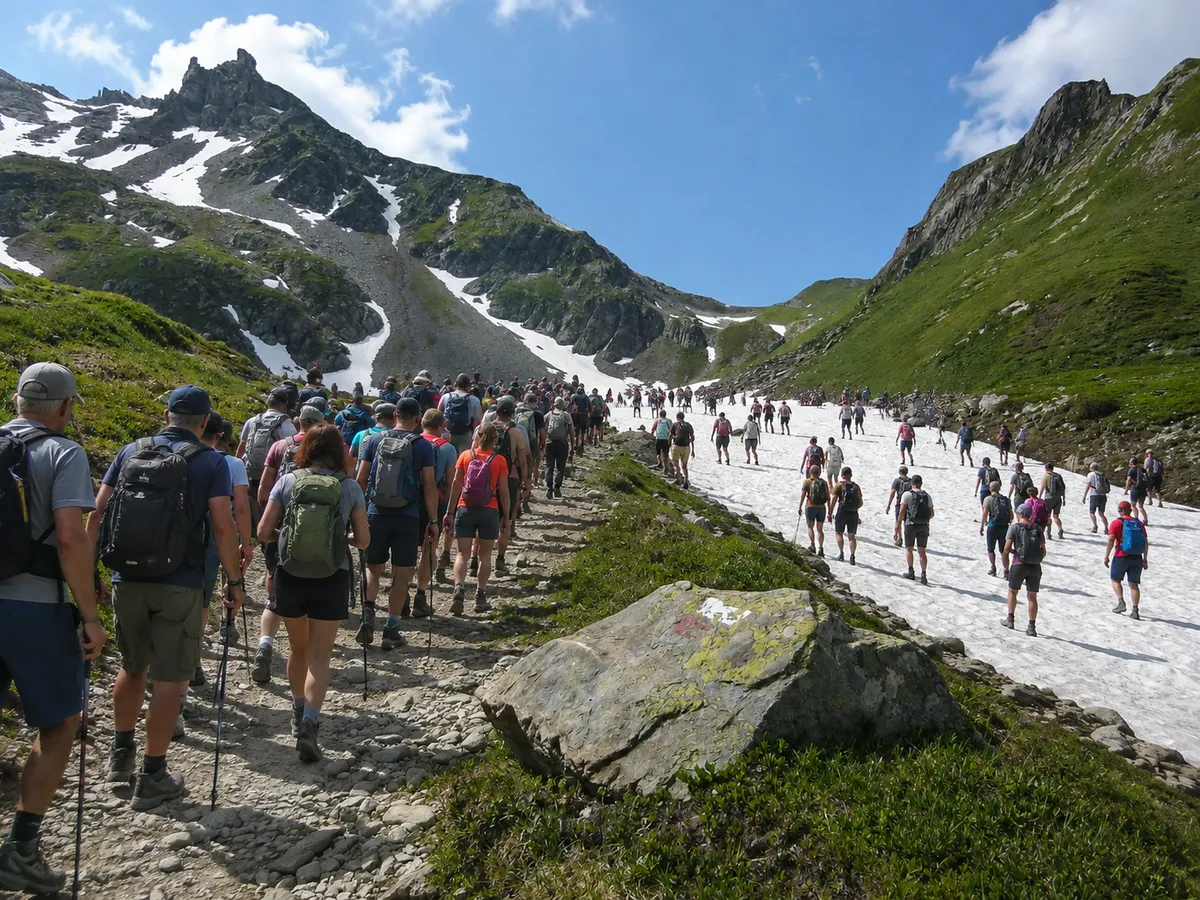
Parking lots full from dawn, degraded trails, proliferation of bivouacs and ecosystems under pressure: the summer success of Haute-Savoie is turning into a headache. To avoid tourist overload, several local authorities are taking action. Mandatory shuttles, traffic restrictions, bivouac quotas, and upcoming regulations on the Tour du Mont-Blanc: regulation is no longer a taboo, it is a reality.
Iconic sites on the verge of saturation
The scene is now a daily occurrence in the heart of summer. From the earliest hours of the day, lines of vehicles crowd the start of Haute-Savoie’s flagship hikes.
While this record influx benefits hosts, refuges, guides, and local businesses, the downside is increasingly worrying:
- Harm to wildlife and flora: accelerated soil erosion, disturbance of high-altitude species, and waste accumulation.
- Conflicts of use: incivility, chaotic parking in protected areas, and “wild toilets.”
- Seasonal smoothing: pressure is no longer limited to July and August, but now extends into June and September.
Faced with the observation of a suffocated natural environment, a conviction arises among local decision-makers: it is no longer enough to raise awareness, it is now necessary to organize and set limits.
Bivouac and swimming: the end of “free camping” at high altitude?
Sleeping under the stars has become a real trend, often amplified by social networks. But when dozens of tents are pitched each night around the same high-altitude lake, the ecological impact becomes devastating.
What is already changing on the ground: In several National Nature Reserves (Aiguilles Rouges, Contamines-Montjoie, Carlaveyron, Vallon de Bérard), bivouacking is now strictly regulated. It is now confined to designated areas and, in some cases, subject to prior reservation. The same applies to swimming in high-altitude lakes, increasingly restricted to preserve water biology.
Regulation methods tested in Haute-Savoie
| Lac Vert (Passy) | Car access closure, shuttles from the bottom |
| Lac Blanc | Awareness and flow monitoring |
| Nature Reserves | Regulated bivouacking on dedicated sites |
Tour du Mont-Blanc: Jean-Marc Peillex aims to take strong measures by 2027
It is one of the most renowned treks on the planet, but also one of the most strained. With peaks approaching 1,000 crossings per day on key sections (such as between Col de Tricot and the Miage chalets), the Tour du Mont-Blanc (TMB) is reaching its limits.
For Jean-Marc Peillex, mayor of Saint-Gervais-les-Bains and president of the CC Pays du Mont-Blanc, the observation is clear: “We can no longer settle for simple recommendations.”
The 4 pillars of the planned management plan:
- Indirect quota by reservation: To hike the TMB over several days, it would become mandatory to prove one’s reservation in a refuge or on a dedicated bivouac site. The number of beds/sites would thus set the maximum accommodation capacity.
- Paid and equipped bivouacs: No more tents pitched anywhere. Specific, paid areas equipped with dry toilets would be established.
- Creation of a “Green Brigade”: Inspired by the Mont-Blanc White Brigade, it would be responsible for checking reservations and rule compliance on the trails.
- Logistical management: Limiting baggage transport vehicle rotations between valleys to preserve the tranquility of the area.
Currently, these proposals do not constitute regulations applicable to the entire Tour du Mont-Blanc. The stated goal is to formalize an inter-municipal and cross-border charter (France, Italy, Switzerland) with initial effective measures by the 2027 season.
Towards the end of free mountain access?
Will it soon be mandatory to reserve a spot before putting on crampons or hiking boots?
For elected officials, the idea is not to ban the mountains nor privatize them, but to smooth out attendance over time and space to avoid the “Instagrammable mass tourism” syndrome.
Three tips to continue enjoying the Haute-Savoie mountains in complete peace of mind:
- Stagger your outings: Favor departures very early in the morning or hikes during the middle of the week.
- Plan the logistics: Check ahead the regulations of the area (paid parking, shuttle access, bivouac reservation).
- Go off the beaten path: From Chablais to Haut-Giffre, Haute-Savoie boasts wild and little-known routes, far from the crowd of major spots.