
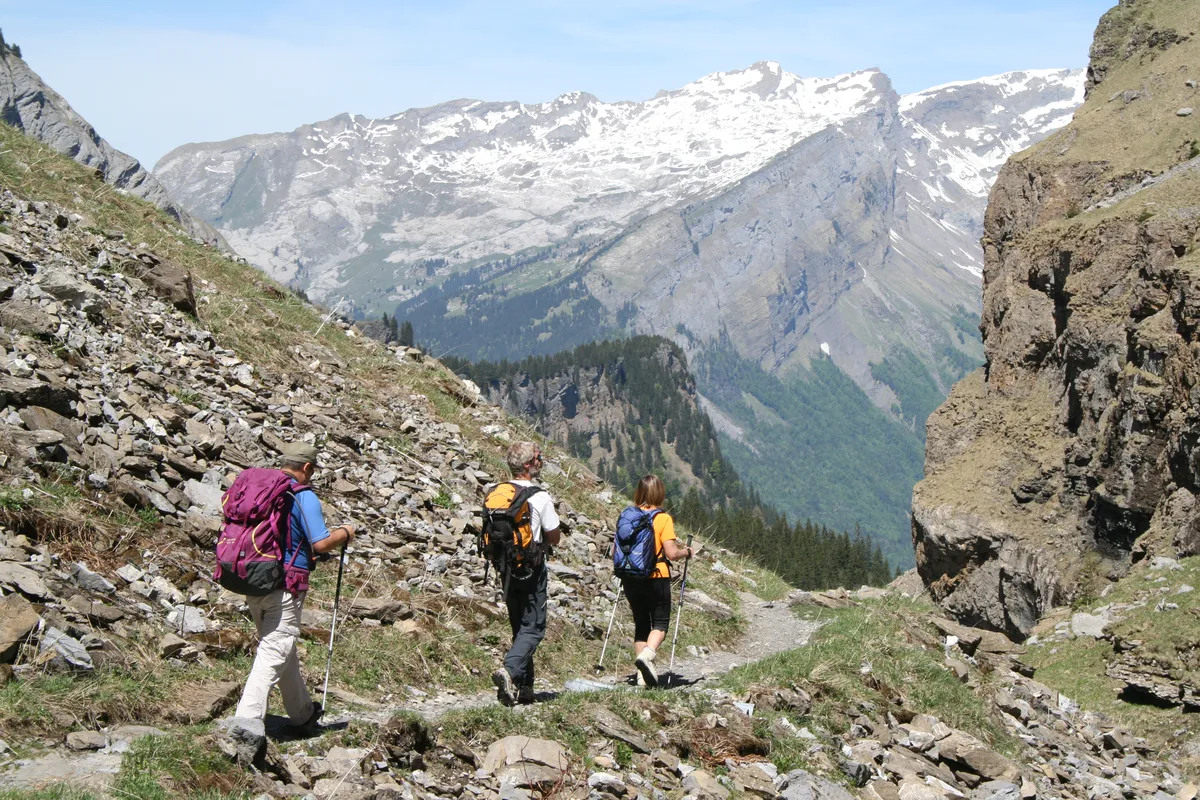
With thousands of kilometers of marked trails, the mountain offers routes for all levels. Yet, every summer, many accidents occur because hikers overestimate their abilities or underestimate the difficulty of a route. Choosing your hike well according to your physical condition, without forgetting the importance of choosing the right shoes, is one of the most important rules to fully enjoy the mountains… and return safely.
The difficulty of a hike is not just about the number of kilometers
Many walkers look only at the distance before choosing a route. However, this is just one of many criteria to consider.
An 8-kilometer loop with 900 meters of positive elevation gain will be much more demanding than a nearly flat 15-kilometer route. The type of terrain also plays a major role: a rocky trail, technical passages, roots, or scree require more effort and concentration.
Before setting off, take the time to consult the detailed hike sheet to assess all these parameters.
Elevation gain is often the best indicator
In the mountains, positive elevation gain is generally the most revealing criterion of difficulty.
As a guideline:
- Less than 300 m elevation gain: easy hike, ideal for beginners and families.
- 300 to 700 m: intermediate level, accessible to people who regularly practice physical activity.
- 700 to 1,200 m: sporty hike requiring good endurance.
- More than 1,200 m: route reserved for experienced hikers, capable of sustaining several hours of effort.
These guidelines remain indicative: altitude, heat, or trail conditions can considerably increase the difficulty.
Honestly assess your physical condition
The desire to reach a well-known summit or to reproduce a hike seen on social networks sometimes leads to unrealistic choices.
Before setting off, ask yourself a few simple questions:
- Have I ever done a similar hike?
- Am I capable of walking several hours without difficulty?
- How does my body react during long climbs?
- Will I be hiking several days in a row or is this a one-time outing?
Being honest with yourself is not frustrating. On the contrary, it allows you to fully enjoy the day without ending exhausted.
Take the group into account, not just your own level
A hike is always prepared according to the least experienced participant. If you are going with children, seniors, or people not accustomed to the mountains, adapt the duration, elevation gain, and walking pace. Breaks will be more frequent and progress slower.
The goal is for everyone to keep enough energy until the return, as the descent strongly stresses muscles and joints. Rescue teams note that the majority of accidents occur during the descent.
Weather and heat completely change the difficulty
A route considered easy in spring can become much more demanding during a heatwave. When temperatures exceed 30 °C, the body tires more quickly and the risk of dehydration increases. At altitude, a thunderstorm can also turn a trail into slippery terrain within minutes.
Before setting off, check the weather forecast and do not hesitate to modify your plan if conditions are unfavorable.
Start gradually
If you are resuming hiking after several months of inactivity, avoid aiming immediately for the most demanding routes.
It is better to gradually increase the difficulty over outings:
- start with walks of two to three hours;
- gradually increase the elevation gain;
- get your body used to long descents;
- test your equipment before a more ambitious hike.
This progression significantly reduces the risk of injury and improves endurance gently.
To read: 1000 m of elevation gain without bursting: the tips that make all the difference
Learn to recognize signs of fatigue
Even on a suitable hike, it is important to listen to your body. Excessive fatigue, cramps, dizziness, or unusual breathlessness should prompt you to slow down, take a break, or, if necessary, turn back.
In the mountains, knowing when to give up is a responsible decision. The summit will always be there another time.
Personally, despite regular practice for many years, I have already turned back during a hike because I did not feel in shape that day. There is no shame in giving up, quite the opposite! I apply this to all my activities, including paragliding or mountaineering, and I am still alive.
Apps do not replace common sense
Today, many apps offer routes with very positive comments. But a popular route is not necessarily suited to your level. Before following a GPS track downloaded from the internet, always check:
- the distance;
- the elevation gain;
- the duration;
- the technical difficulties;
- any exposed passages.
Other hikers’ opinions can be useful, but they never replace personal judgment.
Enjoyment before performance
Hiking is not a competition. The best memory of a day in the mountains is not necessarily a prestigious summit, but the pleasure of having moved safely, at your own pace.
Choosing a suitable route allows you to fully enjoy the landscapes, take time to observe wildlife and flora, take breaks, and share a good moment with loved ones. It is also the best way to keep the desire to explore the trails again on the next outing.
Article mis à jour le 20 August 2026