
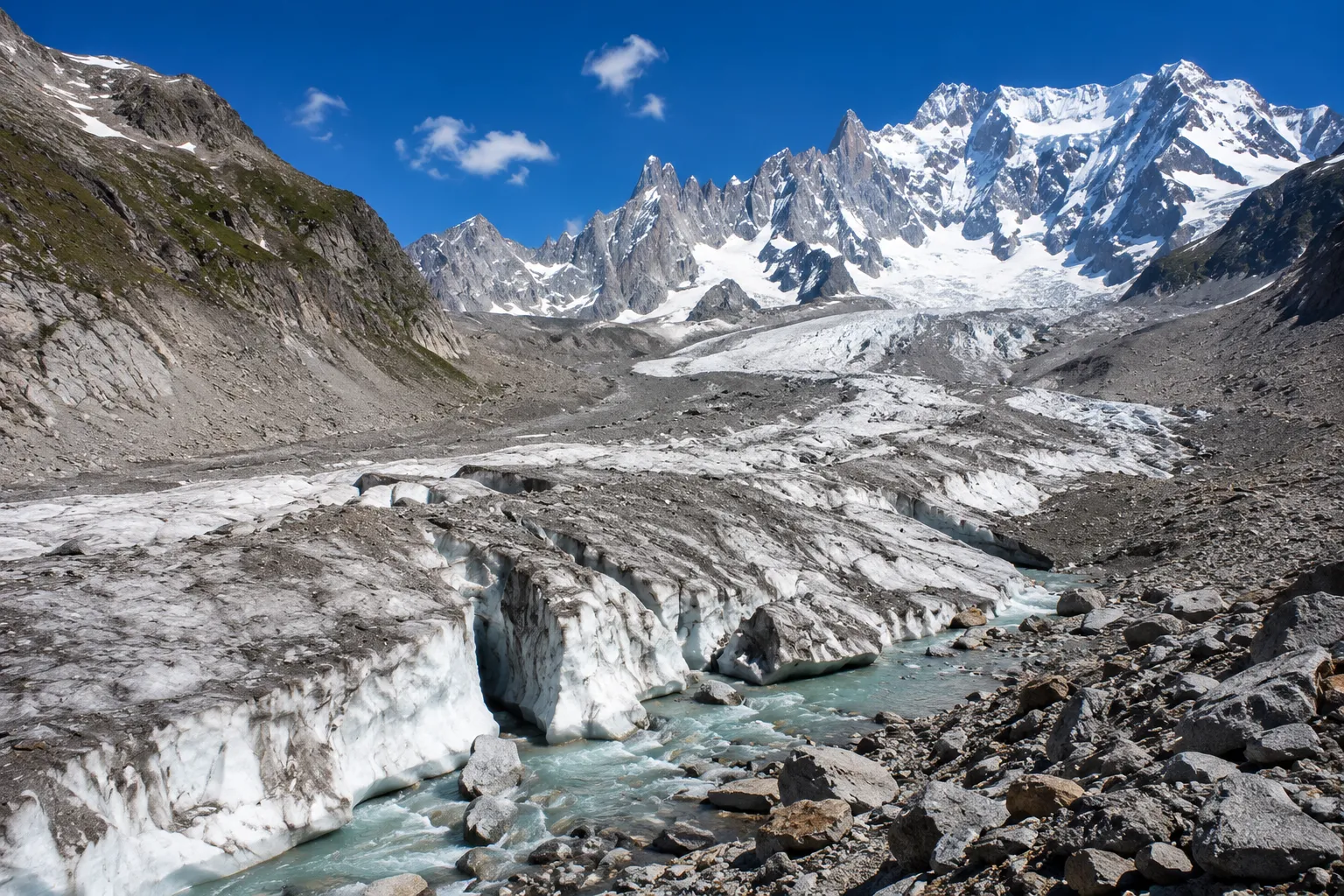
Hardly had July begun, the glaciers of the Mont-Blanc massif already showed a face usually observed in August. After a winter with little snowfall and a June marked by several episodes of intense heat, glaciologists are sounding the alarm: the melting season has taken several weeks ahead. A situation that worries both scientists and mountain professionals.
A month ahead of schedule
This year, the glaciers of Haute-Savoie are experiencing a particularly unfavorable sequence. Winter precipitation was insufficient at high altitude, leaving a protective snow layer thinner than in previous years. Then the June heat waves accelerated its disappearance.
Result: the ice is now exposed to the sun much earlier than usual. According to several observations made in the Mont-Blanc massif, the currently visible conditions already correspond to those of a typical August, with about a month ahead of the usual schedule.
Why snow is essential to the survival of glaciers
We often imagine that glaciers melt only because temperatures rise. In reality, their balance also depends on the snow accumulated during winter.
This white layer acts as a real shield. Thanks to its strong reflective power, it reflects a large part of the solar radiation. When this protection disappears prematurely, the ice, much darker, absorbs more heat and melts at a much faster rate.
Each day of intense heat then becomes particularly penalizing.
The giants of Chamonix are the first affected
The Mer de Glace, the glacier des Bossons or even the glacier d’Argentière are among the most emblematic glaciers of Haute-Savoie. All already show signs of accelerated melting.
At the glacier des Bossons, meltwater flows are particularly visible and ice loss is accelerating due to high temperatures. Aerial images released in recent weeks illustrate an increasingly marked retreat of its glacial tongue.
At the Mer de Glace, whose thickness has been decreasing for several decades, this early melting could further complicate access to the famous ice cave and accentuate the glacier’s retreat observed year after year.
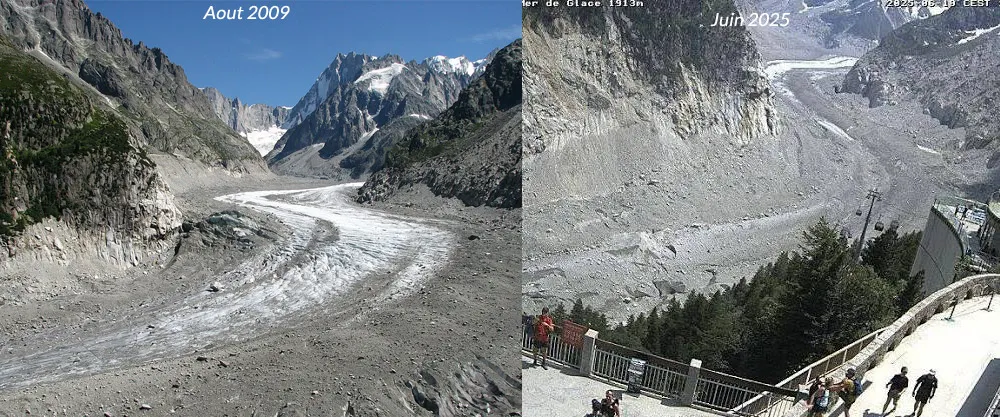
Consequences far beyond the landscape
The progressive disappearance of glaciers not only changes Alpine panoramas.
It also leads to:
- an increase in rockfalls linked to the thawing of permafrost;
- hiking trails sometimes more exposed;
- a modification of mountain water flows;
- consequences for certain tourism activities and mountaineering.
High mountain guides must, moreover, regularly adapt their routes according to changes in conditions on the ground.
Repeated heatwaves worsen the phenomenon
Summer 2026 is already marked by several episodes of exceptional heat.
These high temperatures are not limited to the valleys. The 0 °C isotherm has risen to very high altitudes on several occasions, which means that even usually protected areas are experiencing significant melting.
Throughout the Alps, specialists observe an acceleration in the loss of glacier mass, a phenomenon also noted in neighboring Switzerland where some glaciers have already consumed all their winter snow reserves by the end of June.
Can we still slow down their disappearance?
In the short term, no solution allows stopping the melting of the great Alpine glaciers.
Some local experiments, such as placing geotextile tarps on small strategic areas, allow limiting melt temporarily, but they remain impossible to generalize over glaciers spanning several square kilometers.
Scientists remind us that future evolution will mainly depend on the extent of global warming in the coming decades.
A natural heritage in full transformation
The glaciers of Haute-Savoie continue to attract millions of visitors fascinated every year by the landscapes of the Mont-Blanc massif. Yet, their evolution is accelerating and is profoundly transforming the high mountains.
The beginning of summer 2026 provides a new illustration: when glaciers already seem to be experiencing August during the first days of July, it is an entire ecosystem that reveals its fragility facing a climate changing faster than ever.