
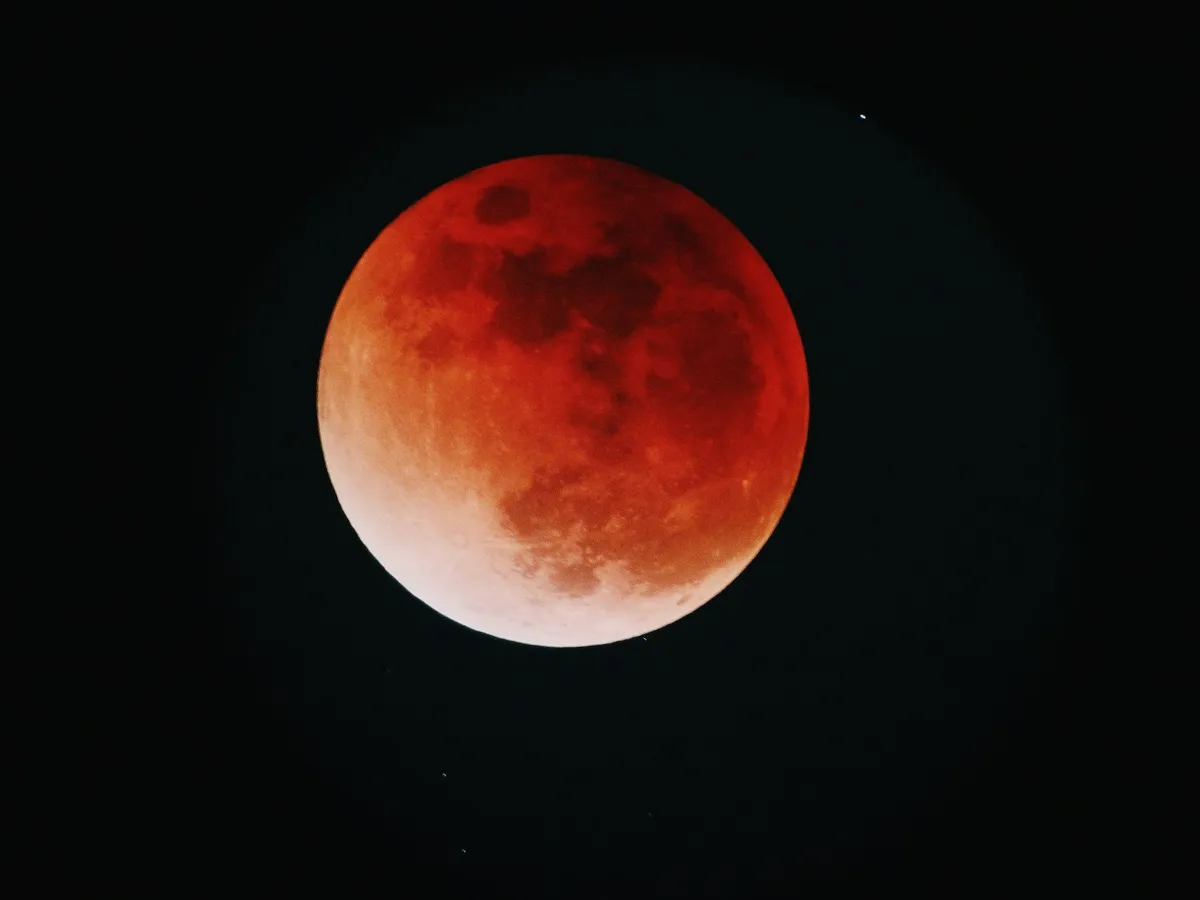
On the night of Thursday, August 27 to Friday, August 28, 2026, the Moon will take on a striking coppery red hue. The cause is a particularly deep partial lunar eclipse, just two weeks after the total solar eclipse of August 12: at maximum, 96% of the lunar disc will be plunged into the Earth’s shadow, such a high rate that the phenomenon will be visually almost indistinguishable from a total eclipse. Explanations, timings, and observation advice, especially in Haute-Savoie.
Why does the Moon turn red during an eclipse?
A lunar eclipse occurs when the Earth comes between the Sun and the Moon, casting its shadow on the latter. Normally, part of the sunlight continues to reach the Moon: it passes through the Earth’s atmosphere, which filters out blue wavelengths and lets through mainly red and orange wavelengths, following the same physical principle that colors our sunsets. This filtered light is then reflected toward the Moon, giving it this characteristic coppery red tint, hence the nickname “blood moon.” The larger the portion of the lunar disc plunged into the central shadow, the more pronounced and uniform this reddish effect is over the entire visible surface.
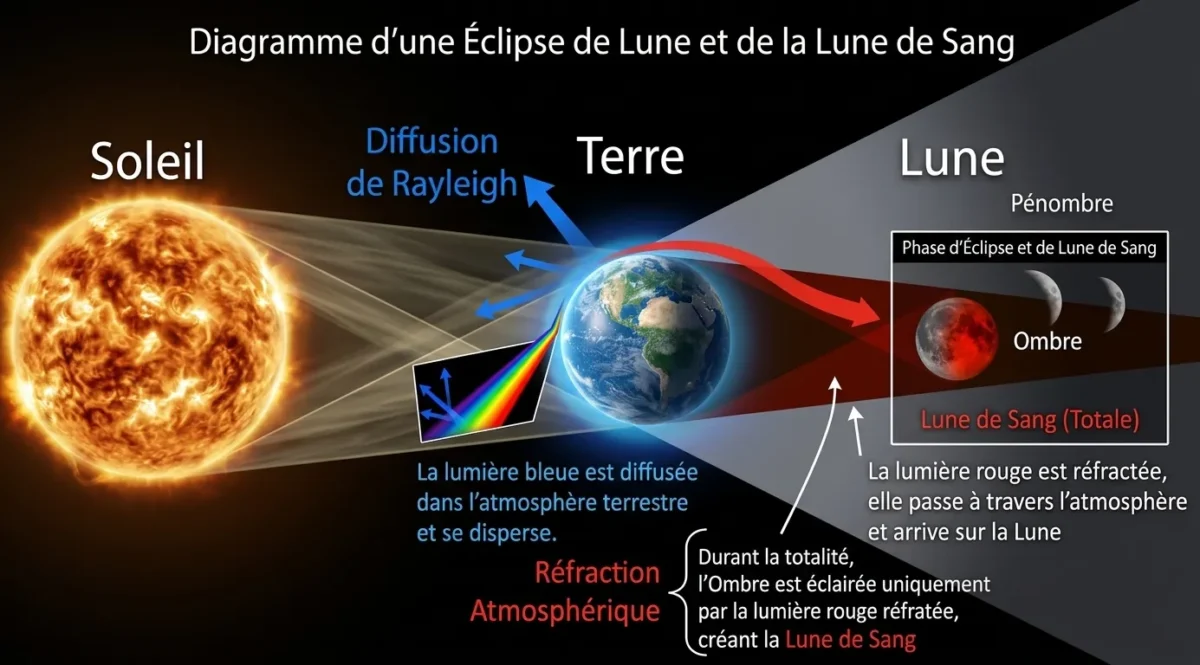
On August 28, this portion will reach 96%, leaving only a thin luminous edge on one side of the Moon. Technically, the eclipse thus remains “partial” since the shadow does not cover 100% of the disc, but the visual effect will be very close to a total eclipse. Unlike a solar eclipse, observing a lunar eclipse poses no danger to the eyes: it can be viewed with the naked eye, without filters or protective glasses.
Timings to know in France
From metropolitan France, the eclipse will take place late at night and in the early morning of Friday, August 28, while the Moon will already be low on the west-southwest horizon and close to setting. Here are the main phases of the phenomenon, in French time (CEST):
| Phase | Time (France) | What happens |
|---|---|---|
| Entry into penumbra | 03:24 | Very subtle phase, almost invisible to the naked eye |
| Start of the partial eclipse | 04:33 | The Earth’s shadow visibly begins to bite into the lunar disc |
| Maximum eclipse | 06:12 | About 96% of the Moon plunged into shadow, coppery red hue |
| End of the partial eclipse | around 07:30-08:00 | The Moon sets or disappears below the horizon depending on the region |
The maximum, at 6:12 a.m., will coincide with the first dawn light in much of the country, which will add a particular contrast between the brightening sky and the reddening Moon. The best observation conditions in France are announced for the west and southwest, where the Moon stays a little higher above the horizon at the time of maximum.
How and where to observe it in Haute-Savoie
In Haute-Savoie, the phenomenon will be visible at the same times as elsewhere in France, but two local parameters deserve special attention.
The relief first. The Moon will be low on the west-southwest horizon at the time of the eclipse, between 4:30 and 6:15 a.m. In a steep valley such as Chamonix or the Arve valley, the surrounding mountains can easily hide a Moon this low well before its actual setting. It is therefore better to favor a high vantage point or a clear view towards the west: the balconies of Salève, the heights around Annecy, Le Mole, a mountain pass or an alpine pasture offering an unobstructed view of this part of the sky will provide better chances to observe than a valley bottom.
The weather next. Forecasts for the night of August 27 to 28 in the Annemasse area announce a significantly higher risk of precipitation than the previous days, with potentially cloudy skies in the early morning of the 28th. These forecasts, however, remain subject to change: it is advised to check the local weather the evening before to adjust the observation spot, or even prefer a break between two cloud banks around maximum, at 6:12 a.m.
No equipment is essential: the eclipse can be followed very well with the naked eye. A pair of binoculars or a small astronomical telescope will nonetheless help to better distinguish the progression of the shadow on the lunar relief.
A summer sky full of events
This lunar eclipse closes a particularly rich August in celestial shows, just two weeks after the total solar eclipse of August 12. Solar and lunar eclipses always come in pairs, about two weeks apart, a phenomenon linked to the way the orbits of the Earth and the Moon periodically intersect. The next lunar eclipses visible from France will not occur until 2027 and 2028, which makes this appointment on August 28 all the more not to be missed for starry sky enthusiasts in Haute-Savoie as elsewhere.