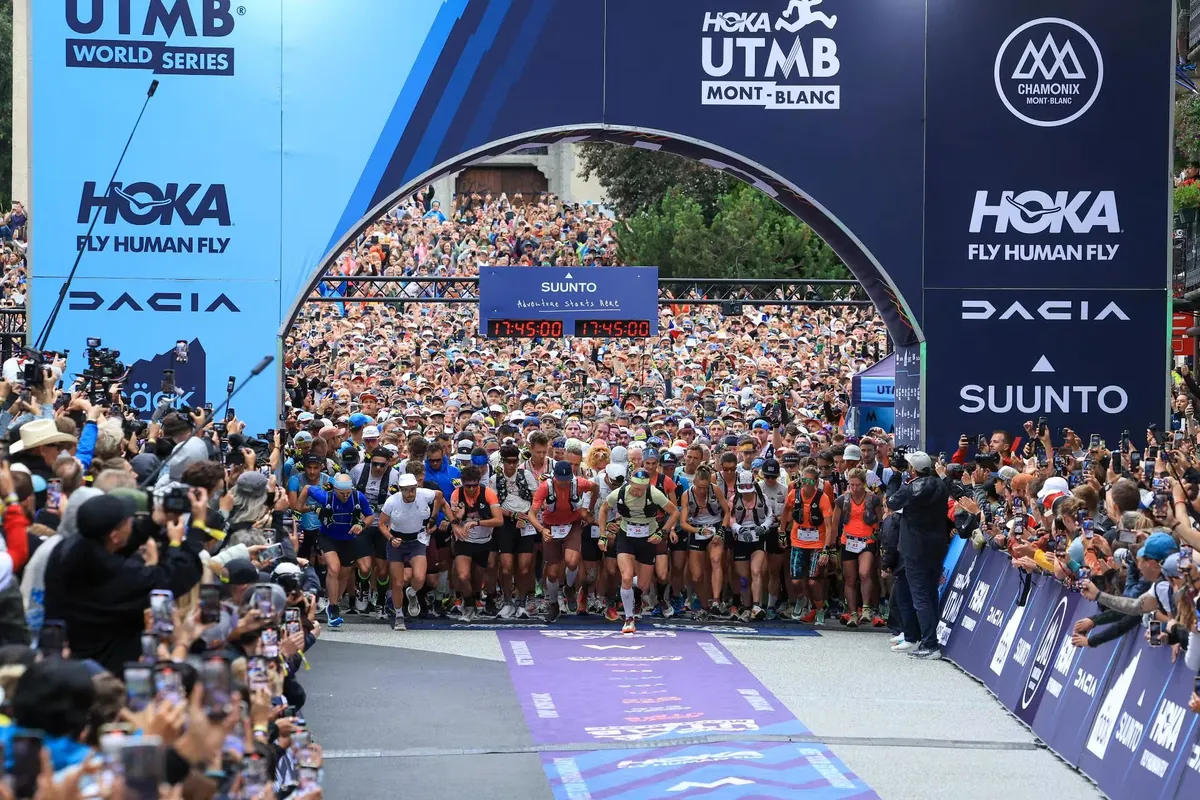
Every year at the same time, Chamonix changes its face. For the 23rd edition of the Ultra-Trail du Mont-Blanc, which takes place from August 24 to 30, 2026, more than 10,000 runners and about 100,000 spectators crowd into a town that has only 9,000 inhabitants. A ratio of one to eleven that, every late summer, puts the resort to the test, and which, this year more than ever, crystallizes a divide among its residents.
A town “not built to host so many people”
For some Chamoniards, the UTMB remains a celebration and an invaluable showcase for the valley. But for others, weariness has taken hold. “Too many people, it’s hell,” confides to AFP Molly Lefebvre, a 19-year-old waitress born in the town, who describes race week as the worst of the year. Saturated streets, traffic jams, accommodations rented at exorbitant prices: several shopkeepers even close down, their regular customers no longer able to find their way to the store. In a dental office in the town center, they outright call it a “dead week,” regretting that the event, once festive, has become difficult to live with on a daily basis.
The new mayor of Chamonix, François-Xavier Laffin, elected in March 2026, himself channels this exasperation into the ballot box. He denounces the phenomenal growth of a competition which, lacking sufficient framework, exceeds in his view the real hosting capacity of the town and now wishes to limit its footprint, notably by reducing the exhibitors’ fair.
On the organization’s side, a share of responsibility is assumed while reminding that the UTMB is not the only source of tourist traffic in the valley: the sole Tour du Mont-Blanc attracted nearly 75,000 hikers in 2025. Environmentally, the UTMB highlights the commitment of 60% of runners to come without a car and a promise to reduce its CO2 emissions by 20% by 2030.
Kilian Jornet, the voice that disrupts
In this debate, one name weighs more than others: Kilian Jornet. The Spanish champion, four-time UTMB winner, is not a last-minute critic. In January 2024, he co-signed with American Zach Miller a public call to boycott the race, denouncing a drift of trail running towards industrialization, loss of meaning, and gigantism—precisely the ills that the inhabitants of Chamonix point to today.
Two years later, a twist: Jornet announces in February 2026 his return to the trails of Mont-Blanc after four years of absence, explaining that he wants to compete on a sporting level more than rediscover the courses. The announcement electrifies the trail community immediately, boosts the expected attendance, and pushes rental prices in the valley even higher; an irony that did not escape anyone, as his return seems to amplify the phenomenon he himself had denounced. Ultimately injured, Kilian Jornet had to forgo starting this 2026 edition, without his critical voice on the direction taken by the event losing any weight in the debate.
What changes for future editions?
Faced with discontent, some avenues are beginning to emerge. François-Xavier Laffin advocates for the establishment of a clear “framework,” still to be defined with the organization, which would set limits to the event’s growth rather than letting it continue unchecked.
First concrete gesture announced for this 2026 edition: a reduced exhibitors’ fair, less intrusive for the town center. On the UTMB side, co-founder Catherine Poletti says she wants to “find the right balance” and “invent the solutions of tomorrow” to limit nuisances, without detailing numerical measures at this stage.
Several levers are regularly mentioned in the local debate: stricter spreading out of spectator flows, reinforced regulation of tourist rentals during race week, or strengthening already made commitments on soft mobility and reducing CO2 emissions by 2030. But more and more, one also hears calls for a stronger limitation on the number of race entries. It remains to be seen whether these adjustments will suffice to reconcile a town and the event that made its global reputation.
A symbol that has become too large for its village
Born in 2003 on the initiative of Michel and Catherine Poletti, the UTMB has established itself in just over twenty years as the most prestigious trail race in the world, generating several tens of millions of euros in economic benefits for the valley each year. But this success has a downside: eight races, seven days of festivities, 150 exhibitors, and a renown such that the question now posed in Chamonix is no longer whether the UTMB should grow, but how far a mountain town can absorb its own success.