
Last updated: 07/28/2026
In Haute-Savoie, the breathtaking natural setting of the Devil’s Bridge gorges attracts many visitors seeking adventure and geological discoveries. Nestled in the Aulps valley, they offer an impressive display of rock formations and waterfalls, shaped by the Dranse river over millennia. This article explores the many facets of this must-see destination for nature and history enthusiasts.
Discovery of the Devil’s Bridge Gorges
Location and access
Located at the place called “le Jotty”, in the commune of La Vernaz, the Devil’s Bridge gorges are near the towns of Thonon-les-Bains and Morzine, in Haute-Savoie. To get there, you must take the D902 road that runs along the Dranse river, offering a breathtaking landscape throughout the journey. The car ride from Thonon or Évian-les-Bains takes approximately 20 minutes.
Description and features
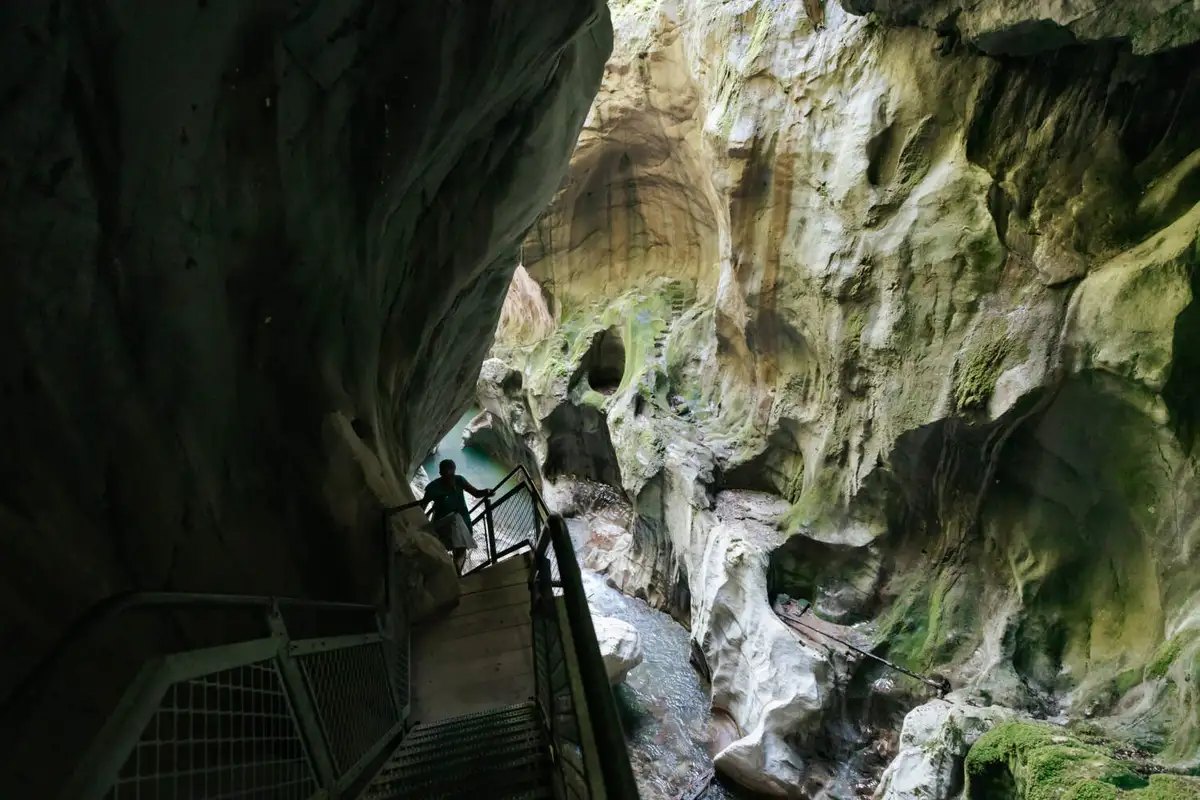
Listed in the Chablais Geopark and classified since 2012, the Devil’s Bridge gorges stand out for their exceptional geological formations. These result from the erosion of water on the rock, creating a true labyrinth of large rock blocks and waterfalls. The route includes a metal staircase offering dizzying views of the gorges, as well as a unique experience with the “step into the void,” a glass structure suspended 60 meters high.
Amenities and visit
The recent improvements completed in 2019 have enhanced the site’s accessibility, although the elevation change remains 110 meters over a short distance. Informative panels line the path, enriching the visit with valuable information about the site’s geological formation. The average duration of the visit is 50 minutes. Wearing comfortable shoes is recommended due to the rugged terrain.
Beyond this initial overview, the historical and legendary aspects of the gorges also offer fascinating discoveries.
History and legends of the gorges
Historical origins
The Devil’s Bridge gorges are rich in history dating back centuries. In the past, shepherds and travelers used these natural passages to cross the region. This place has always been considered strategic given its geographical location and its natural resources.
Associated legends
The Devil’s Bridge gorges owe their name to a persistent local legend. It tells that the devil built the bridge in a single night to prove his power, in exchange for the soul of the first living being to cross it. However, the villagers managed to trick the devil by letting a dog pass first, thus saving their souls.
- This legend has not only marked the collective imagination but also helped forge a unique identity for the site.
- The fantastic tales continue to enliven the visits, adding a mystical dimension to the visitors’ experience.
Practical information for the visit

Essential preparations
To fully enjoy the Devil’s Bridge gorges, some preparations are necessary. It is advisable to visit the site on weekdays to avoid crowds, especially during July and August when attendance is at its peak. People sensitive to vertigo should exercise caution, particularly when using the site’s metal staircases.
Accessibility and equipment
The site is accessible to all, although people with reduced mobility may experience difficulties due to elevation changes and stairs. Along the route, various informational panels are placed to guide and enlighten visitors about the geological curiosities and local legends. To ensure their comfort, visitors should wear clothing suitable for a nature walk, with appropriate shoes.
Rates and opening hours
Periods and hours
The gorges are generally open from late March to late September. In April, May, June, and September, they are open from 10:30 a.m. to 4:30 p.m. During July and August, access is possible from 9:00 a.m. to 6:00 p.m. These hours aim to maximize everyone’s experience while preserving the site’s integrity.
Pricing
| Category | Price |
|---|---|
| Adults (16 years and over) | €19 |
| Youths (4 to 15 years) | €14 |
This pricing structure aims to allow families to discover this natural heritage while contributing to its preservation. Tickets do not require prior reservation, simplifying the planning process for visitors.
Important information
- The visit involves an elevation difference of 110 meters and numerous stairs.
- Sports shoes are strongly recommended for the visit.
- The site’s configuration may pose a difficulty for pregnant women or those with heart or respiratory problems.
- Mandatory baby carrier for children not autonomous in walking (not stroller accessible).
- For your safety, that of other visitors, and also for your animals, dogs are prohibited.
- The gorges can also be visited in rainy weather.
By deepening our exploration, let’s discover how the geographical and toponymic context enriches the experience of the Devil’s Bridge gorges.
Geographical and toponymic context
Exceptional natural setting
The Devil’s Bridge gorges are located in a remarkable natural setting, characterized by steep mountains and deep valleys. The Dranse, a turbulent river, played a key role in forming the gorges, shaping this spectacular landscape through its erosive action. This region is also marked by rich biodiversity, with varied fauna and flora revealed throughout the visit.
Meaning of the name
The name “Devil’s Bridge” evokes not only the local legend but also suggests the complex relationship between man and nature in this region. This name has endured through the ages while retaining its mystery and appeal, contributing to the impressive aura of the site’s natural resources. This designation also invites reflection on the importance of preserving stories and heritage sites.
Through the discovery of the Devil’s Bridge gorges, history and geography blend to offer a place of contemplation where nature imposes its power and beauty. This geological jewel does not merely display its wonders; it also tells a story, that of a territory shaped by time. Each aspect helps make the gorges a unique and fascinating destination, to be visited at least once in a lifetime. Through a balanced approach between conservation and accessibility, the gorges continue to captivate, amaze, and inspire generations to come.
Article mis à jour le 28 July 2026