
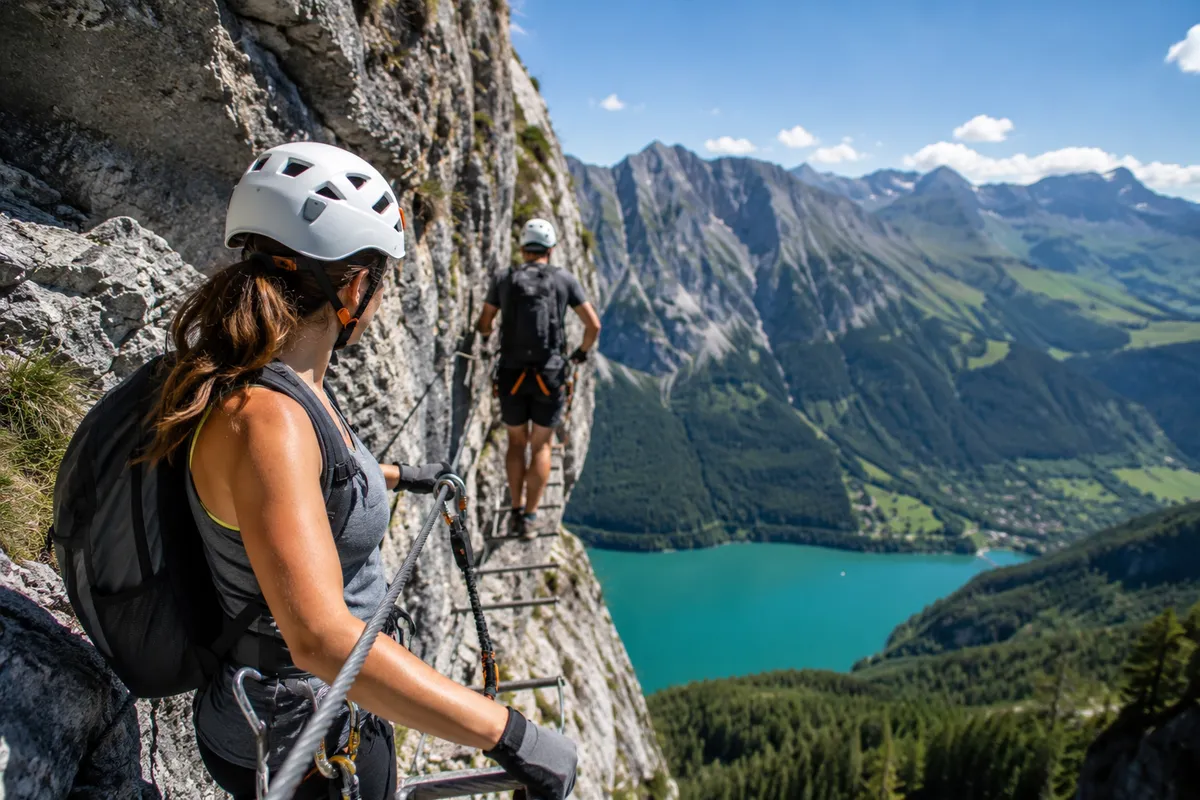
With its cliffs, gorges, and walls offering breathtaking views of the surrounding mountain ranges, Haute-Savoie is one of the favorite playgrounds for via ferrata enthusiasts. Accessible from a very young age and without any prior climbing experience, this activity attracts an increasing number of families and athletes seeking thrills each summer. Here is everything you need to know to start confidently.
What is via ferrata?
Via ferrata is a permanently equipped mountain route: cables, rungs, bars, monkey bridges, and footbridges allow progression on a rocky wall safely, without requiring the techniques and equipment of traditional climbing. The principle is based on a lanyard attached to the climber’s harness, which remains clipped at all times to a safety cable fixed along the route.
Born in the Austrian Prealps as early as 1843, the discipline developed more widely in the Italian Dolomites at the beginning of the 20th century, where the Italian army equipped steep passages to facilitate the movement of alpine troops. It only really became widespread in France in the 1990s, later than in other alpine countries, before experiencing the boom it enjoys today.
An accessible activity, but not without risks
This is one of the great assets of via ferrata: unlike classic climbing, it does not require any particular climbing technique nor exceptional physical condition for the easiest routes. Many beginners discover that it is not so much physical fitness that poses difficulty but managing vertigo and fear of heights.
That does not mean the activity is without danger. A fall with a poorly positioned lanyard, a moment of inattention when passing an anchor, or a route poorly suited to the group’s level can have serious consequences. The best guarantee of safety remains training: for a first experience, it is highly recommended to call on a professional (mountain guide, instructor, local club), who will know how to teach the right techniques, guide you to an appropriate route, and manage the group’s progress.
Understanding route grading
Each via ferrata usually displays, right from its starting point, a sign indicating its difficulty, length, and estimated time to complete. The grading breaks down into six levels, ranging from F (easy) to EF (extremely difficult), passing through PD (a little difficult), AD (fairly difficult), D (difficult), and TD (very difficult). For a first outing, it is always better to choose a route graded F or PD, even if that means gradually progressing toward more demanding routes as experience is gained.
Essential equipment
Via ferrata requires specific equipment, different from that of classic climbing:
- A helmet, essential to protect against falling rocks, including those dislodged by other climbers higher up the route.
- A harness, to attach to the lanyard system.
- A via ferrata lanyard with energy absorber, specifically designed for this activity: it has two arms ending with carabiners, allowing continuous attachment to the cable, including when passing intermediate anchors.
- Gloves, not mandatory but highly recommended to protect the hands from repeated contact with the metal cable and rungs.
- Hiking or approach shoes, providing good grip on rock.
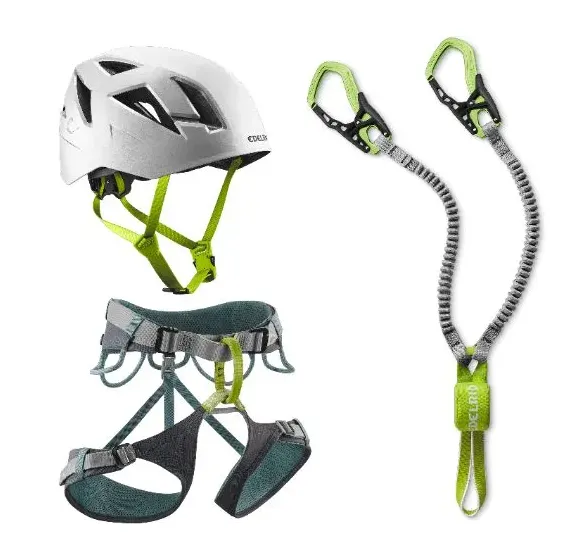
For a first outing, it is not necessary to invest in your own equipment: most via ferrata sites in Haute-Savoie offer complete gear rental at sports stores in nearby resorts, and when the outing is guided by a professional, equipment is generally included in the service. For regular and autonomous practice, owning equipment is necessary.
Good safety practices
A few simple rules allow for peaceful practice, even outside guided outings:
- Get information before you go (information panel, guidebook, tourist office) and choose a via ferrata suited to the physical condition and experience of all group members.
- Keep the lanyard clipped onto the lifeline at all times, with at least one carabiner clipped when passing each anchor.
- Remain attentive and vigilant throughout the route, including on sections that seem easy.
- Perform a mutual equipment check before starting the route: it is the best way to spot any gear errors before they become dangerous.
- Never exceed the recommended number of people between two anchors to avoid overloading the cable in case of a fall.
- Get trained before practicing independently: if you are a beginner, contact a professional or a club who can introduce you to basic safety techniques.
Where to learn via ferrata in Haute-Savoie
The department has about fifteen routes spread across its territory, offering a nice variety of atmospheres and levels:
- The Passy via ferrata, facing the Mont-Blanc range, with views over Lake Passy, gently accessible for a first introduction.
- The Saix de Miolène, near La Chapelle d’Abondance, an athletic and fairly long route (about 900 meters), alternating sections of varying intensity on limestone rock.
- The Cascade des Nants, in Bellevaux in the Chablais massif, a short and playful route that follows the riverbed above a series of waterfalls — particularly pleasant in hot weather.
- Via ferratas around Thônes and the Aravis, appreciated for their accessibility to beginner athletes and families alike, with panoramas over the Aravis range.
- Routes near Annecy, including a private via ferrata on the heights of Talloires, offering a view over the lake.
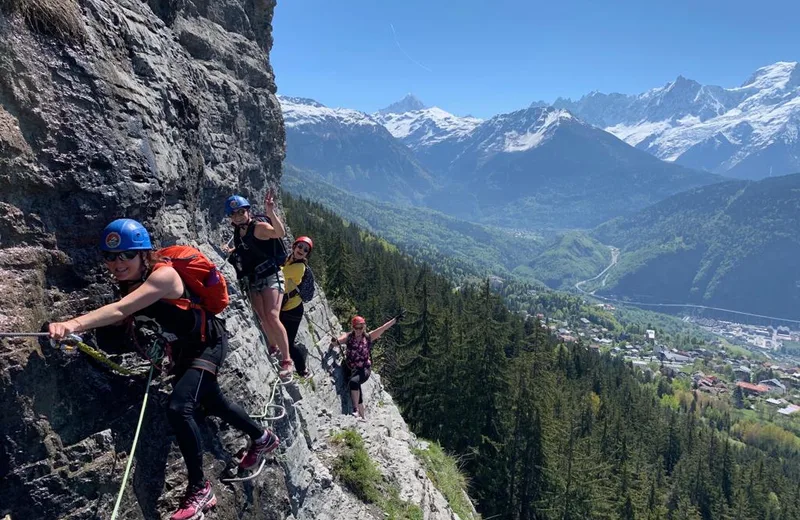
Each site presents its own specifics regarding access, parking, and difficulty: it is recommended to consult the detailed description of each route before going, especially to check for escape routes along the way, useful in case of fatigue, changing weather, or difficult vertigo management.
To read: A spectacular new via ferrata has just opened in Haute-Savoie, with footbridges and zip lines
Should you go alone or with a professional?
For a first experience, guidance by a professional remains the most recommended option, particularly for children or those prone to vertigo. A mountain guide or certified instructor can choose a route truly suited to the group’s level, provide the necessary equipment, and reassure the most apprehensive practitioners facing heights. Guided outings are generally offered half-day, with small group sizes to promote individual learning.
Once the basics are acquired and confidence on the cable established, it becomes possible to practice independently on the easiest routes, provided you remain strict with safety rules and never engage on a route whose level exceeds that of the least experienced group member.
In summary
Via ferrata is a spectacular activity that allows discovering the mountain differently, without requiring prior climbing experience. Helmet, harness, and lanyard with energy absorber make up the basic equipment, available for rental at most sites. For a first outing, favor a route graded F or PD and ideally be accompanied by a professional, which remains the best way to discover the discipline with confidence before setting off to conquer the most beautiful cliffs of Haute-Savoie independently.