
In brief
- In Haute-Savoie, the rain-snow limit can drop to around 1,700-1,800 meters as early as mid-September during a cold drop episode, while the valleys remain summery.
- The Mont-Blanc, Aravis, Chablais, and Bornes massifs have already experienced early snow episodes in the past — this is not an anomaly, but a signal to anticipate.
- A thin layer of snow is enough to hide markers, make stones slippery, and turn a familiar route into uncertain terrain.
- Good preparation (weather, equipment, realistic itinerary, informed person) allows you to continue hiking in Haute-Savoie without taking unnecessary risks.
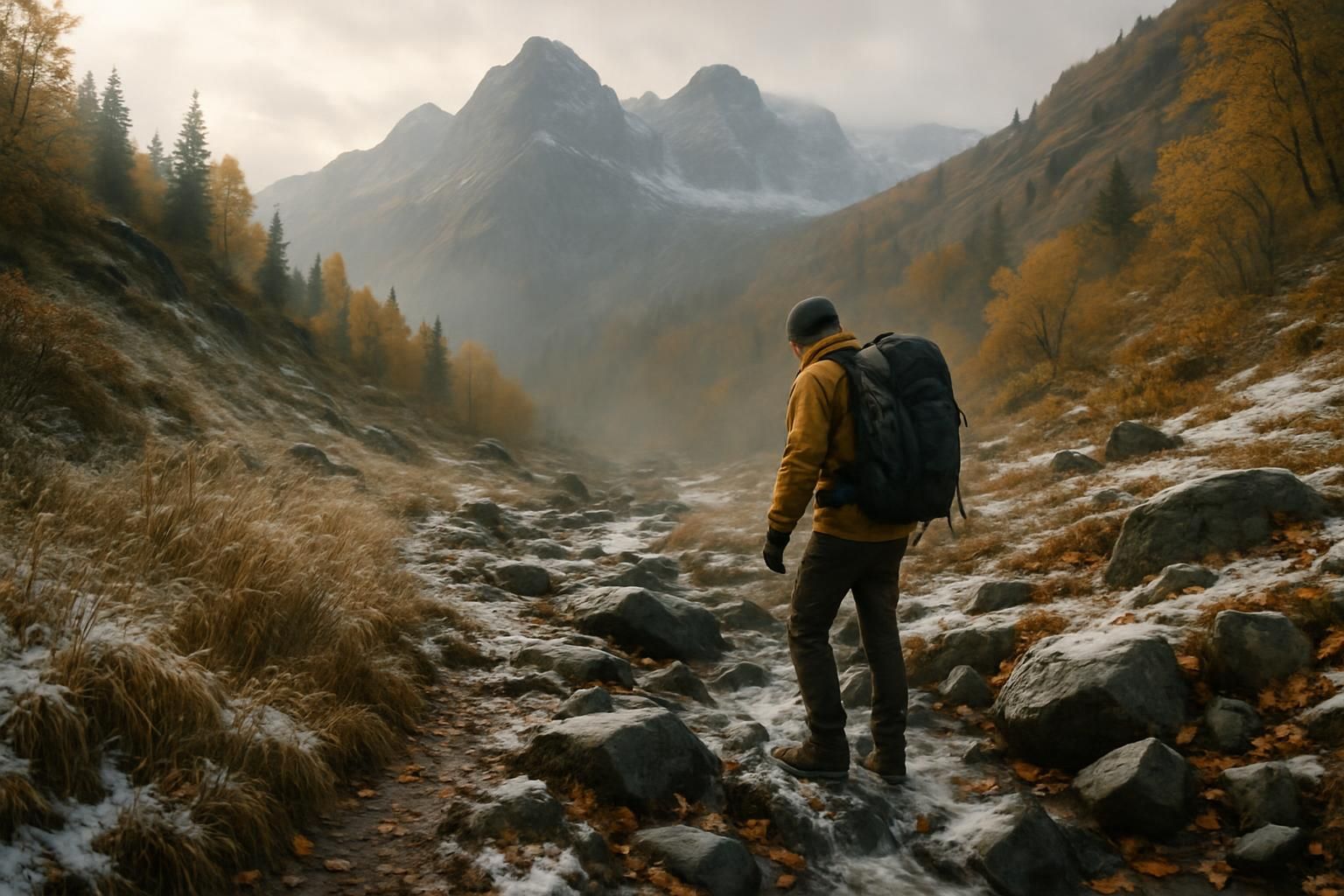
In September, the Haute-Savoie mountain can still give a summery impression around Annecy, Sallanches, or the Arve valley, while abruptly shifting to winter conditions just a few hundred meters higher. A high-altitude cold drop is sometimes enough to lower the rain-snow limit to 1,700 or 1,800 meters, cover stones with a slippery film, and erase marks that seemed obvious just hours before on the trails of Mont-Blanc, Aravis, or Chablais.
These first snowfalls are not exceptional in the department. For hikers, the challenge is not systematically to give up outings, but to understand that the same route changes nature as soon as cold, wind, and snow set in.
First snows from September: why the Haute-Savoie mountain changes so quickly
At the end of summer, the calendar is not enough to describe the conditions encountered at altitude. The sun sometimes remains warm in the valleys, the alpine pastures are still green around the refuges, but the atmosphere can cool quickly above 1,500 or 2,000 meters, whether on the Mont-Blanc massif, in the Aravis, or near Chablais. Temperature generally decreases with altitude, and a disturbance coming from the north can intensify this difference in just a few hours.
The phenomenon often called cold drop corresponds to a pocket of very cold air isolated at altitude within a mass of milder air near the ground. This setup forms when the jet stream, which flows several kilometers above the surface, shapes wide undulations. A small portion of polar air can then descend towards the Northern Alps, causing strong instability and turning rain into snow on the Haute-Savoie slopes.
The term polar detachment also describes this type of situation. It does not mean that winter is settling permanently, but that the contrast between the mild air in the lower layers and the cold air at altitude becomes significant enough to produce showers, wind, and localized snowfalls on the department’s summits. A sunny morning on the shores of Lake Annecy or Lake Geneva can thus give way to a closed, damp, and much colder afternoon on the nearby ridges.
Early episodes, but already known in Haute-Savoie
Past observations show that snow in September is not an absolute anomaly in the department. Haute-Savoie has previously experienced marked snow episodes from mid to late September, with several tens of centimeters above 2,000 meters on the heights of the Mont-Blanc massif and the Aravis. In September 2013, Haute-Savoie and Savoie recorded 30 to 50 centimeters above this altitude, while the summer season was not yet over.
These historical benchmarks do not allow precise forecasting of every autumn, but they remind of an essential rule: September does not mean summery conditions in the mountains, even on the most frequented massifs of the department. The cold can be temporary and the snow melt quickly on sun-exposed slopes, while creating real traps for a few days on trails around Mont-Blanc, Aravis, Chablais, or Bornes.
This year 2026, and after the heatwave episodes of this summer, it is still wise to remain cautious, even if current forecasts for September do not seem to announce a cold episode… but that could change quickly!
Different weather over just a few hundred meters
Camille, a hiker accustomed to marked routes around the Aravis massif, may leave with a temperature of 18 degrees at the parking lot and find 2 degrees at the pass. If a shower crosses the area, the rain observed at departure becomes heavy snow upon arrival. The difficulty comes precisely from this shift: the equipment chosen in the valley no longer necessarily corresponds to the environment encountered at altitude.
North-facing slopes, narrow valleys, and areas close to passes retain snow more. Conversely, a south-facing slope can become dry again around midday, before refreezing as soon as night falls. This alternation complicates visual assessment: a usable path at 2 p.m. can become hard, wet, and slippery two hours later, even on trails reputed to be easy in the department.
The first snow should therefore be considered a signal of changing conditions, even when it forms only a thin layer. It reminds that altitude, wind, and return time count as much as the distance shown on a map.
Snowy trails in autumn: the hidden traps beneath the white layer
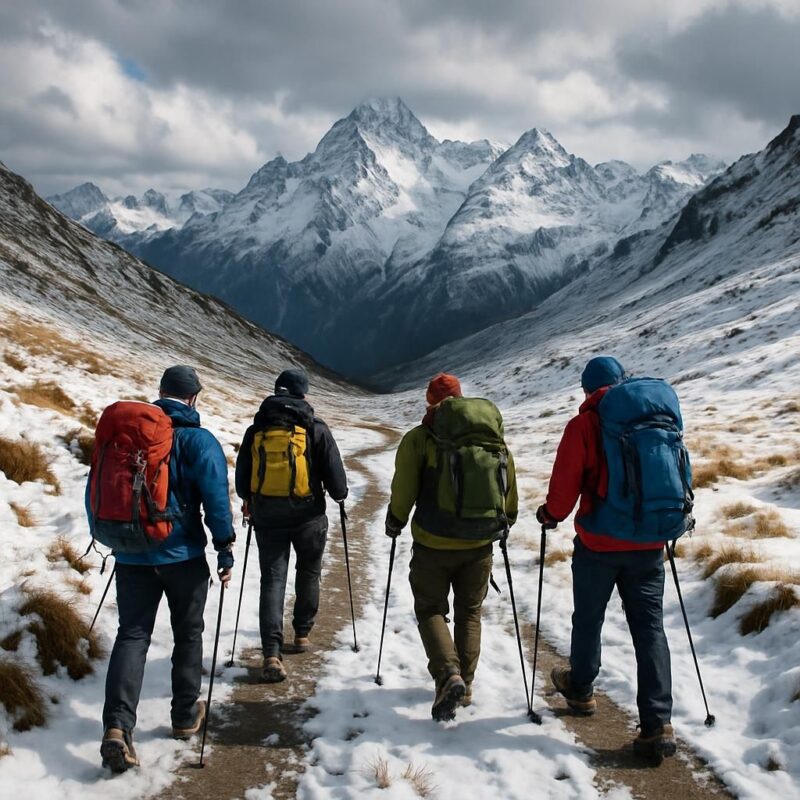
A thin snow film does not just transform the scenery. It changes the texture of the ground, hides obstacles, and reduces the information usually helpful for progressing. Protruding stones, roots, water-etched grooves, and ground irregularities disappear under a uniform surface.
On an easy summer path, this transformation may be enough to strongly slow progress. A hiking track becomes less readable, painted marks on rocks hide, and cairns merge with whitened blocks. When fog adds to precipitation, visibility can drop to a few dozen meters, particularly near the ridges of Mont-Blanc or Aravis.
Slipperiness, freezing, and hard snow plates
The danger does not come only from the amount of snow. A few centimeters layer can be harder to cross than a thick and even coat if it covers a rocky or grassy ground. Wet snow adheres poorly to soles, while cold snow compacts underfoot and quickly forms a hard surface.
During the day, solar radiation and slightly positive temperatures can melt the superficial part. At night, cooling transforms this moisture into ice. In the morning, shaded areas, slope crossings, and torrent sides may present a hard-to-spot ice patch.
Poles provide additional support, but they do not replace suitable soles. On steep sections, a fall of several meters can have serious consequences, even without a precipice. Light crampons can be useful on less technical routes when the snow is frozen, but they must be mastered and used with compatible boots.
Erased landmarks and more delicate orientation
Snow reduces the visibility of markers on several levels. It covers passage traces, softens contrasts between the trail and neighboring terrain, and can push walkers to follow an old footprint that no longer corresponds to the official itinerary. A visible trace is not necessarily a safe trace: it may have been left by an animal, a skier, or a hiker who veered off the path themselves.
Camille knows a route leading to a refuge from a well-marked pass. In summer, she follows a line of cairns without consulting her map. After a snowfall, several piles of stones look alike and the slope seems continuous. In a few minutes, she can drift towards a neighboring valley, lose time, and find herself exposed to the wind before even realizing her mistake.
The paper map remains useful if the phone fails or if the cold quickly drains the battery. A navigation app can help, provided the data has been downloaded offline and the position can be read. Orientation in snowy terrain requires regularly checking progress, rather than waiting to be completely disoriented.
Risks for hikers: falls, fatigue, and exposure to cold
The main risk associated with the first snows is falling. It can happen on a trivial passage, when the sole grips poorly on a wet stone or a thin ice patch. The backpack sometimes unbalances the body, while gloves reduce movement precision and make recovery from a misstep more difficult.
A fall without serious injury can still cause a sprain, knee pain, or bruising. In an isolated area of the department, returning to the starting point then becomes slower and more exhausting.
Underestimated physical fatigue
Walking in snow requires more energy than progressing on a dry trail. Each step can sink, slip, or require stabilization effort. Cold also increases energy consumption: the body uses more resources to maintain temperature, while the sensation of thirst decreases.
A 12-kilometer itinerary, doable in four hours during summer, can take an extra hour as soon as conditions become wintry. The time indicated on a trail guide is a summer estimate, not a valid guarantee under snow.
Hypothermia and wet clothing
Hypothermia does not concern only high mountain expeditions. It can appear after prolonged immobilization, a fall in a torrent, or a hike ending after dark. Cold rain, wind, and sweat form a particularly unfavorable combination.
Cotton clothes retain moisture and dry slowly. Breathable underwear, an insulating layer, and a protective jacket better manage temperature variations. It is also necessary to plan dry gloves, a hat, and a spare pair of socks in a waterproof bag.
Preparing a hike in Haute-Savoie in September with suitable equipment
Preparation starts several days before departure by consulting local weather forecasts. Temperatures should be checked at departure, maximum altitude, and return time, but also wind, rain-snow limit, visibility, and thunderstorm risk. Weather France bulletins, tourism offices in the department, refuges, and rescue services can provide more precise information than a general forecast.
Snowfall announced at 2,000 meters does not concern only summits. Wind can push snow onto a lower pass, while a north-facing trail remains frozen despite a positive temperature in the valley. Access restrictions must also be taken seriously: the temporary closure of a pass before a snow episode shows authorities consider traffic, visibility, and overall sector safety.
The essential list before departure
- High-cut shoes with grippy soles, suitable for hiking on wet and possibly snowy terrain.
- Clothing in layers: first breathable layer, warm layer, and windproof or waterproof jacket.
- Warm accessories: gloves, hat, neck gaiter, and spare socks kept in a waterproof bag.
- Hiking poles to improve balance on muddy, slippery, or uneven passages.
- Light crampons only if conditions warrant and if their use has been learned beforehand.
- Map, charged phone, and external battery, with the itinerary available offline.
- Headlamp, survival blanket, first aid kit, and whistle to face delay or incident.
- Water and energy food, as cold and progressing in snow increase needs.
Choosing a realistic route in the department
In September, a mid-altitude route with little exposure, around lakes, in the Bornes, or in the low Arve valley, can be preferable to a long ridge crossing on the Mont-Blanc massif. Routes with several escape options offer appreciable decision margins: return via a track, descent to a village, or possibility to reach an open refuge.
The group’s level must be honestly assessed. An experienced person on dry terrain is not automatically comfortable on hard snow, and a beginner can progress well if choosing a short, well-marked loop adapted to their abilities.
| Observed situation | Recommended adaptation | Prudent decision |
|---|---|---|
| Light snow on easy trail and good visibility | Slow down, use poles, and check markers | Continue while keeping a time margin |
| Frozen ground on slope or narrow crossing | Assess grip and use appropriate equipment | Give up if equipment or experience is lacking |
| Fog, strong wind, and masked landmarks | Consult the map and stay grouped | Return to the last known point |
| Wet clothes, fatigue or pain | Protect from wind, drink, and warm up | Descend without waiting for worsening |
Do not go alone and share your route
Informing someone remaining at home is a simple and effective precaution. The message must specify the starting point, itinerary, targeted summit or refuge, planned return time, and the number to call in case of extended absence.
Going in a group also allows better management of an incident. However, the group must advance at the pace of the slowest member and avoid splitting up in fog.
Adopt the right reflexes in the face of the first snowfalls
Caution does not start when the trail becomes white. It is built before departure, then continues with regular observations. The sky, temperature, wind speed, and ground condition provide concrete indications on the evolution of the outing.
If the snow falls lower than expected, if fog sets in, or if the layer becomes continuous on a steep slope, the plan must be reassessed. A summit does not have an obligation to be reached. The Haute-Savoie mountain will still be there on a more stable day.
Knowing when to turn back
Several signals should prompt stopping progress: missing signage, icy snow on an exposed passage, loss of visibility, significant temperature drop, participant fatigue, or delay on the planned schedule. Taken separately, these elements may seem moderate. Together, they strongly reduce the safety margin.
To avoid late discussions, the group can set simple rules in advance: a time limit to reach a point, a minimal acceptable temperature, necessary visibility, and a person responsible for making the final decision.
Train in snow techniques
Supervised initiation can teach walking on hard snow, using poles, adjusting light crampons, and recognizing slopes requiring higher skills. This training is not reserved for mountaineers: it can be useful to any hiker regularly frequencing Haute-Savoie massifs in autumn and spring. The department’s guide offices regularly offer this type of initiation.
However, it is necessary to distinguish hiking on snowy trails from glacier progression or mountaineering, especially present on the Mont-Blanc massif. A steep slope, exposed crossing, or glacier area requires specific knowledge and equipment.
Respect the mountain and local instructions
Closures of passes, trails, or refuges are not administrative obstacles unrelated to hiking. They may respond to risks of snow or tree falls, stones, ice patches, or to inaccessible rescue services. Bypassing a barrier exposes the hiker and may complicate rescue teams’ interventions in the department.
Snow does not make Haute-Savoie mountain forbidden. It invites to slow down, observe, and accept that the initial plan may evolve. The best skill for a hiker in early autumn is to adjust ambition to real conditions, with enough anticipation so that caution remains a calm decision rather than an emergency reaction.
Frequently Asked Questions
Can it really snow in the mountains from September in Haute-Savoie? Yes. In certain weather situations, notably during the arrival of a cold drop, the rain-snow limit can drop towards 1,700 or 1,800 meters, sometimes lower, on the department’s massifs. These episodes are early but not unprecedented in the Northern Alps.
Should one always cancel a hike after the first snowfalls? No. An outing can remain feasible on a short, little exposed itinerary adapted to the group’s level. However, local bulletins must be consulted, the trail’s condition checked, warm equipment planned, and accepting turning back if visibility or grip deteriorate.
Are light crampons indispensable? They are not necessary on all snowy trails. They can become useful on frozen snow or slippery slopes, provided they are used properly and compatible boots are worn. They do not replace the experience required on steep or exposed routes, notably on the Mont-Blanc massif.
What to do if the path disappears under snow? One must stop in a safe place, consult the map or GPS position, check the last identified landmarks, and stay grouped. If the route cannot be quickly confirmed, the safest choice is to return to the last known point rather than follow an unknown track.
Why inform someone before going to the mountains in Haute-Savoie? Sharing the route, planned return time, and any variants allows a faster alert in case of delay or accident. This precaution is particularly important in autumn, when days shorten and conditions can degrade rapidly.