
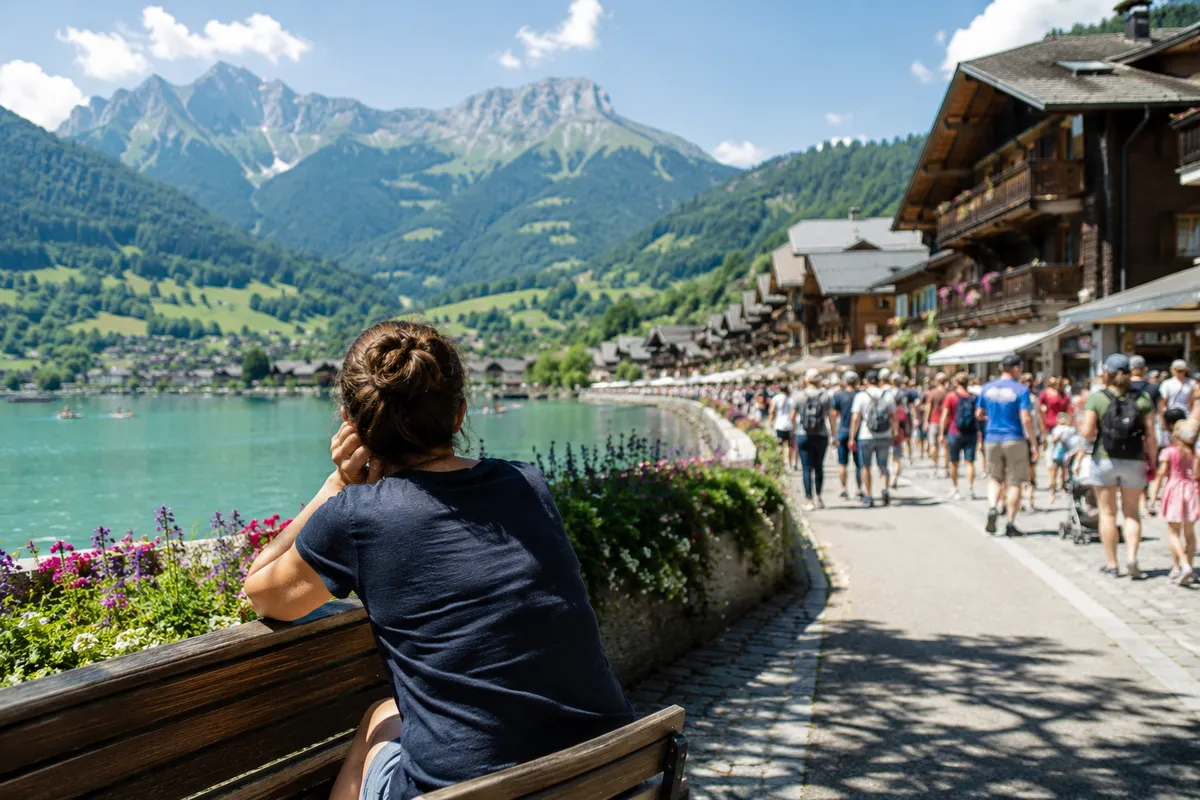
In Annecy, in the Chamonix valley or around the lake, summer increasingly rhymes with resignation for the inhabitants of Haute-Savoie. Congested roads, shopping that has become an obstacle course, appointments canceled to avoid rush hours: many residents now organize their daily lives around the peaks of tourist attendance, summer and winter alike, and wait for the low season to regain some tranquility.
A department under pressure, twice a year
Haute-Savoie combines multiple factors of tourist pressure: a lake among the most popular in France, the Mont-Blanc massif, large ski resorts, and a border position that attracts a constant flow of visitors. The department has more than 870,000 inhabitants, continuously growing since 2010, but its population swells even more during seasonal peaks, when mountain villages multiply their population several times over for a few weeks.
This pressure is not limited to summer. In winter, it is the large valleys leading to the resorts that suffocate: the road to the most popular massifs becomes saturated every Saturday of school holidays, to the point that inhabitants have launched a petition to request the closure of secondary roads during traffic peaks, denouncing villages “not designed to support a massive influx of vehicles.” For many residents of Haute-Savoie, simply going grocery shopping or dropping children off at school becomes, on some days, an exercise in patience.
In Annecy, the feeling of a deteriorated living environment
Around Lake Annecy, weariness is expressed more and more directly. The city center and the shores, stormed every summer, give some residents the impression of living in a setting thought more for visitors than for themselves: a comparison to an amusement park regularly comes up in the testimonies gathered on site. This exasperation has not been without consequences on the city’s image itself: Annecy, long cited at the top of rankings of cities where it is good to live, has recently fallen from first to seventh place in a national ranking, a signal deemed revealing of a living environment perceived as deteriorated by its own inhabitants.
To read: “We feel like we’re at Disney”: in Annecy, tourists annoyed by… other tourists!
Faced with this pressure, Greater Annecy has begun to act without choosing between strict regulation and simple flow management. Since June 2026, the number of short-term rental authorizations has been capped at 2,660, with permits valid for four years, non-transferable, and limited to one authorization per person. The tourist office is also relying on diversifying the offer: business tourism, longer stays, off-season events, to try to spread attendance over the year rather than concentrate it over the two summer months.
In the massifs, nature also under pressure
The discomfort is not limited to urban centers. On the most popular hiking trails of the department, the scene has become familiar from the earliest hours of the day: lines of vehicles clustering at departure points of key routes, parking lots saturated before dawn, bivouacs proliferating. This record attendance keeps hosts, refuges, guides, and local businesses alive, but it increasingly raises environmental concerns: accelerated soil erosion, disturbance of wildlife at altitude, accumulation of waste.
Faced with this situation, several Haute-Savoie local authorities have chosen regulation rather than the status quo: mandatory shuttles to access certain sites, traffic restrictions, quotas on bivouac areas, and upcoming regulation on the Tour du Mont-Blanc, one of the most frequented routes in the Alps.
Winter, another face of the same pressure
While summer concentrates attention, the Haute-Savoie winter is not spared. Lack of snow below 1,300 meters during some seasons pushes skiers to focus on the higher-altitude resorts with the best snow cover, increasing density in the most popular areas. Some resorts themselves acknowledge having had to limit access to their roads temporarily to manage vehicle influx during rush hours. For inhabitants of access valleys, these school holiday Saturdays have long been recognized as days to avoid on the roads, to the point that postponing non-essential trips to Sunday or midweek has become a reflex for many.
Personally, for example, I no longer ski at all in resorts during school holidays. I ski on pistes only outside of holidays, and during those times I practice ski touring.
Living to the rhythm of tourist seasons
Across testimonies gathered in the department, the same pattern emerges: residents learn to schedule their outings, appointments, and even daily routes around peaks in attendance, even if it means purely and simply giving up certain outings during the busiest weeks. It is only upon return of the low season, when roads clear and the lake shores or mountain village streets regain a calmer pace, that many say they fully relive their territory.
The debate currently crossing Haute-Savoie is less about suppressing tourism, a sector that supports a significant part of the local economy, up to one in three workers in some urban areas, than about its balancing with the quality of life of those who live there year-round. Between rental capping, flow regulation in the mountains, and attempts at season spreading, the department’s authorities are seeking, season after season, the formula that will allow inhabitants no longer to have to choose between their living environment and the attractiveness of their territory.
Cover photo: AI illustration