
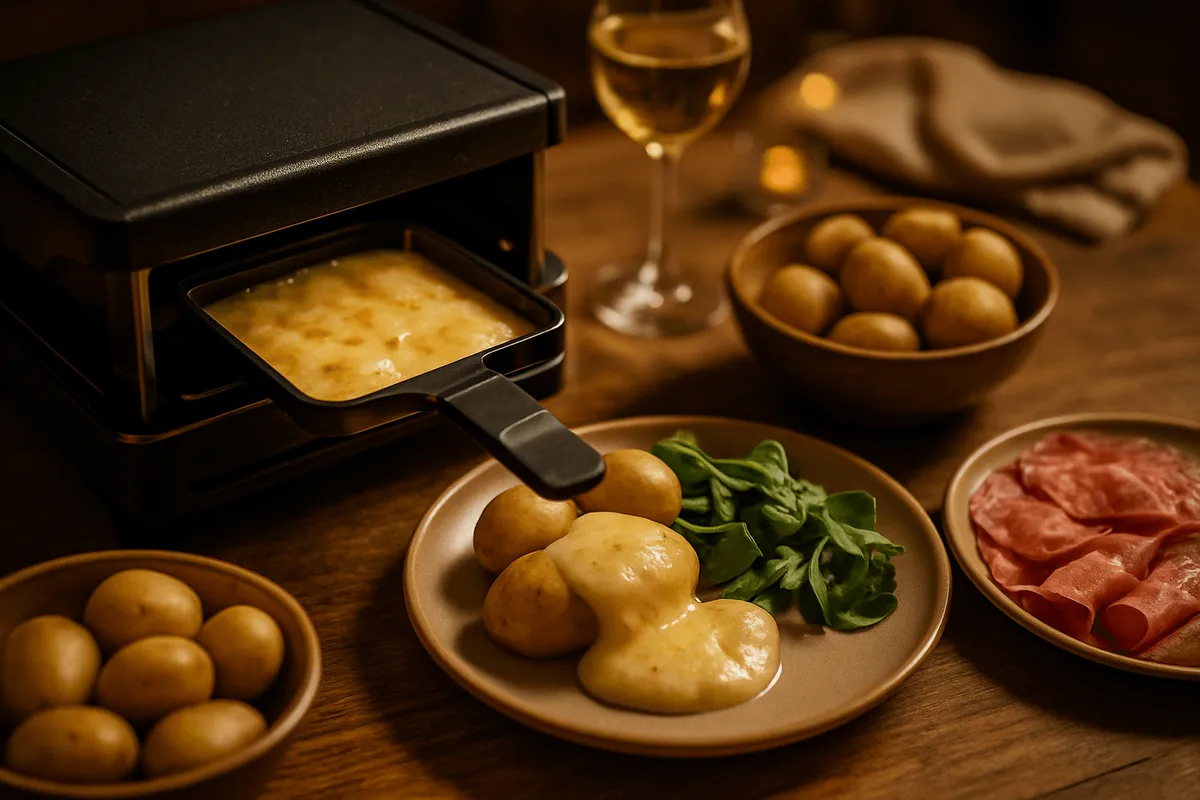
Organizing a perfect raclette evening requires careful preparation, especially when it comes to the quantities to plan for. How can you avoid running out of cheese or ending up with too many potatoes? Here is our complete guide to measuring precisely and ensuring the success of your convivial meal.
Key points to remember
- Raclette, the quintessential convivial dish, requires a precise balance of ingredients
- Count about 200 g of cheese and 300 g of potatoes per adult
- Discover our practical tips to adjust portions according to your guests and avoid waste
Winter is well established, and with it comes the irresistible urge to share a good raclette evening with friends or family. But the question inevitably returns: what quantity should be planned to satisfy all guests without being overwhelmed by leftovers? You dream of perfectly melting cheese, tender potatoes, and smooth service throughout the evening.
Also read: Savoyard Fondue Recipe
Rest assured, a few simple benchmarks will help you aim just right, whether your table hosts insatiable gourmands or children with smaller appetites.

Recommended quantities per person: the practical guide
Here are the ideal proportions to correctly calibrate your purchases:
- Raclette cheese: 200 g per adult, 250 g for big eaters, 150 g for small appetites or children.
- Potatoes: 3 medium pieces per adult (about 300 g), 2 to 3 small ones for a child.
You are free to opt for a 100% traditional raclette cheese evening or enrich the experience with other cheese varieties. The important thing remains to adapt quantities to your guests’ appetites and the time of the meal, without complicating things when it’s time to sit down at the table.
Quantity table according to the number of guests
This practical table applies our standard recommendations for adults: 200 g of cheese and 3 medium potatoes per person. Use the “big appetites” column if your table is particularly hungry.
| Number of guests | Cheese (standard) | Cheese (big appetites) | Potatoes (medium) ≈ weight |
|---|---|---|---|
| 2 | 400 g | 500 g | 6 pieces ≈ 600 g |
| 4 | 800 g | 1.0 kg | 12 pieces ≈ 1.2 kg |
| 6 | 1.2 kg | 1.5 kg | 18 pieces ≈ 1.8 kg |
| 8 | 1.6 kg | 2.0 kg | 24 pieces ≈ 2.4 kg |
| 10 | 2.0 kg | 2.5 kg | 30 pieces ≈ 3.0 kg |
| 12 | 2.4 kg | 3.0 kg | 36 pieces ≈ 3.6 kg |
To adapt these quantities for children, reduce by about 50 g of cheese and one medium potato compared to the adult portion, or plan for 2 to 3 small potatoes.
Anti-waste tip: do not present all the cheese at the beginning of the meal. Keep some in the refrigerator and adjust as the evening progresses according to your guests’ appetites.

Choosing potatoes: varieties and cooking technique
Favor firm-fleshed potatoes like Annabelle or Roseval. These varieties keep their shape after cooking, which is more elegant on the plate and more practical for serving. Do not peel them before cooking: just brush them carefully. They will hold better and retain more nutrients. Each person can peel theirs on their plate if they wish.
To keep them at the ideal temperature throughout the meal, here is a simple but effective tip: place them in a bowl with a splash of water, placed directly on the raclette grill. The gentle heat maintains the perfect temperature all evening long, without drying out the potatoes. This method proves especially valuable when the service stretches over several rounds.
With these tips, your raclette evening will be a guaranteed success, stress-free and with perfectly adapted portions for each guest!
Article mis à jour le 28 July 2026