
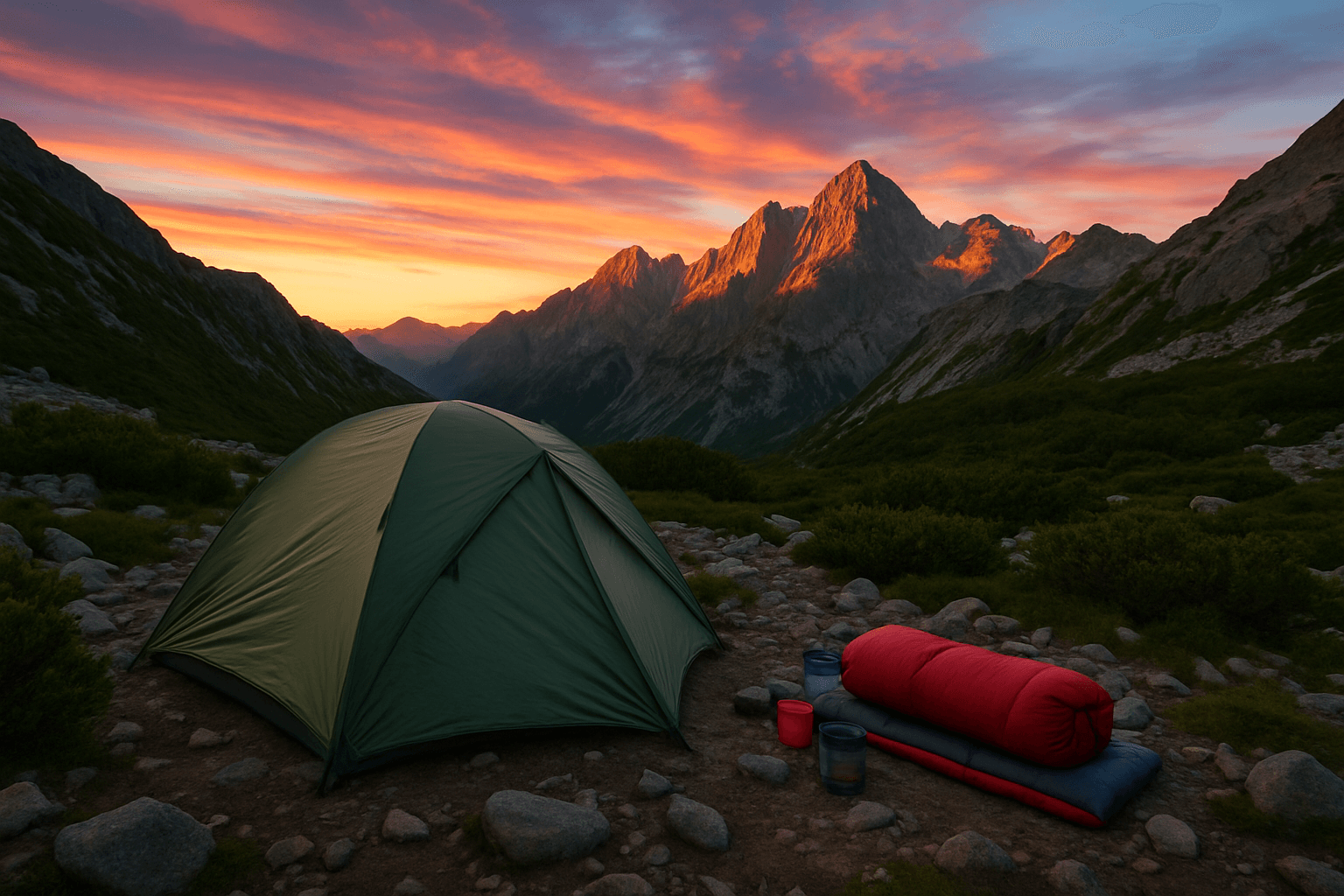
Imagine yourself perched atop a ridge, your gaze lost in the endless blue of the sky, the setting sun lighting up the snowy peaks with a golden glow. The silence is broken only by the whisper of the wind and the subtle song of a blackbird. Mountain bivouacking is a sensory adventure, an enchanted pause far from the hustle and bustle of everyday life. But for this experience to remain magical, you must know and respect a few golden rules, essential for safety, respect for nature, and the success of your night under the stars.
Why bivouac in the mountains?
Spending a night in the mountains is about reconnecting with simplicity, savoring freedom, and letting yourself be carried by the authenticity of nature. But the mountain is a demanding and fragile environment. Each bivouac is a promise of adventure, but also a responsibility towards the environment and other hikers.
I still remember my first night at the foot of the Mole summit: the cool breeze, the Milky Way as a backdrop… An unforgettable experience made possible by respecting some fundamental principles.
1. Understanding mountain bivouac regulations
In France, bivouac regulations vary according to territories, national parks, and nature reserves. It is essential to get information before you set off.
- Bivouac = light and temporary installation, usually between 7 p.m. and 9 a.m.
- Wild camping = prolonged installation, often prohibited in the mountains.
- Bivouac is permitted in many national parks, but only in specific zones and during defined hours.
- In nature reserves or on classified sites, bivouac is often forbidden to protect biodiversity.
Note that since 2023, you must reserve your bivouac night during the summer period, from June to September, in nature reserves:
- the Massif des Aiguilles Rouges (June 1 to September 30)
- the Contamines-Montjoie (June 15 to September 15)
- Sixt-Fer-à-Cheval/Passy
Before each departure, check the local Tourist Office website or the information panels on site. In 2026, regulations are regularly evolving to better preserve our mountains!
2. Choosing the right spot: discretion and respect
Choosing the location is crucial, both for your safety and for site preservation. Nothing beats the pleasure of falling asleep on a soft grass carpet, away from beaten paths, but always respecting nature.
- Keep at least 200 meters away from watercourses, shelters, and main trails.
- Favor flat ground, sheltered from the wind, and away from risk areas (rockfalls, avalanches, sudden floods).
- Avoid cultivated fields and grazing areas to not disturb wildlife or inconvenience farmers.
- Set up discreetly: a tent in subdued colors blends better into the landscape.
During a bivouac in Haute-Savoie, I discovered a secret valley, sheltered from the wind by a larch hedge. In the morning, the sun warmed my tent fabric while the dew slowly evaporated… A memory engraved forever!
3. Preparing your gear: lightness and efficiency
- Prefer a compact tent, wind and rain resistant.
- A sleeping bag suited to the season: even in summer, nights can be freezing at altitude!
- An insulating mattress to protect from the cold ground.
- A lightweight stove, minimalist cookware, and a water filter bottle.
- Warm and waterproof clothes, a headlamp, and a first aid kit.
- Don’t forget a bag to carry all your waste: the mountain must remain spotless.
Tip from experience: slip your gas cartridge into your sleeping bag at night to prevent it from freezing in the early morning!
4. Respect nature and others
- Leave no trace of your passage: pick up all your waste, even fruit peels.
- Avoid making fires, unless it is explicitly allowed and safe (prefer using a stove).
- Respect the peace of wildlife and flora: observe without disturbing.
- If you meet other hikers, share a smile and some advice, but keep the place discreet.
To read: The guide to good practices in hiking
One morning in the Pyrenees, I was lucky enough to see a chamois just a few meters from my tent. A magical moment, only possible because I had taken care not to leave anything behind and to remain discreet.
5. Anticipate weather and safety
- Check the weather before departure and adjust your itinerary accordingly.
- Always inform a close contact of your route and bivouac location.
- In case of doubt (storm, fog, strong winds), give up or seek shelter.
- Always keep water in reserve and know where potable water points are located.
The mountain is beautiful, but it can be deadly. One August evening, an unexpected storm forced me to pack up urgently. Since then, I never leave without checking weather forecasts and planning a plan B!
Dare adventure, respect the mountain
Mountain bivouac is as much an inner journey as an outer one. Every night spent under the starry vault is a privilege, an invitation to humility and wonder. But this freedom implies duties: respect the rules, preserve nature, anticipate dangers.
So, ready to live an unforgettable night in the heart of our Haute-Savoie mountains? Prepare your bag, get informed about local regulations, and set off to conquer the heights. The mountain awaits you… but it deserves your full attention and respect.
To read: Discover the 10 most beautiful hikes in Haute-Savoie for 2026
Your turn: embark on the adventure of mountain bivouac, and share the beauty of these precious moments, in complete safety and with passion!