
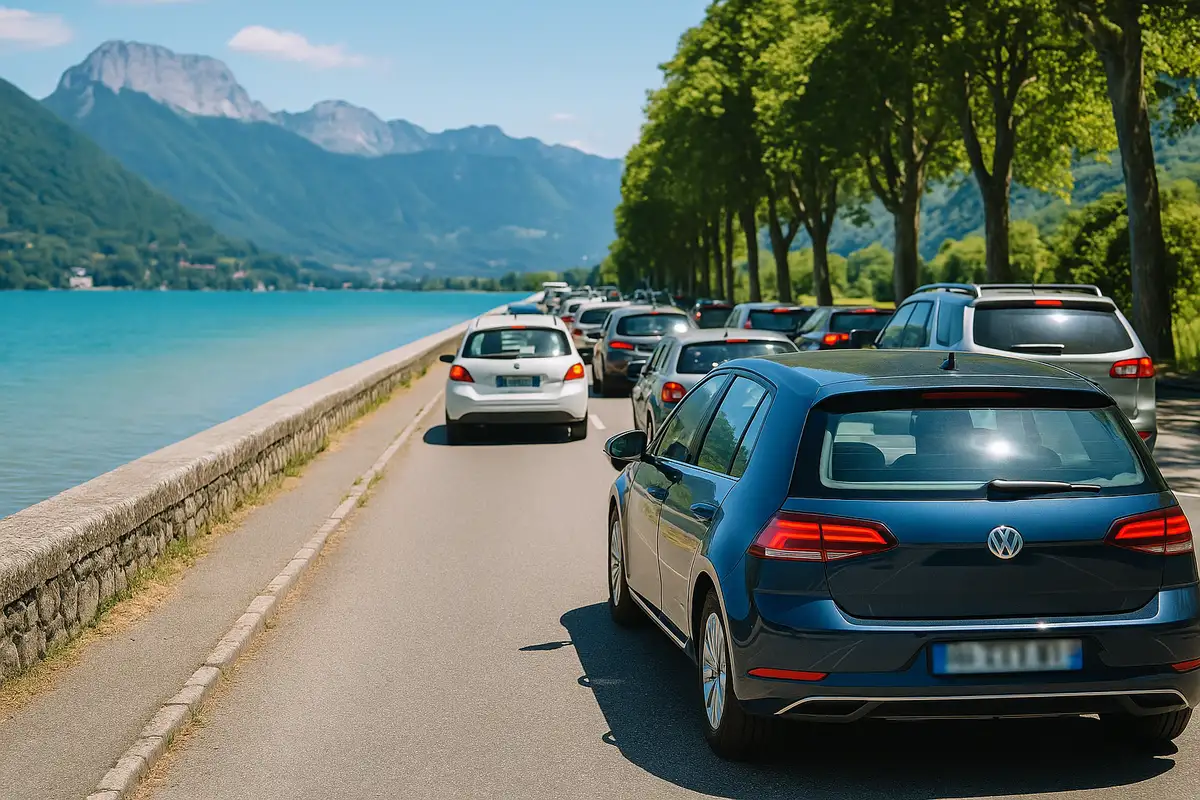
Congested roads, summer and winter alike
Haute-Savoie is undoubtedly a land of contrasts: the visual escape offered by its mountains sharply contrasts with the nervous tension of a daily life often marked by traffic jams. Especially around Annecy, Cluses, Annemasse, or the Mont-Blanc tunnel, the routes are regularly saturated. Even to go shopping or drop off the children at school, one sometimes has to arm oneself with patience.
As a resident for several years, I have lost count of missed appointments or early departures to avoid rush hours, especially during tourist seasons.
Housing that has become inaccessible
Another sensitive subject: finding housing in Haute-Savoie today amounts to an obstacle course. The economic attractiveness (notably due to neighboring Switzerland) and the postcard image attract more and more residents, both permanent and secondary. The result? Rents soaring, interminable waiting lines to access social housing, and silent precarity.
A couple of friends, though tenured teachers, took more than two years to find a decent apartment at a reasonable price in Thonon-les-Bains. This says a lot about the gap between the beauty of the region and the realities experienced by those who live there year-round.
A sealed Arve valley
The Arve valley, despite being surrounded by snow-capped peaks, is sadly notorious for its poor air quality. In winter, during thermal inversion periods, pollution stagnates in the basin formed by the mountains. In Sallanches or Cluses, a simple walk can sometimes sting the eyes and throat.
Personally, I was struck during a stay in January: despite the blue sky above the heights, a gray layer covered the entire valley. Hard to believe, but here, even breathing can be problematic.
A difficult-to-sustain tourist pressure
The success of Haute-Savoie has an obvious downside: tourist overuse. Certain villages like Yvoire, Talloires, or Chamonix see their populations multiply by ten in high season. Hiking trails are sometimes crowded, parking lots saturated from 9 a.m., and mountain huts fully booked months in advance. I have several times abandoned the idea of taking a family walk around the Lake Annecy for fear of not finding a single parking spot. This mass tourism, unregulated, gradually gnaws away at the sought-after tranquility. The bike path around the lake, often presented as a haven of peace, becomes a real two-wheeler traffic jam in the middle of summer, as described in this testimony on the lake cycling tour.
A region under demographic and border tension
The proximity of Geneva, a true economic magnet, attracts thousands of cross-border workers every day. This reality certainly boosts the local economy but also drives up real estate prices, creates fierce competition for housing, and increases pressure on public services.
In my municipality, the daycare shows a waiting list as long as a Savoyard winter, and general practitioners have not taken new patients for a long time.
Harsh winter and delicate logistics
Winter in Haute-Savoie, although magical for vacationers, can become a real logistical headache for residents. Icy roads, chains to put on to leave the house, heating breakdowns, or schools closed due to heavy snow. Even if you get used to it over time, each year brings its share of troubles. I remember a freezing morning when my car wouldn’t start – a trivial detail for some, but quickly becoming daily stress.
A climate in full mutation
Climate warming weakens mountain infrastructures a little more every year. Low-altitude resorts struggle to guarantee snow cover, while melting permafrost destabilizes some slopes.
Iconic places like the Aiguille du Midi now require urgent work to avoid any risk of collapse. Talking with local guides, one quickly understands that the mountain is changing its face, faster than we think.
Haute-Savoie: a postcard with a double edge
Haute-Savoie continues to inspire dreams, and rightly so. But behind the idyllic image lie very real challenges that inhabitants face daily.
As a resident for over 20 years in this department, I have learned to cope with these realities – sometimes with philosophy, sometimes with frustration. It is time to lift the veil on these shadows, to envisage a more balanced future between attractiveness, habitability, and respect for the environment.