Mythical hike above Chamonix, Lac Blanc could soon be booked like a table at a restaurant. The town hall is working on a mandatory reservation system starting next summer, a first in the Mont-Blanc valley.
A site out of breath
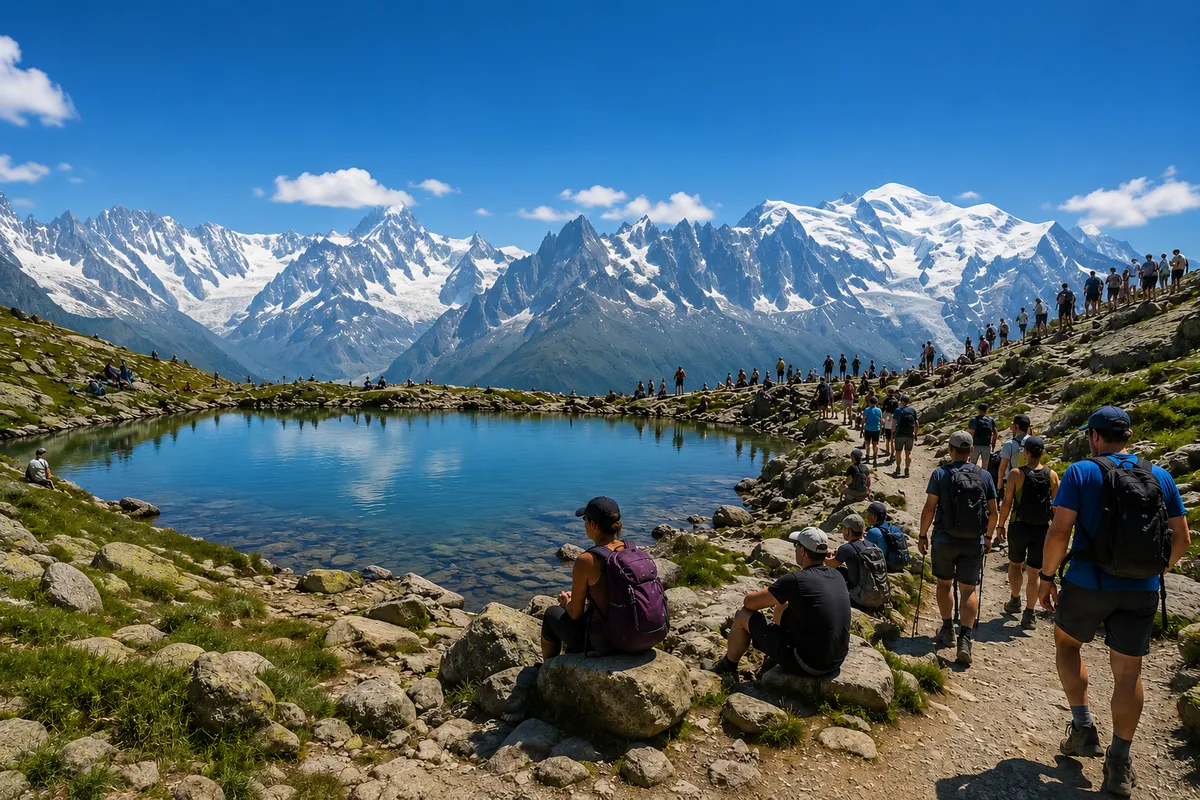
Perched at 2,350 meters in the Aiguilles Rouges nature reserve, Lac Blanc offers one of the most photographed panoramas of the French Alps, with the north face of Mont-Blanc as a backdrop. A success that comes at a high price: between June 1 and September 30, the site can accommodate up to 4,000 visitors per day depending on the weather, a level of attendance that the municipality now considers unsustainable both for the trails and the natural environment.
Elected mayor of Chamonix last March, François-Xavier Laffin has made this issue one of the priorities of his term. Faced with a valley that attracts between 2.5 and 4.5 million visitors each year, the mayor has chosen Lac Blanc as a pilot site to test a new tool for regulating tourist flows in the mountains.
The Calanques model as a source of inspiration
To build its system, the municipality has turned to an example that has proven effective further south: the Sugiton calanque, near Marseille. Since 2022, access to this highly sought-after site in the Calanques National Park has required reservation in summer, with peaks that could reach 2,500 visitors per day before the measure was implemented.
The mayor of Chamonix met with the managers of the Marseille system and even adopted their slogan: “Booking is preserving.” The idea would be to combine prior online booking, a daily visitor gauge, and on-site controls, only during the summer period, from June 1 to September 30.
No numbers yet, nor special rights for residents
The system remains at the level of intentions at this stage: no precise quota has been set, and the town hall does not foresee priority access for valley residents either. They would therefore have to book their slot like any other visitor during the high season. Outside of this period, access to Lac Blanc would remain free, as it is today.
This reflection adds to already existing rules in the area, such as the prefectoral decree banning swimming in Lac Blanc and the Chéserys Lakes, and the quota of 30 tents applied to bivouacking at Chéserys, now subject to reservation.
A consultation before any decision
Before any implementation, the municipality wants to bring together the local stakeholders around the table: Asters-CEN Haute-Savoie (which manages the nature reserve), the Mont-Blanc Company, neighboring municipalities, consortia, and tourism professionals. The stated objective: to find a system that protects the site without penalizing the visitors’ experience.
The town hall has also identified a risk: seeing hikers refused at Lac Blanc turn to other trails in the valley, with a spillover effect. A phenomenon that the managers of the Calanques say they have not observed at Sugiton, but which Chamonix will watch closely.
And after Lac Blanc?
If the experiment works, the municipality does not rule out extending regulation to other emblematic sites in the valley. For now, the message is clear: make Lac Blanc a laboratory before considering going further. Enough to change, starting summer 2027, the habits of thousands of hikers who until now came up without booking.
What the editorial team thinks
We are not particularly in favor of a strict quota system like in the Calanques but rather a “mixed” solution: free access for hiking, but quotas for access via ski lifts. But how to put this into practice? That seems very complicated to us.
So for you, good or bad solution? And what other solution(s) would you propose?
Even if the subject is controversial, please remain polite and constructive in your comments. Any comments deemed abnormal will be deleted.