
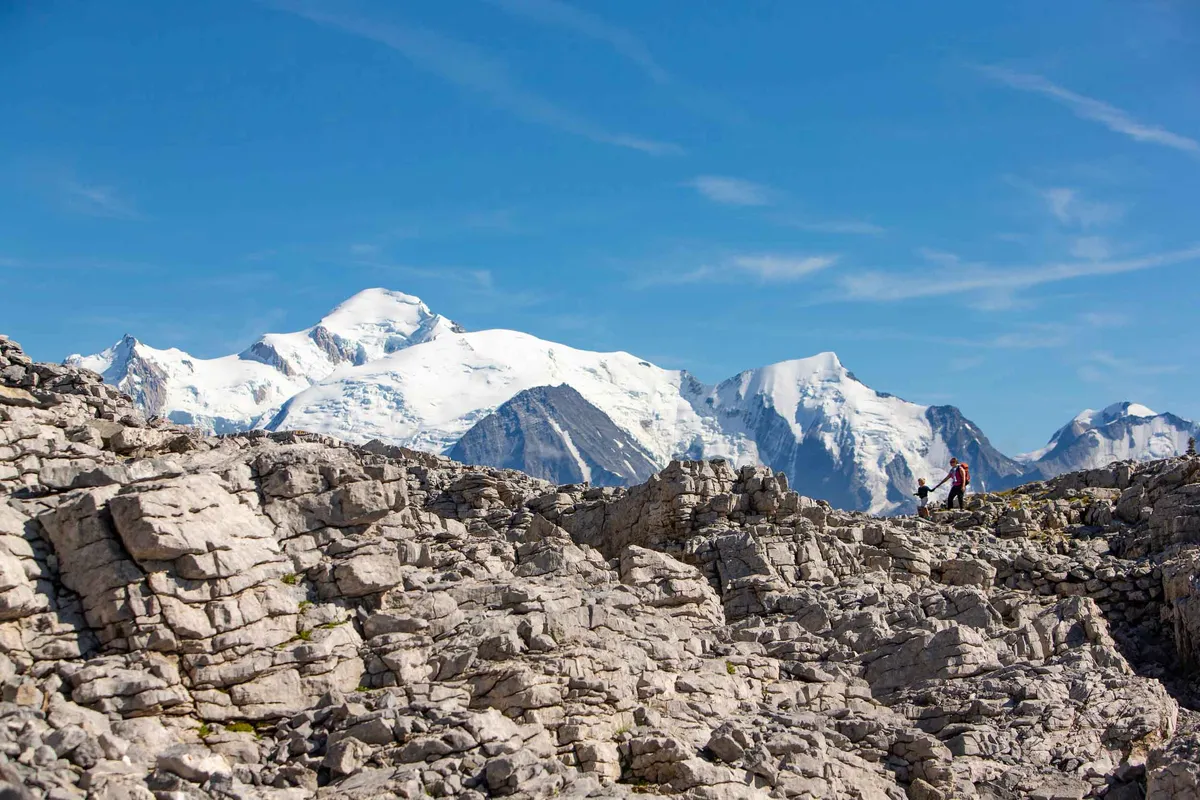
At first glance, one might think of a lunar landscape or a scenery from Iceland. However, this vast limestone plateau is indeed located in Haute-Savoie, facing Mont Blanc. The Désert de Platé, classified as a natural reserve, is considered the largest lapiaz in Europe. A hike on this extraordinary site feels like walking on another planet.
A landscape one would not expect to find in the Alps
Above Passy and Sixt-Fer-à-Cheval, between 2,000 and 2,500 meters of altitude, the Désert de Platé immediately surprises with its appearance. Here, almost no vegetation remains. As far as the eye can see, thousands of grooves, crevices, and limestone slabs sculpted by water form a vast mineral labyrinth.
This relief, called a lapiaz, is the result of several million years of erosion. Rain, snow, and frost have slowly carved the rock, giving birth to a spectacular landscape, unique in France and recognized as one of the largest karstic formations in Europe.
The contrast is striking: while the ground seems desert-like, the snow-capped peaks of the Mont Blanc massif dominate the horizon.
A feeling of walking on the Moon
What strikes visitors the most is the almost surreal atmosphere of the place.
The geometric shapes of the rock, the deep fissures, and the immense white expanses sometimes give the impression of moving on another planet. Depending on the time of day, the light further accentuates the reliefs and transforms the plateau into a changing scenery.
In clear weather, the panorama is exceptional. The view extends over Mont Blanc, the Fiz, the Aravis, the Aiguilles Rouges, the Chablais massif, and even further over a large part of the French Alps.
A natural reserve of unsuspected richness
Despite its austere appearance, the Désert de Platé shelters remarkable biodiversity.
Between the rock cracks, alpine plants perfectly adapted to extreme conditions grow. Marmots, ibex, chamois, and birds of prey also frequent this vast protected area.
Since 1978, the site has been classified as Réserve naturelle nationale de Sixt-Passy, one of the largest in Haute-Savoie. This protection helps preserve exceptional geological heritage as well as species particularly sensitive to human presence.
A hike that deserves preparation
Several routes allow access to the Désert de Platé. The most popular starts from the Plaine-Joux area, above Passy, before reaching the Platé refuge and then the mineral plateau.
Even if the trail does not present major technical difficulties for experienced hikers, it is a true mountain hike with significant elevation gain, rocky passages, and rapidly changing weather.
Good preparation remains essential: appropriate footwear, sufficient water supply, warm clothing, sun protection, and checking the weather forecast before departure.
An even more spectacular experience at sunrise or sunset
Photographers are well aware of the potential of the Désert de Platé. At dawn and late afternoon, the limestone reliefs take on golden hues while the shadows highlight the countless fissures of the lapiaz. Mont Blanc, often tinged with pink at sunset, then offers an exceptional backdrop.
For those wishing to extend the experience, an overnight stay at the Platé refuge allows full enjoyment of these lights and the observation of a starry sky of great purity, far from any light pollution.
My advice
Leave early in the morning, especially in summer. You will enjoy cooler temperatures, beautiful light on the plateau, and avoid storms that can develop quickly in the mountains during the afternoon.
Practical information
- Location: Réserve naturelle de Sixt-Passy, between Passy and Sixt-Fer-à-Cheval.
- Altitude: between 2,000 and 2,500 meters.
- Most frequent access: departure from Plaine-Joux (Passy). Access possible from Flaine and the Grandes Platières cable car in summer.
- Duration: plan a full day depending on the chosen route.
- Level: mountain hike with a significant elevation gain.
- Ideal period: from late June to early October, depending on snow cover.
- More information: Flaine website