
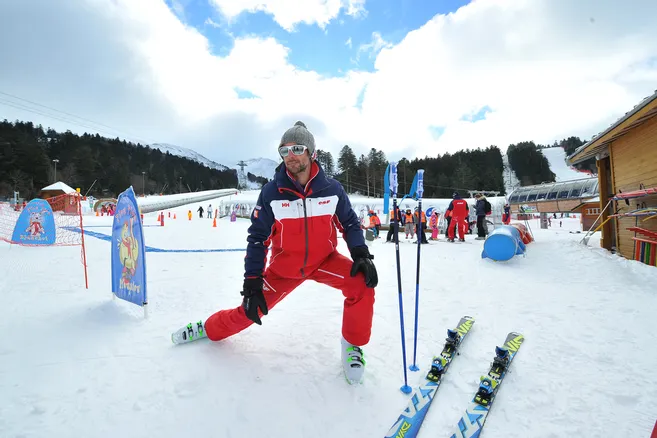
The ski season will start in a few weeks, you want to arrive in shape for your first descents, it is time to think about getting back in shape, if necessary, before sliding down the ski slopes.
Skiing works muscles in movements slightly different from most sports, so you need to prepare for it. As a reminder, a large number of skiing accidents occur on the third day of practice. The reason is simple: lack of preparation leads to excessive fatigue, and this accumulated fatigue on the third consecutive day of practice is enough to encourage these accidents.
In this article, we will offer you a simple and suitable physical preparation program for skiing or surfing.
Warm-up :
Before any preparation session, it is essential to warm up and stretch your muscles and to awaken your heart muscle. To do this, start moving gradually for 5 to 10 minutes. Run on the spot, alternate “heel-to-butt” and knee lift movements, also do arm movements (arm rolls, boxer movements, scissors with extended arms…).
The second part of your warm-up will be dedicated to stretching. Hold each movement for about fifteen seconds and avoid jerky movements.
Back of the thighs (hamstring muscle):
Standing, right leg straight, heel resting on a chair. Grab your foot with your hands while keeping your body aligned with your leg and your back straight. Hold the position for at least 15 seconds then switch to the other leg.
Front of the thighs (quadriceps muscle):
Still standing, bend one leg to bring the foot to the buttock and keep balance by resting one hand on a wall or a tree. Grab your foot with your hand and hold this stretch by keeping your leg aligned with your body for about fifteen seconds. Important, keep your back straight.
Back :
Lying on your back, grab your knees with your hands. Round your back then roll backward. Pass your legs over your head and try to place your feet on the ground while keeping your legs straight.
Preparation exercises for skiing:
There are several muscle groups to prepare for skiing or surfing.
Abdominals
All these exercises must be performed with the stomach pulled in to avoid arching the back.
- 1st exercise: rowing
Sitting on the floor, balanced on the buttocks, legs bent in front and held in the air. Bend and straighten the legs making a rocking movement with the body. Arms must be extended in front to help maintain balance.
Do 3 sets of 30 repetitions.
- 2nd exercise: touch the feet
Lying on your back, legs straight in the air, perpendicular to the body. Touch your feet with your hands by contracting the abdominals to sit up.
Do 3 sets of 20 repetitions.
Obliques and transverse muscles
- 3rd exercise: rowing
Repeat the 1st exercise but with hands crossed behind the neck. Bend and straighten the legs alternately and touch the right elbow to the left knee and vice versa each time the leg is brought in.
Do 2 sets of 40 repetitions (20 on each side).
- 4th exercise: rotations
Sitting on the floor, balanced on the buttocks, legs in the air, knees bent. Twist the body one way then the other, accompanying the movement with arms that alternately go from one side of the legs to the other.
Do 2 sets of 40 repetitions (20 on each side).
Quadriceps
- 5th exercise: squat
Place a broomstick on your shoulders, behind your neck, and hold it on each side with your hands. Standing, feet spaced shoulder-width apart, bend your knees and go down as low as possible while keeping your back and head straight. Stop before your buttocks touch your heels. Very important, the movement must be done smoothly, without jerks or bouncing. Come back up dynamically, always keeping your back straight.
Do 3 to 5 sets of 20 repetitions each.
- 6th exercise: single-leg bend
Still standing, with a broomstick behind your neck held with both hands, step forward into a lunge, one leg in front of your body, the other behind, but both aligned. Lower yourself on the front leg keeping your back straight and head up. Stop at 90° then rise while controlling the movement.
Do 3 sets of 10 to 15 repetitions on each leg.
- 7th exercise: the chair
Place yourself with your back against the wall, knees bent at 90°, as if sitting on an imaginary chair. Maintain this position while pulling in your stomach and contracting your abs.
Hold this position first for 30″, then 1′, and finally 1′ 30″.
Lower back muscles
- 8th exercise: static
Lying on your stomach, arms extended along the body holding a broomstick in your hands. Lift your arms and legs a few centimeters above the ground. Hold this balanced position for several seconds without arching your back too much.
Do 1 x 10″, 1 x 20″, 1 x 30″, 1 x 20″, 1 x 10″.
Hamstrings
- 9th exercise: the bridge
Lying on your back. Keep the back parallel to the floor and support yourself on your arms and legs. Lift one leg and place it above the body, knee bent at 90°. The other leg is still on the ground, knee bent with an angle between 130° and 170°. Maintain this position with the back parallel to the floor for 10″, rest, then switch legs. Do 5 x 10″ on each leg.
Cardiac muscles
- 10th exercise: jogging
Practice 3 slow jogging sessions per week. Run slowly without exceeding 70% of your maximum heart rate. To put it simply, you should be able to talk while running. If you can’t keep talking, you are running too fast, slow down. Feel free to alternate walking and running, especially during your first sessions. The most important is to run slowly, you must not be out of breath. Run (or alternate walking and running) for 30 minutes at the beginning and up to 45 to 60 minutes depending on your condition.
- 11th exercise: acceleration
Once a week during your jogging and after running slowly for 20 minutes, do 5 short accelerations on about 200m. The accelerations must remain reasonable, don’t go all out!
The exercises and number of repetitions given here should be adjusted according to your fitness level. Practice these exercises 2 to 3 times a week for 2 months.