
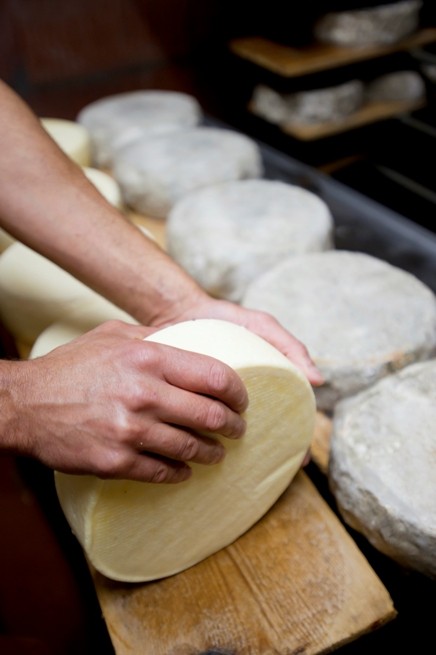
Haute Savoie is renowned, among other things, for its cheeses. In addition to the essentials such as reblochon, raclette cheese, Beaufort, Abondance, and tome, there is a wide variety of lesser-known yet equally excellent cheeses.
How is cheese made?
The manufacturing techniques vary somewhat depending on the type of cheese, but the basic principles are the same. The diversity of colors, consistency, flavors, and aromas of cheeses is related to the importance of each of the five major steps in their production.
Coagulation : Milk consists of water, sugars, and especially lactose, casein, and mineral salts. When it rests in a warm place, the milk naturally acidifies due to the presence of lactic ferments that feed on lactose; this results in the precipitation of casein: this is coagulation. The granular mass containing this solidified casein is called the curd, and the separated liquid is the whey. Artificially, milk can also coagulate by adding an enzyme extracted from the calf’s gastric juice, rennet. This enzyme chemically breaks down the casein and promotes the uniform formation of the curd throughout the mass. Generally, coagulation is both natural and artificial, with both processes acting together in the formation of the curd.
Draining : The second step consists of draining the curd. The draining phase is sensitive because it determines the consistency of the cheese paste. It can be done as is on the curd (for brie or goat cheeses), after cutting (munster), stirring (fourme d’ambert), pressing the curd (reblochon, saint nectaire), or even cooking it (beaumont). It is during the draining process that cheeses are molded and salted. Salting is done in various ways, by sprinkling salt on the curd, immersing it in brine, or rubbing it with a salted cloth. Salt slows the production of lactic acid, preserves the cheese, enhances the aroma, and accelerates the drying process.
Maturation : Maturation is the aging process of the cheese. It is placed for a variable length of time in a room or special cellar, sometimes called a curing room, ventilated or not, where temperature and humidity are controlled: during this time, the cheese may be washed, turned, brushed, or moved. It is during maturation that the cheese becomes more compact, its rind forms, and its taste develops. When the cheese is not matured, it is consumed as fresh cheese. During aging, the curd may ferment, transforming the remaining sugar into carbon dioxide and lactic acid, fats into fatty acids, and proteins into amino acids. This internal fermentation produces gases that cannot escape the cheese; this is how the vacuoles (holes) characteristic of emmental are formed.
Molding : The curd is pressed into cloths bound with wood or another material, or into perforated molds. The cheese thus takes its final shape and maximum whey is expelled.
Salting : By controlling the development of microorganisms, salting reveals the true value of the cheese. Most often, the cheese itself is immersed in a brine bath (salt-saturated water). The salt gives the curd the final appearance and taste of the cheese and especially helps form the rind.
Source: revue l’Epicier – October 2004