
Article updated on 11/21/2024
Despite all the precautions you may take, you may one day be caught in an avalanche. What to do in such a case.
During the avalanche
You are outside the avalanche
From the moment it starts, observe the person or persons carried away until the flow comes to a complete stop. Try to memorize their point of disappearance and imagine their trajectory. This spotting is very important to determine the preferential search zone. If it was not possible to observe the victim(s) during the avalanche, try to immediately determine, after it stops, its trajectory by spotting clues left along its path (objects, bag, clothes …).
You are inside the avalanche
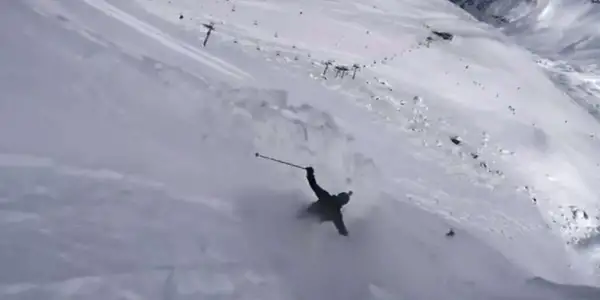
- The avalanche starts far upstream : You can try to escape on the sides. Usually, try to gain speed by diving into the slope and then veer toward the edges of the flow path.
- The avalanche starts beneath your feet : If you are near the edge of the avalanche, try to reach stable snow. If you are far from the edge, you must do everything possible to try to stay on the surface of the avalanche. If you have time, you should:
- remove the ski safety straps.
- remove your hands from the pole straps.
- If you have a large backpack, open the chest strap. If possible, you should separate from the backpack as late as possible, it will give an indication of your position if you are buried.
- With a small backpack, you can keep it on you; it will insulate you somewhat from the snow.
- If you have an airbag backpack, deploy it as quickly as possible and try to escape sideways relative to the slope line. The Airbag backpack is truly a tool that can save your life.
Then, you must adapt your behavior depending on the nature of the avalanche:
- Hard slab : the snow layer breaks into large blocks without releasing a cloud of snow. The sliding speed is generally moderate and the risk of suffocation is low. The skier carried away can lean on the surrounding blocks to try to stay on the surface.
- Breakable slab / powder snow : the primary risk is suffocation. You must absolutely try to protect your airways while curling up on yourself. During the flow, take advantage of moments at the surface to replenish air supply. When the flow begins to stop, relax as much as possible to increase the volume you occupy; the goal is to create the largest possible air pocket.
- Wet snow flow : the flow speed is generally moderate, without generating a cloud of snow. The behavior to adopt is to try to stay on the surface with breaststroke-like movements. If despite this you are sucked to the bottom of the flow, remember to protect your airways and preserve an air pocket.
When the avalanche stops
What to do to survive an avalanche? The most important point is to create a “survival” space (the relaxation movement already mentioned). Try to create an air space in front of your face. And from now on, it is imperative to conserve your energy. It is useless to shout for help; you must stay calm (easier said than done, I agree!).
After the avalanche stops

The race against time begins but you must absolutely not panic or rush without thinking. It is preferable that a member of the group, the most experienced or psychologically strongest, takes charge of the operations. If the group of witnesses is upstream of the avalanche, the approach is made from above, if possible on the flow’s travel zone, to spot any clues left behind. If possible, post a watcher who will closely monitor any potential secondary avalanche.
Calling for help
The decision to call for external help will depend on the group’s ability to manage the search, the remoteness, the size of the group, weather conditions, available equipment… Once the decision is made, the alert must be given as quickly and as precisely as possible. The expansion of GSM network coverage in France, including mountainous zones, makes your mobile phone an essential tool. As a reminder, the emergency number to call from a mobile is 112.
In the next article, we will see how to conduct searches and we will talk about the ARVA (or DVA), an essential tool along with the probe and snow shovel.