
For a few years now, and this has become even more true since covid, more and more people are taking up mountain hiking, whether regularly or occasionally. This is an excellent thing, mountain activity frees the mind and is also good for the body, but we regularly notice less positive things: incivilities, putting oneself in danger, poor preparation, sometimes delicate coexistence… In short, small things that are sometimes trivial but become annoying in the long run.
So here are some rules of good conduct for hiking and mountain activities in general, as well as some tips to start hiking in the best way.
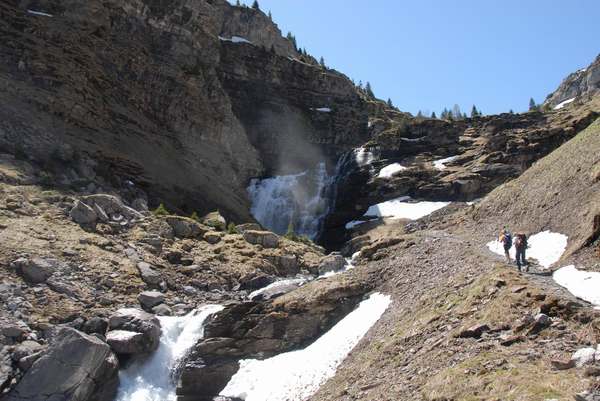
Choose a hike adapted to your physical and technical abilities
It may seem like a trivial piece of advice, but I often come across hikers struggling on the trails. So either they are masochists (why not, after all everyone is free to make their own choices), or they have chosen a hike beyond their physical abilities. Would it occur to you to climb Everest for your first outing? Okay, I’m exaggerating a bit… or maybe not. I have already met complete beginners, not trained at all, on the ascent of Buet. I think they still remember their climb.
Anyway, in the mountains we talk about elevation gain, that is the difference between the highest altitude and the lowest one. Ideally, you should especially talk about cumulative elevation gain, that is taking into account any descents and intermediate climbs (yes, in the mountains it doesn’t go straight up).
You must also take into account the technicality of the hike. Some hikes pass through somewhat challenging places (where falling is forbidden), close to voids (be careful if you are afraid of heights), or that may require using fixed equipment (rope, chain, ladder).
Whether you are beginner or experienced hikers, there are hikes for all levels in Haute-Savoie. Check beforehand to choose a hike suited to your level.
Prepare your itinerary and take precautions
You have found the ideal hike, now it’s time to prepare it well. Look at the itinerary on a map or a guidebook, gather information about current conditions (mountain guide and accompanying offices give very good advice), write down the itinerary on a paper you will have in your backpack, make a quick list of the equipment and things to bring with you…
Inform someone of your itinerary and your expected return time. This is true if you are in a group, and even more so if you hike alone (which I discourage if you are not very experienced). One thing I often do when I go alone or when I accompany a group, is to leave a paper under the windshield wipers of my car, on which is indicated my itinerary and my expected return time. And I also send a copy of this document to a close person. That way, in case of a problem, rescuers will have an idea of where I am.
At the last moment, check the local weather, and in case of doubt, abstain, you will do this hike another, more favorable day.
Equip yourself with the right material

We can’t say it enough, the equipment is important in hiking, especially in the mountains. Forget hiking in flip-flops (yes, yes, we still see too many), the fanny pack as a backpack, clothesline for difficult passages… But on the other hand, don’t overload yourself too much either, you will regret it on the climb.
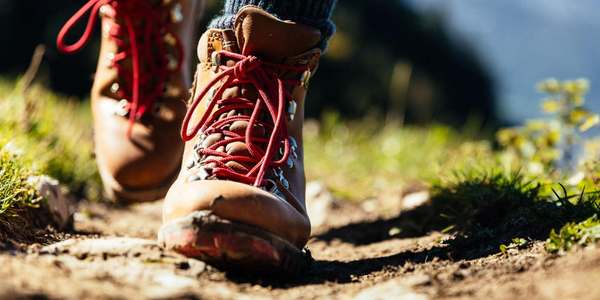
Hiking boots
It is probably the most indispensable equipment, unless you like walking barefoot, but you will soon see that it is not the best solution! Anyway, for hiking shoes, take the time to choose well according to your practice. There are many specialized shops that can advise you, but if there is one piece of equipment on which you should not skimp on price, it is the shoes. Just one piece of advice, even if it’s fashionable, avoid low-cut shoes and even more so trial shoes, especially if you don’t have a mountaineering foot. Prefer good high-cut shoes, your ankles will thank you 😉
Appropriate clothing
I very often see people in shorts/t-shirts with no additional clothing: no fleece, no rainwear… You have to be aware that in the mountains the weather can change very quickly, and even if you go hiking with bright sunshine, it can quickly turn to rain or cold. Planning clothes accordingly is therefore essential.
For the upper body, ideally a 3-layer system: 1 t-shirt (preferably technical fabric that wicks sweat much better), a fleece, and a rain jacket, ideally breathable like Gore-Tex (but to start a simple k-way or poncho can do the job, even if it’s far from perfect).
For the lower body, hiking pants with detachable bottoms are perfect.
And of course, a cap will not be superfluous.
The backpack
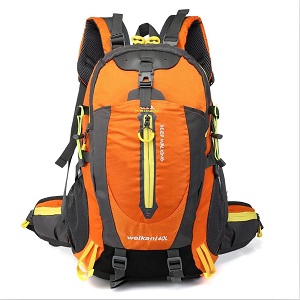
Forget the canvas backpack from the 80s, there are now much more comfortable bags adapted to all types of practice: small bags for a one or two-hour walk, day hiking backpack, trekking backpack…
For a day hike, a backpack with a capacity of 35 to 40 liters is ideal. Choose one equipped with a waist belt and wide shoulder straps to gain walking comfort and avoid back pain.
A water bottle
Hydration is indispensable in the mountains. Depending on the hike planned, there may be no water, or it may not necessarily be drinkable (presence of herds upstream for example), so you must plan a sufficient quantity of water. You can use a bottle, or a camelbak (personally I find it more practical). Capacity 1 liter minimum.
Walking poles
Once just a comfort accessory a few years ago, but quickly becoming essential, walking poles are a real plus for the hiker. They help relieve the body of the weight carried uphill, and especially protect the joints during descents, as well as improve stability if you don’t have a mountaineering foot. Choose quality poles, they won’t break at the first difficulty.
Hiking accessories
Some useful accessories for every hiker: cap, sunglasses, sunscreen, headlamp, first aid kit (disinfectant, bandages, anti-inflammatory, elastic bandage, compeed, etc.), a small knife, GPS, etc.
The “bottom of the bag”
The bottom of the bag is a set of safety equipment that should always be in your bag, whatever the planned hike. It generally includes:
- a survival blanket
- cereal bars or any caloric emergency supply
- a rain jacket and a fleece
- a multi-purpose knife
- a whistle (useful to help rescuers locate you in case of problem)
- a map of the area, and a compass (yes the hiking app on your phone might not work)
Respect protected areas and prohibitions
Out of respect for nature, and for your safety, stay on the specially marked hiking trails for walkers. This will prevent you from trampling insects/plants, damaging the landscape and fragile natural areas, and incidentally from getting lost. Respect the prohibitions, they are not there just to annoy you.

Carry down your waste
With the increase in mountain attendance, we also notice an increase in waste left by the side of trails, or sometimes roughly hidden behind rocks. Unlike at home, there is no garbage collection service in the mountains, marmots have other things to do (they already have chocolate bars to wrap)! So go hiking with a trash bag at the bottom of your backpack, and carry down your waste! The mountain is beautiful, make sure it stays that way.
Walking
Walking in the mountains inevitably impacts the environment, let’s see some good practices to minimize it.
Walking on trails
Trails are often the best route to take but it is useful to respect certain rules:
- Do not walk next to the trail, this will promote erosion and harm the vegetation.
- Do not cut corners, also for problems of erosion, runoff, and vegetation damage
- Do not damage the soil and vegetation bordering the trails with your poles.
Walking off trails
During your hikes you may need to go off trail (to pee, get water, etc.). In this case, you should try to minimize the impact of your passage on vegetation and soil.
- Avoid trampling vegetation or prefer areas with less fragile vegetation
- Try if possible to walk on “durable” non-vegetal surfaces: rocks, sand, gravel, snow…
- If you hike in a group off-trails, do not all walk exactly in the same place, this will reduce the impact of your passage.
The fauna
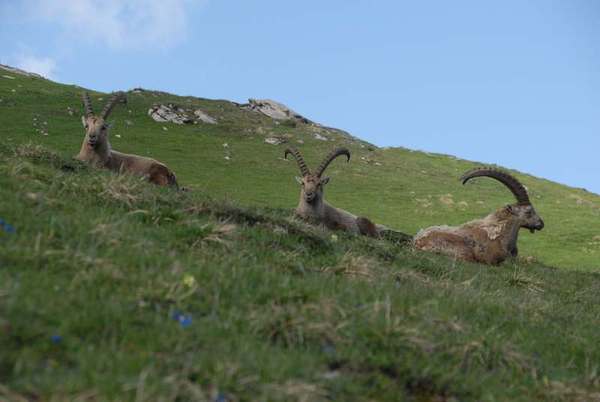
- Do not feed the animals, even if they seem to be begging (which they are not in fact). Human food is not necessarily good for their health.
- To avoid scaring local wildlife, limit noise and sudden movements. Avoid shouting for example, especially for children.
- Observe animals from afar, without trying to get too close (which would cause them to flee quickly). This is even more important during certain periods: mating, nesting, winter…
- Do not leave your food and waste lying around.
The flora
- In many national and regional parks, but also in many natural sites, picking plants and flowers is forbidden. There are also many protected species for which picking is forbidden. In case of doubt, abstain! You can inquire about protected species in France with the DREAL (Regional Directorate for the Environment, Planning and Housing).
- If picking is allowed, be reasonable: pick in small quantities, cut rather than uproot, and not all from the same place.

Cultural heritage
Just as for flora and fauna, it is important to respect mountain cultural heritage.
- Do not leave any trace of your passage (engravings, added objects, graffiti, etc.).
- Do not take or move objects that are part of the cultural heritage.
- If you want a souvenir, take a photo of yourself in front instead!
Water
As stated above, water is essential for hiking. Even if there are many walks where you can find water points, it may not be drinkable. It is also important to respect some points near water points:
- No bivouac too close to water points (at least a hundred meters, that’s good).
- For your natural needs, as far as possible from water points and outside runoff zones.
- For your morning wash or dishes, avoid doing them directly at water points. The ideal is to take water and move away at least a hundred meters to do it. And even better, use biodegradable products exclusively.
- Avoid swimming in mountain lakes, especially if you have just applied sunscreen.
- Do not build dams.

Bivouacs
In France, bivouacking is regulated, even completely forbidden in some areas and tolerated in others. So please, inform yourself and respect the regulations!
You have found an ideal bivouac place, there is no prohibition, perfect, settle in, but respect some common sense rules:
- Set up your bivouac on durable surfaces (ground and vegetation).
- If there are already well-marked bivouac spots, use them, this will avoid spreading the impact to other areas.
- On the other hand, avoid poorly marked spots so that damaged vegetation can recover.
- At worst, prefer a place without prior impact that can recover more easily from your passage.
- You don’t have a building permit, so don’t dig the ground or build permanent structures.
- Set up somewhere where you won’t disturb the wildlife.
- Set up at least a hundred meters away from water points.
- You are not on a seaside holiday resort, so stay discreet.
- Of course, take all your waste with you.
- Restore your bivouac spot before leaving.
Fires
Certainly it is pleasant to sit in front of a good campfire in the evening at bivouac, but it is not always without impact.
- In some areas fires are totally forbidden, so check beforehand and if that is the case, abstain.
- If fires are allowed, don’t be reckless and assess the real risks: making a fire when there is wind and very dry vegetation is not necessarily a good idea, even if it is not forbidden.
- Avoid making fires if wood is scarce in your area.
- Do not cut wood, use exclusively dead wood. And preferably, collected from different places.
- Choose a spot for your fire that has minimal impact on vegetation: an existing fireplace if there is one, or a new one on a durable ground and without nearby vegetation if possible.
- Of course, do not burn waste, carry it down.
- Before leaving, extinguish the fire, make sure no embers remain, and restore the place as best as possible.
Dogs
Many people like to hike with their dog, but there are some rules and good practices to respect.
- There are prohibitions and dogs are not allowed everywhere, especially in national parks, regional parks, reserves, and natural sites. In other places, they are accepted but must be kept on a leash. These prohibitions or restrictions are not to annoy you but to protect nature and local fauna. So check during the preparation of your hike.
- Control your dog and do not let it disturb wild fauna or herds in alpine pastures. Even if your dog is very obedient, if it chases a marmot or chamois, you will not be able to contain it.
- When approaching other hikers, keep your dog close to you, and even better, on a leash.
- As with your own needs, do not leave your animal’s droppings on the trails.
- Be careful near herds, there are often guardian dogs (often Patous or Pyrenean shepherds), and coexistence with your dog could be very delicate. These guardian dogs are there to protect the herd, they are doing their job. So near a herd, keep your dog on a leash.
Mountain orientation
We haven’t talked about it but knowing how to orient yourself in the mountains is vital. Hiking trails are often very well marked, but it can happen that signs are damaged, or that changes have occurred without being reported on the marking. That is why it is important to always have a map with you, know how to read it, and know some basic orientation techniques.
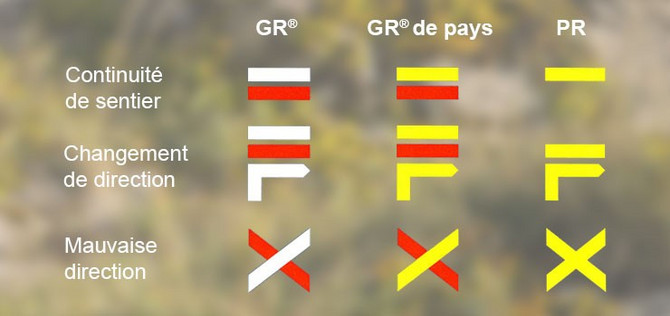
Current hiking apps are very good, but it is still useful to know how to find your way and orient yourself without them, your phone might run out of battery, or there might be another problem. You can consult our articles on mountain orientation to discover some basic or more advanced techniques.
Other mountain users
The mountain is a privileged and still somewhat preserved place, and more and more people practice activities there, so it is essential to coexist wisely and respect some good practices:
- Be courteous.
- Be discreet: you are not alone and others may appreciate the peace of the mountain.
- Try to educate others if you notice abnormal behaviors, but always politely, explaining the impact of their attitude. However, if you see someone intentionally leaving trash behind for example, you can drop diplomacy, there are jerks everywhere unfortunately!
Some practical advice
So, we have reviewed some main points about hiking in the mountains that will help you start this activity good for health and mental well-being. Here is a little summary:
- Choose a hike suited to your level (physical and technical)
- Be well equipped
- Learn some basics of mountain orientation
- Prepare your hike and plan a margin of safety
- Check the forecast and in doubt, abstain
- Take enough water with you.
- Respect nature (fauna, flora, heritage…)
- Do not feed local wildlife: human food is not necessarily suitable for animals you will encounter
- Stay as much as possible on marked trails
- Do not make fires
- Limit bivouacs
- If hiking with your dog, check that there is no prohibition, and preferably keep it on a leash
- If you encounter a herd on your route, try to bypass it, and be careful with the guardian dogs
- Try to minimize your impact as much as possible
- Stay discreet
- Be courteous with other users and share these places
And above all, the most important, enjoy the mountains!
Happy hiking