
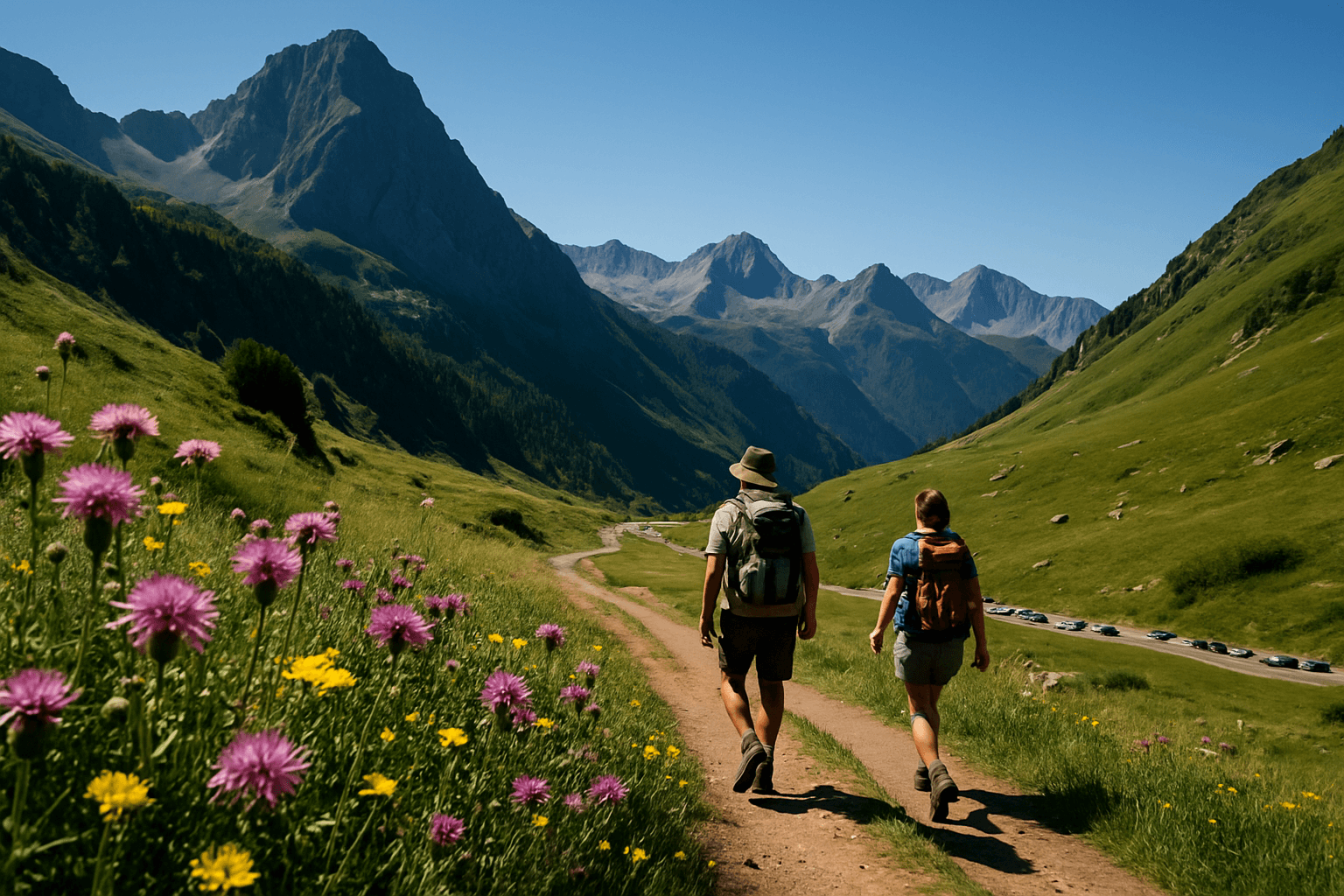
For several years, the mountains of Haute-Savoie have been attracting an increasing number of visitors, especially during the summer season. This growing popularity is unfortunately accompanied by behaviors that disrupt the natural balance of these preserved areas. Among these behaviors, noise pollution has become a major problem that affects the experience of hikers seeking tranquility and communion with nature.
Noise: an unwelcome intruder in the mountains
The mountainous landscapes of Haute-Savoie naturally invite silence and contemplation. Yet, reality is often quite different. Many hikers bring portable speakers with them, play their music at high volume, and forget that the mountainous terrain significantly amplifies every sound emitted. What might seem like simple background noise in an urban setting turns into a real racket at altitude, disturbing not only the local wildlife but also the experience of other visitors.
The echo phenomenon, characteristic of mountain spaces, worsens this situation. A simple burst of laughter, an animated conversation, or an argument can carry from one valley to another. The rocky walls act as natural resonance boxes that repeat and amplify every sound. This acoustic particularity, which is part of the magic of the mountains when respected, becomes a source of nuisance when exploited without consideration.
Bivouacking and its often neglected rules
Bivouacking in the mountains is attracting more and more nature experience enthusiasts. However, this practice is not an absolute right but a tolerance governed by precise rules that too many people ignore or choose to neglect. Respecting quietness is among the fundamental principles of responsible bivouacking.
The essential rules of respectful bivouacking include:
- Set up late and leave early (generally after 7 p.m. and before 9 a.m.)
- Maintain absolute sound discretion
- Limit the use of artificial lights
- Leave no trace of your passage
- Respect the surrounding fauna and flora
Unfortunately, these principles are frequently violated. Campsites that drag on for several days, unauthorized campfires, abandoned waste, and especially noise disturbances turn what should be a discreet stopover into a real wild camping site. These behaviors jeopardize not only the environment but also the very sustainability of this tolerated practice.
Initiatives to preserve tranquility in the mountains

Faced with the increase in noise nuisances in the mountains, various measures have been implemented in Haute-Savoie. Some municipalities have notably deployed mediators on the most frequented trails. Their mission is not repressive but preventive: to inform, raise awareness, and remind hikers of good practices.
These agents favor an educational approach rather than a punitive one, considering that a benevolent explanation is generally more effective than a sanction. Their discreet but essential presence helps to defuse many problematic situations before they escalate.
Some mayors have even been forced to issue bans on bivouacking, often near mountain lakes, due to an increase in incivilities.
The impact of noise disturbances on the mountain experience
Noise pollution in mountain environments deeply affects hikers’ experience. Most people who venture into the Alps are precisely looking for what noise takes from them: an authentic, wild, and soothing atmosphere. When natural sounds—the wind’s breath, a bird of prey’s cry, the murmur of a stream—are drowned out by artificial noises, the entire contemplative dimension of hiking vanishes.
This nuisance is not limited to a simple temporary inconvenience. It alters the deep connection that can be established between humans and nature. Silence is not a luxury in the mountains but the very condition of an authentic experience. When it disappears, it is the spirit of the place that progressively fades, transforming exceptional spaces into mere noisy recreational grounds.
Towards an ethics of silence in the mountains
In light of this observation, a genuine ethics of silence in the mountains seems necessary. It is based on simple but essential gestures: turning off music, moderating one’s voice, limiting the use of noisy equipment. These individual choices, far from trivial, collectively contribute to preserving the unique atmosphere of mountain spaces.
This ethic fits within a broader approach to respecting the mountains. Walking early, speaking little, observing much: the true high-altitude experience is built on this sobriety. Experienced hikers know this well—it is in silence that the mountain fully reveals itself, offering its most beautiful moments of communion with nature.
Recommendations for responsible behavior
To contribute to preserving the natural soundscape of the Haute-Savoie mountains, each hiker can adopt a few simple principles. Favor listening to natural sounds rather than imposing one’s own music, choose low voices for conversations, especially in the evening and early morning, and kindly raise awareness among those who may ignore the impact of their noisy behaviors—these are all gestures that make a difference.
Refuge guardians regularly report situations where they have to intervene to remind these basic rules. Their role as mediators is essential but should not always be necessary if everyone were aware of their individual responsibility in preserving the mountain sound environment.
What future?
Noise pollution now represents a major challenge for preserving the authentic mountain experience in the Alps. This phenomenon, symptomatic of growing and sometimes disrespectful visitation, threatens the fragile balance between accessibility and the preservation of these exceptional natural spaces.
The solution lies primarily in individual and collective awareness. The mountain is not just a playground but a living environment worthy of respect and consideration. Silence there is not empty but instead filled with all the natural sound richness that our noise seeks to mask. Preserving this richness is the responsibility of all mountain lovers, so that the mountains of Haute-Savoie continue to offer those precious moments where humans can still marvel at nature’s silent grandeur.