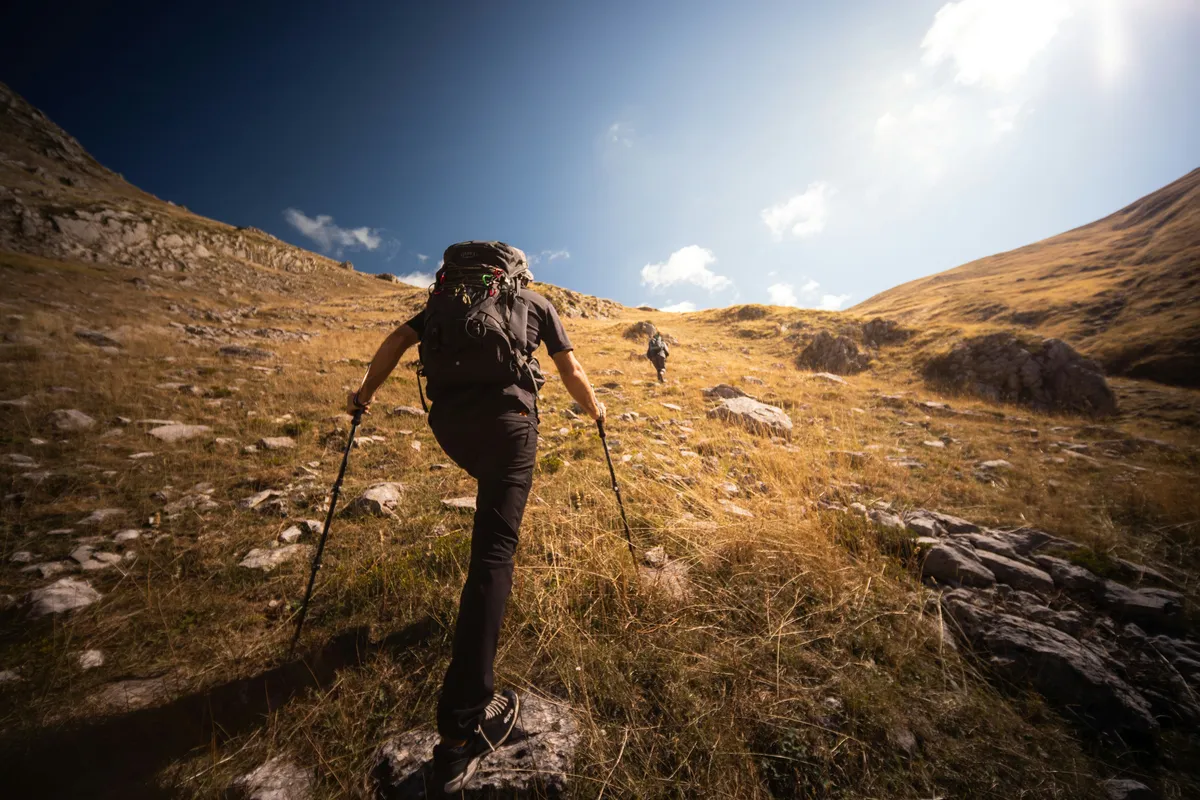
Going on a day hike is one of the best ways to discover the magnificent landscapes of Haute-Savoie. Whether you are aiming for a high-altitude lake near Annecy or a panoramic ridge in the Mont-Blanc massif, a successful outing depends on thorough preparation.
Many hikers think that a few hours excursion doesn’t require specific equipment. Yet, in the mountains, the weather changes quickly and forgetting something (insufficient water, lack of windbreaker jacket) can turn a beautiful day into a painful experience.
Here is our complete guide and hiking gear checklist to leave with peace of mind.
Why properly prepare your hiking equipment?
The mountain remains an unpredictable environment
Even on marked trails, the mountain imposes its rules. A path can become slippery after a shower, the wind can rise at the summit, or a simple navigation error can extend your outing. Appropriate equipment allows you to:
- Maintain an optimal thermal comfort.
- Handle unforeseen events (minor injuries, delays).
- Limit fatigue thanks to balanced carrying.
Common mistakes to avoid
Mountain rescue notes that most incidents are linked to a lack of anticipation: dehydration, blisters caused by poor shoes, bad preparation (route, weather, unsuitable or missing equipment…), or even severe sunburns at altitude.
The hiking backpack: the foundation of any successful outing
The hiking backpack is the central element of your equipment. It will hold everything you need for the day. But it shouldn’t hold your entire house either! Remember, you carry it!
What backpack capacity to choose for a day hike?
For a classic hike, a backpack with a capacity of 20 to 30 liters is usually sufficient. It allows you to carry water, extra clothes, a picnic, and some safety accessories, all without weighing you down too much. Here are some useful benchmarks:
- 15 to 20 liters: short hike or easy stroll
- 20 to 30 liters: classic day hike
- 30 liters and more: long hike or more technical terrain
The most important thing is to choose a comfortable and well-fitted backpack.
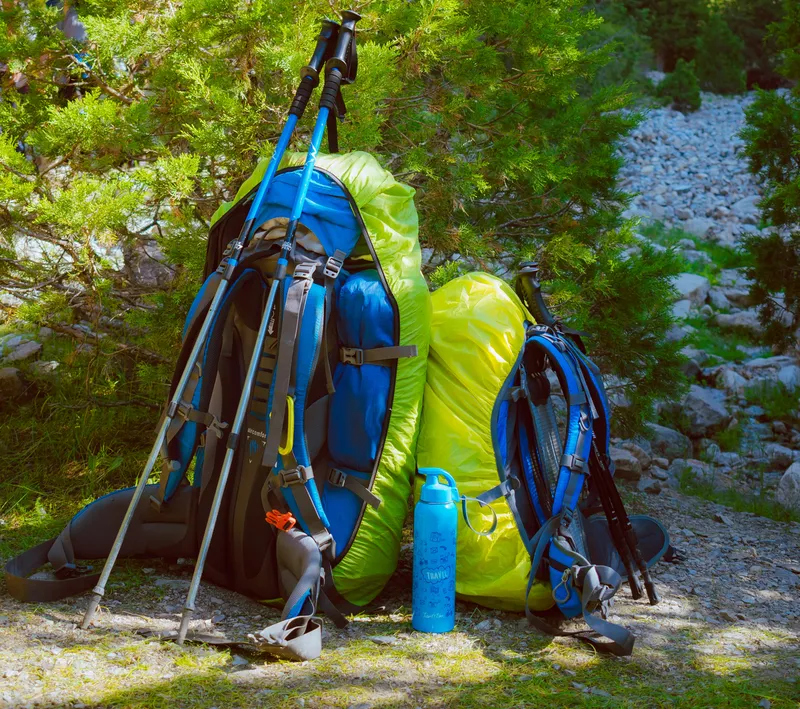
The essential features of a good hiking backpack
A good hiking backpack should offer:
- a ventilated back to reduce sweating
- a waist belt to better distribute weight
- a chest strap to stabilize the backpack
- a built-in rain cover
- several easily accessible pockets
These details greatly improve comfort on long walks.
How to properly pack your backpack
Packing your backpack is almost as important as its contents. Some simple rules:
- place the heaviest items close to your back
- keep useful accessories within easy reach
- distribute the weight evenly
A well-organized backpack allows you to walk more comfortably and avoid back or shoulder pain.
Hiking shoes: your first equipment

Often forgotten in the “bag list,” but the hiker’s equipment starts with your feet. Poorly shod, or with hiking shoes unsuited to your morphology and activity, you will face multiple problems (hot feet, blisters,…). In the best case, these remain minor troubles, but they could lead to much more critical situations. Without going into details, there are several types of hiking shoes:
- High-cut shoes: Ideal for technical terrain and ankle support.
- Low-cut or Trail shoes: Perfect for lightness on easy trails.
- Technical socks: Essential to wick away sweat and prevent chafing.
Clothing: the 3-layer rule
In the mountains, forget the heavy cotton sweater. Adopt the 3-layer system to adapt to effort and weather:
- Breathable layer: A technical t-shirt (synthetic or merino wool) that wicks away sweat.
- Insulating layer: A light fleece or thin down jacket to retain warmth.
- Protective layer: A waterproof and windproof jacket like Gore-Tex.
Essential items for a day hike
Here are the essential items to bring for a well-prepared hike.
Water and food
Hydration and nutrition are the most important points on a hike. Always plan for:
- at least 1.5 to 2 liters of water per person
- energy bars or dried fruit (a mix of seeds and dried fruit is ideal)
- a light picnic
- possibly isotonic drinks
In summer or during a sporty hike, you can increase the amount of water. Also be careful in winter, thirst is felt less but dehydration can occur quickly during intense effort.
Essential clothing
Even in good weather, it is recommended to take an extra layer, as the weather can change quickly in the mountains. In your backpack, you should have at least:
- a windbreaker and/or waterproof jacket (preferably GoreTex)
- a light warm layer (fleece or thin down jacket)
- a cap or beanie depending on the season
- sunglasses
Safety equipment
Even for a simple hike, some simple accessories can be very useful.
- a first aid kit
- a survival blanket
- a headlamp
- a whistle to signal yourself in fog, for example.
These items take up little space but can be precious in case of unexpected events. For me, they are part of the “bottom of the bag“, a “safety kit” that never leaves my backpack, even for a simple stroll.
Orientation and navigation
Although many apps exist today, it is always better to have a backup solution. Don’t forget that your smartphone can run out of battery!
Remember to bring:
- a hiking map (such as an IGN map)
- a compass (having learned to use it beforehand, of course)
- a smartphone with GPS
- a power bank
This helps avoid finding yourself disoriented in areas with poor network coverage.
Useful small accessories
Some items are not essential but can greatly improve your comfort. For example:
- a multitool knife
- sunscreen
- a anti-chafing balm
- a small bag for trash
- toilet paper
These small details can transform a classic hike into a much more pleasant outing.
Adapting your equipment according to the season
- Summer: Focus on hydration and UV protection. Beware of late afternoon thunderstorms common in the Alps.
- Autumn/Spring: Temperatures drop quickly in the shade. Plan for light gloves and a beanie.
- Winter: Equipment becomes more technical (light crampons, thermos with hot drink, thermal clothing, gloves and beanie). With shorter daylight hours, a headlamp becomes even more important.
Example of equipment for a summer hike in Haute-Savoie
Take the example of a classic hike to a high-altitude lake or panoramic ridge, lasting about 4 hours round trip in summer (June, July, August). In your bag, you might have:
- 2 liters of water
- a picnic
- a windbreaker jacket
- a light fleece
- a first aid kit with survival blanket
- a headlamp
- a hiking map + compass
- sunscreen + cap
- a multitool knife
This type of equipment is generally enough for a 4 to 6 hour mountain outing.
Mistakes to avoid when preparing your backpack
Some mistakes are very common among beginner hikers.
Here are the main ones:
- a backpack that is too heavy which tires you out quickly. It’s the most common mistake among beginner hikers.
- not enough water
- poor weight distribution
- carrying unnecessary equipment
The goal is to find the right balance between safety and lightness.
In summary: the balance between lightness and safety
The secret to a successful hike in Haute-Savoie is to bring nothing superfluous while having what’s necessary to cope with nature’s whims. Weigh your backpack before leaving: beyond 5-6 kg for the day, you are probably carrying too much!
A little personal anecdote: during a multi-day hike with bivouac, to optimize the backpack’s weight as much as possible, I ended up cutting the handle of my toothbrush. A few grams saved, but I can assure you that after several days of walking, every gram counts!
To read: The guide to good hiking practices
Complete checklist of equipment for a day hike
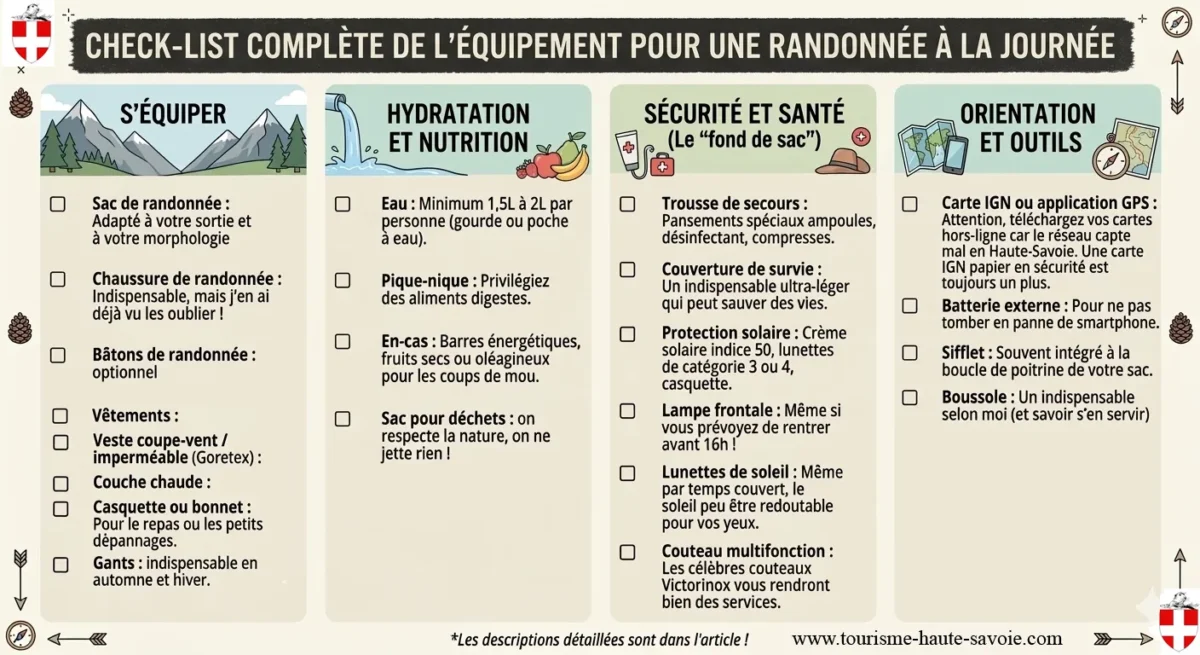
- [ ] Hiking backpack: Suitable for your outing and your body type
- [ ] Hiking shoes: Essential, yet I’ve seen them forgotten!
- [ ] Hiking poles: optional
Hydration and nutrition
- [ ] Water: Minimum 1.5L to 2L per person (bottle or hydration bladder).
- [ ] Picnic: Prefer easily digestible foods.
- [ ] Snacks: Energy bars, dried fruits or nuts for energy boosts.
- [ ] Trash bag: Respect nature, don’t litter!
Safety and health (The “bottom of the bag”)
- [ ] First aid kit: Special plasters for blisters, disinfectant, compresses.
- [ ] Survival blanket: An ultra-light essential that can save lives.
- [ ] Sun protection: SPF 50 sunscreen, category 3 or 4 sunglasses, cap.
- [ ] Headlamp: Even if you plan to return before 4 p.m.!
- [ ] Sunglasses: Even in cloudy weather, the sun can be fierce on your eyes.
- [ ] Multitool knife: The famous Victorinox knives will serve you well.
Orientation and tools
- [ ] IGN map or GPS app: Be careful, download your maps offline because the network is poor in Haute-Savoie. A paper IGN map as a backup is always a plus.
- [ ] Power bank: So you don’t run out of phone battery.
- [ ] Multitool knife: For meals or small repairs.
- [ ] Whistle: Often integrated to your backpack’s chest strap.
- [ ] Compass: An essential in my opinion (and knowing how to use it)
Clothing
- [ ] Windbreaker / waterproof jacket (Goretex)
- [ ] Warm layer
- [ ] Cap or beanie: For meals or little repairs.
- [ ] Gloves: essential in autumn and winter.
And you, what are the essential items that you always slip into your backpack before going hiking?