Finding the right ski size is essential for your safety and enjoyment on the slopes, but it is not always obvious. Experienced skier in Haute-Savoie, I share with you my tips to determine the ideal size according to your height, weight, level and practice (piste, freeride, all-mountain).
In short:
- A ski that is too short lacks stability at speed,
- one that is too long makes turns difficult to control.
- Beginners: short skis for maneuverability,
- experts: lengths for stability at speed.
- Rigidity and rocker influence the choice depending on the snow.
Choosing your skis: why is the right size so important?
Packing for the mountains is exciting, but choosing the ski size is crucial. A poorly fitted size makes the descent unstable and dangerous. The right size ensures comfort, safety and pleasure. I have seen skiers struggle with mismatched skis on the slopes of Haute-Savoie. I guide you according to your height, weight, level and type of practice.
Key factors for choosing ski size
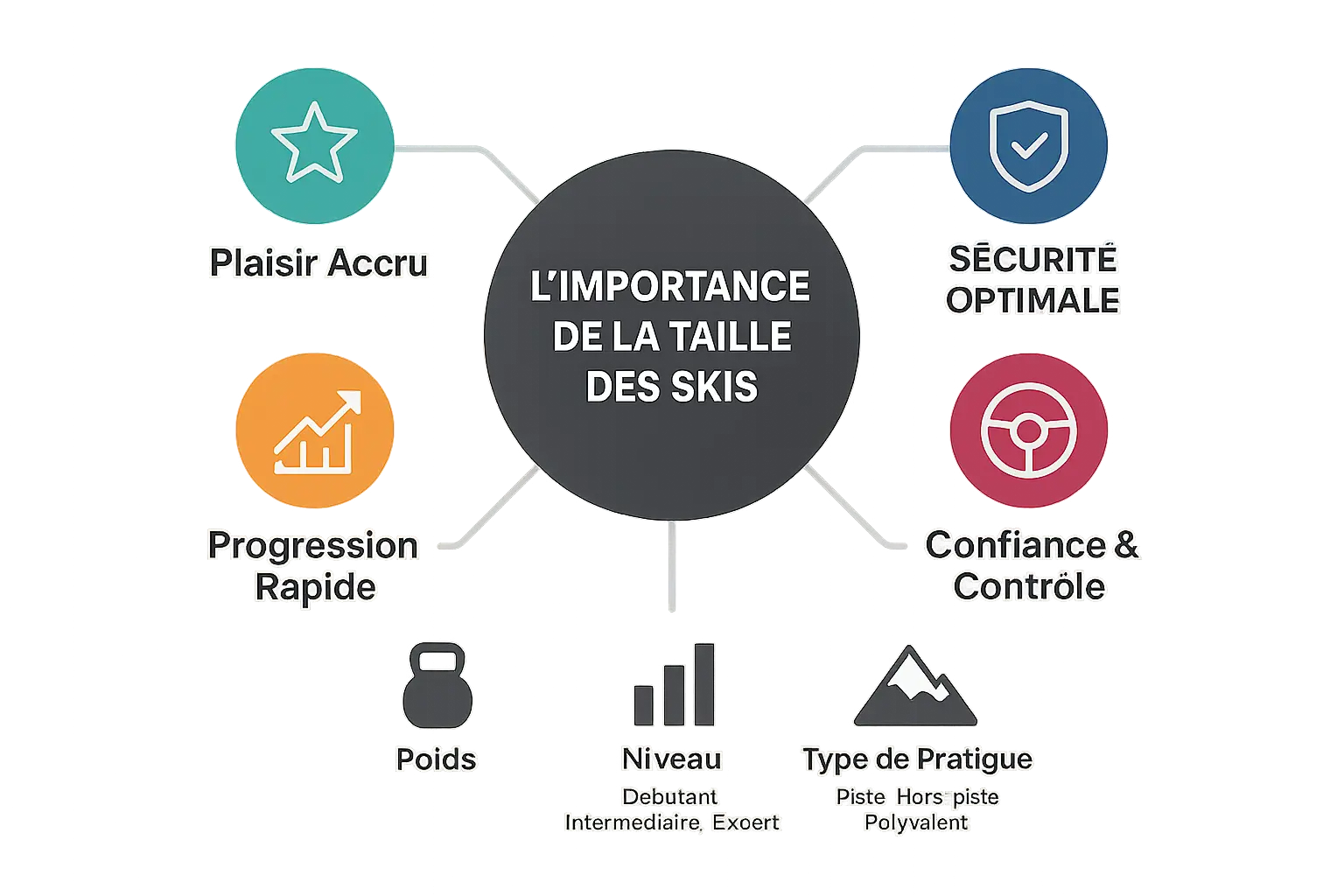
Height and weight are key: tall and heavy → long skis for stability. Beginners: -10/-15 cm, intermediates: -5/-10 cm, experts: size or +5 cm. Ski type: piste (short), freeride (long for powder).
| Type | Size |
|---|---|
| Beginner piste | -10/-15 cm |
| Intermediate piste | -5/-10 cm |
| Confirmed freeride | +5/+15 cm |
The 3 fundamental criteria to determine your ski size

1. Your height: the starting point of all calculations
When you hold your skis upright in front of you, they should reach between your chin and the top of your head. This is a basic rule, but it adapts according to other factors. With modern parabolic skis, shorter lengths are often preferred for better maneuverability.
2. Your weight: an adjustment factor for stability
Your weight greatly influences stability. A heavier skier will need a longer ski to avoid deformations. Conversely, a lighter weight allows choosing a shorter, more agile ski.
3. Your technical level: the key to refining your choice
Your technical level is important to refine the choice. Here’s how to identify yourself:
- Beginner: You are starting, skiing on green/blue slopes. Priority on maneuverability. A short ski makes turning easier and reduces fatigue.
- Intermediate: Comfortable on blue and red runs. Seek a balance between stability and maneuverability. Ski -5 cm for controlled turns.
- Confirmed: Ski on all slopes, including black. You’re looking for performance and stability at high speed. Ski at size or slightly shorter.
- Expert: Master all terrain, off-piste, difficult conditions. Long ski for floatation. Rocker models for powder.
| Ski type | Beginner | Intermediate | Advanced | Expert |
|---|---|---|---|---|
| Groomed slopes | Size -10 cm | Size -7 cm | Size -5 cm | Size |
| All-mountain | Size -10 cm | Size -5 cm | Size | Size +5 cm |
| Freeride and powder | Size -5 cm | Size | Size | Size +5 cm |
In summary, the more beginner you are, the shorter the ski should be. Conversely, experts favor longer skis for stability. Don’t forget to consult a professional for a personalized adjustment.
What ski size for which practice? My advice for each discipline
The choice of your ski size determines your comfort and safety on the slopes. Without the right length, you risk losing stability or maneuverability. I explain everything in this guide.
For piste skiing: from leisure to performance
Leisure piste skiing is perfect for beginners. A size of -15 cm to -5 cm allows better control. Personally, I started with short skis and progressed faster.
For intermediate skiers, opt for -5 to -10 cm. This offers more stability in wider turns. It’s ideal for enjoying the slopes without stress.
In competition, racing skis are very stiff. I recommend a size close to your height, or even +10 cm for giant slalom. This guarantees excellent stability on fast slopes.
Don’t forget: your weight also matters. Heavier, choose the upper size of the range. Carving skis require a shorter size for tight turns.
For all-mountain skiing: versatility above all
All-mountain skiing is my preferred choice to explore the Grand-Bornand area. Its versatility allows you to go from groomed slopes to off-piste with confidence.
For beginners, -15 cm is ideal. Intermediates: -5 cm. Experts: +5 cm. The rocker at the front facilitates floating in powder, a real plus for snowy days.
I prefer models with moderate rocker for mixed use. It’s the perfect ski for a varied day in the mountains. You will never lose comfort.
For freeride skiing: powder target
Freeride skis are designed for deep snow. A length longer than your height (up to +15 cm) ensures better flotation. Here is an indicative table according to your height and weight:
| Height | Weight | Ski length |
|---|---|---|
| 150-160 cm | 45-55 kg | 155-165 cm |
| 160-170 cm | 55-65 kg | 165-175 cm |
| 170-180 cm | 65-75 kg | 175-185 cm |
| 180-190 cm | 75-85 kg | 185-190 cm |
Freeride skis are wide (95 to 140 mm underfoot), which improves flotation in powder. “Fat” models (110-130 mm) are ideal for beginners in off-piste.
Even with these guidelines, a professional adjustment is essential. An expert can adjust the binding and length according to your precise needs. Always test several models before buying!
Summary table to find your ideal ski size
On the ski slopes choosing the right ski size is essential for safety and pleasure. I have prepared a clear table with concrete examples. Find your profile for a good start!
| Skier profile (Height / Weight) | Level | Type of practice | Recommended ski size |
|---|---|---|---|
| Female (160 cm / 55 kg) | Beginner | Leisure Piste Skiing | 145 – 150 cm |
| Female (165 cm / 60 kg) | Intermediate | All-Mountain Skiing | 158 – 165 cm |
| Male (175 cm / 75 kg) | Intermediate | Leisure Piste Skiing | 165 – 170 cm |
| Male (180 cm / 85 kg) | Confirmed | All-Mountain / Performance Piste | 175 – 180 cm |
| Male (185 cm / 90 kg) | Expert | Freeride Skiing | 188 – 195 cm |
Attention: general guide. Rigidity and your preferences may modify recommendations. Consult a professional for personalized adjustment.
I’m hesitating between two sizes, what to do?
Classic dilemma in a mountain ski shop: maneuverability or stability? The choice depends on your level and skiing style.
Many beginners choose skis that are too long in the mountains, which complicates their progress. A shorter size facilitates learning for an optimal experience.
- Choose the shorter size if: beginner or progressing, light weight, short and fast turns. Ideal for narrow slopes, less tiring over a full day. Maneuverability is priority.
- Choose the longer size if: confirmed/expert, speed, off-piste, large build. Better grip on hard snow and optimal flotation in powder. Stability required.
Modern ski technology, like rocker, influences their behavior. A long ski may seem more maneuverable than it really is, offering more fluidity to experts even in powder.
Always consult a professional for personalized adjustment. Your morphology and skiing style influence the final choice.
If in doubt, favor the shorter size for intermediates. A maneuverable ski offers more pleasure than a ski that is too long and demanding. Confidence on the slopes is essential to fully enjoy your day in the mountains.
My final advice to avoid mistakes
To choose the right ski size, be honest with your level. An objective opinion avoids mistakes. If you have doubts, ask for help from a professional at the resort. Your real level is key for safety and pleasure on the slopes.
The best advice I can give you: talk to ski rental shops in the Haute-Savoie ski resorts. They know the equipment and snow conditions like the back of their hand. Their expertise will save you from bad choices and optimize your experience.
To manage your budget, discover how to equip yourself for skiing at a reduced price. Enjoy great runs on our magnificent slopes!
FAQ
How to determine the right ski size based on my height?
Hello! For my part, I always start with the chin-to-head rule. If you place your ski upright, it should reach between your chin and the top of your head. It’s a base, but your weight, level and type of ski modify this choice. For example, if you are a beginner, a shorter ski (10-15 cm below your height) will be more maneuverable. I saw this in skiing at Megève last winter: skis too long for beginners, it’s complicated!
What ski size recommended for a person of 1.70 m?
If you are 1.70 m tall, generally, for leisure piste skiing, I recommend between 155 and 160 cm. But it depends on your level and weight. For example, if you are light and beginner, a 155 cm ski will be perfect. If you are confirmed and heavier, 160 cm will be more stable. I tested this in Val Thorens resort: it changes everything depending on conditions!
For a man of 180 cm, what ski size to choose?
For a man of 180 cm, it depends on your level and practice. If you are starting, 170-175 cm. Confirmed in all-mountain, 175-180 cm. For freeride, even 185 cm. I saw my friend in Courchevel with 185 cm skis for powder: he loved the stability, but it was more difficult on groomed piste. So, it depends on your preferences!
What ski size to favor for off-piste?
For off-piste, I advise skis longer than your height, between +5 and +15 cm. For example, if you are 180 cm tall, go for 185-195 cm. The extra length allows you to float in powder. Last year, in the Alps, I tested a 190 cm ski for freeride: it was really more stable and comfortable in deep snow. But be careful, it’s less maneuverable on groomed slopes!
What ski size for a man 1.60 m?
Ah, careful: “shoe size” concerns boots, not skis! For a man of 1.60 m, ski size depends on your level. If you are beginner, 145-150 cm. Intermediate, 150-155 cm. For all terrain, 155 cm. I saw small skiers with skis too long who struggled… Prefer a short ski for more maneuverability at the beginning!
What is a mondo size 26.5?
The mondo size is the measuring system for ski boots. A 26.5 size corresponds approximately to EU size 42-43 or US 9-10. It’s important because well-fitted boots are essential for control. During my rentals in Chamonix, I always checked the mondo size: a bad fit is a nightmare for performance!
How to check if my ski size matches my morphology?
It’s simple! Place your ski upright: it should reach between your chin and the top of your head. Then, consider your weight and level. If you are light, a slightly shorter ski is better. If you are heavy, favor length for stability. Last year, skiing with my brother, we saw that his skis (175 cm for 170 cm) were too long for his beginner level. He switched to 160 cm: much easier to turn!
What type of ski to choose according to my practice level?
Beginner? Opt for short skis (minus 10 to 15 cm) for maneuverability. Intermediate? An all-mountain ski at your size to -5 cm. Confirmed or expert? Longer (at your size or +5 cm) for stability at speed. I tested a carving ski for an expert friend: it was too stiff and demanding for his beginnings. The ski level must match your experience, not your ambition!
What ski size to choose after progressing in skiing?
If you have progressed, you can move to a slightly longer ski for more stability. For example, if you were at -10 cm as a beginner, move to -5 cm as intermediate. I saw skiers who stayed too short for too long, but when moving forward, they gained confidence with longer skis. However, if you change discipline (like going from piste to freeride), adjust according to your practice. Don’t hesitate to consult a pro in the shop, they know the equipment!