
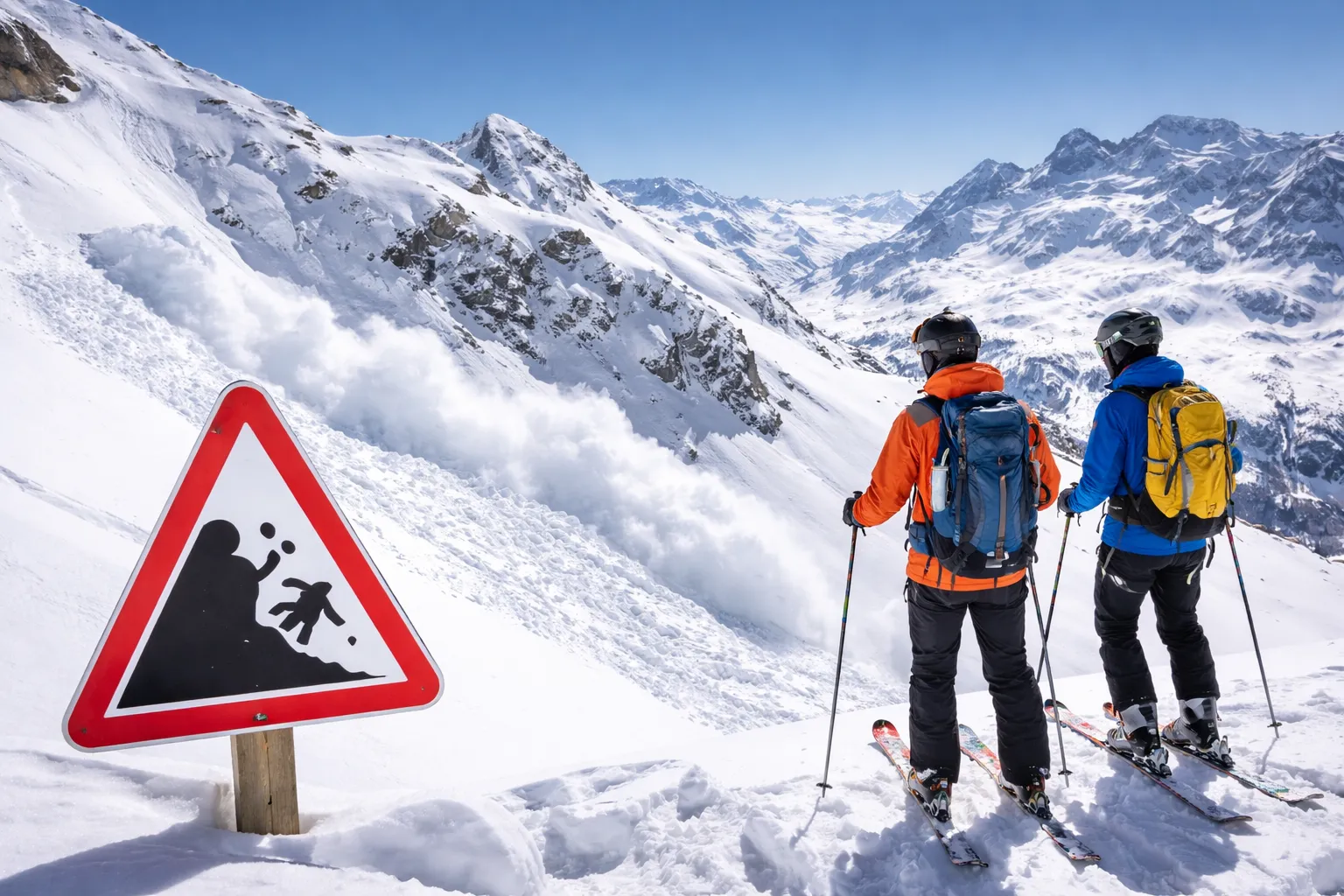
As the French mountain ranges face significant snowfall episodes, the question of mountain safety is once again at the forefront. Every year, despite level 4 or 5 alerts on the avalanche risk scale, many skiers continue to venture into powder snow, off the marked trails. The most recent accidents confirm this trend. But in the face of danger, can the authorities legally block your passage?
The principle of freedom VS safety
In France, the golden rule remains freedom of movement. Contrary to a common misconception, the mayor of a municipality or the prefect cannot generally and absolutely prohibit off-piste skiing throughout an entire domain. Skiing is considered a leisure activity practiced at the user’s own risk as soon as they leave the colored markers of maintained pistes.
However, this freedom is not absolute. Mayors have municipal police powers allowing them to issue temporary and localized municipal orders. If a deadly danger is imminent and specific to certain areas, access can be formally prohibited by tape or explicit signage.
Are you risking a fine or legal action?
If you enter an area specifically forbidden by municipal decree, you expose yourself to a fine. But beyond the fine, the criminal aspect can become more severe in case of an accident. If an off-piste skier triggers an avalanche that injures others or endangers rescuers, they may be prosecuted for “deliberately endangering the life of others.”
Awareness rather than repression

On the ground, mountain rescuers often prioritize dialogue. Their role is to inform about the state of the snow cover, often unstable after heavy snowfall or a sudden thaw. The main argument remains the efficiency of rescues: in cases of maximum risk, an intervention to rescue a reckless skier also endangers the rescuers’ lives.
European avalanche risk scale
Detailed explanations of the European avalanche risk scale (Scale from 1 to 5)
This scale is an essential tool to assess the stability of the snow cover and the risk of avalanche triggering. It must be consulted through the Bulletin d’Estimation du Risque d’Avalanche (BERA) before any mountain outing.
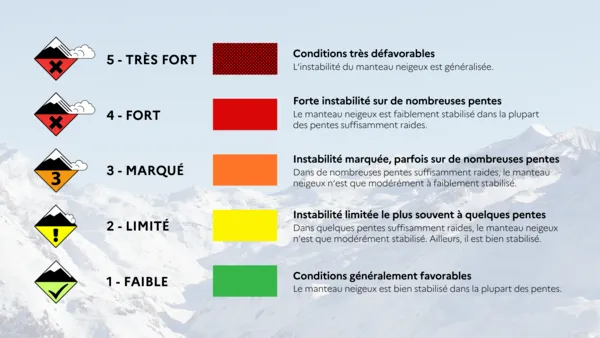
1 – Low (Green)
- Description : The snow cover is generally stable.
- Conditions : Avalanche triggering is unlikely, except in rare very specific areas (extremely steep or locally loaded slopes).
- Advice : Conditions are generally safe. The risk is mainly related to typical objective mountain dangers (falls, slips, crevasses).
2 – Limited (Yellow)
- Description : The stability of the snow cover is average.
- Conditions : Avalanches are possible, particularly on some slopes or after a load (passage of skiers, for example). The spontaneous triggering of small avalanches is not ruled out.
- Advice : Vigilance and good assessment are required for off-piste skiing. It is recommended to avoid exposed steep slopes and not to venture alone.
3 – Marked (Orange)
- Description : The snow cover is unstable on many slopes.
- Conditions : Avalanche triggering is easy from the passage of a single skier on many steep slopes. Spontaneous avalanches (medium to large) are probable.
- Advice : Off-piste outings become dangerous and require very good snow experience, terrain knowledge, and full safety equipment. It is often safer to stay on marked pistes.
4 – Strong (Red)
- Description : The snow cover is very unstable.
- Conditions : Avalanche triggering is very likely on many slopes, even with little disturbance. Large spontaneous avalanches can occur.
- Advice : Off-piste skiing is strongly discouraged. Risks are very high, even on moderate slopes. Marked pistes and routes can also be threatened. Stay on marked and open pistes.
5 – Very Strong (Dark Red/Black)
- Description : Danger is widespread. The snow cover is extremely unstable.
- Conditions : Very large spontaneous avalanches are expected, even on gentle slopes. They can reach usually safe areas and infrastructures.
- Advice : Mountain travel is impossible and extremely dangerous. You must stay in a safe place and not venture outside secured urban areas. These situations are rare but devastating.
Experts’ advice : Before leaving the slopes, consulting the Bulletin d’Estimation du Risque d’Avalanche (BERA) is essential (BERA Northern Alps here: https://meteofrance.com/meteo-montagne/alpes-du-nord/risques-avalanche), as well as carrying the safety triptych: DVA (Avalanche Victim Detector), shovel, and probe.