
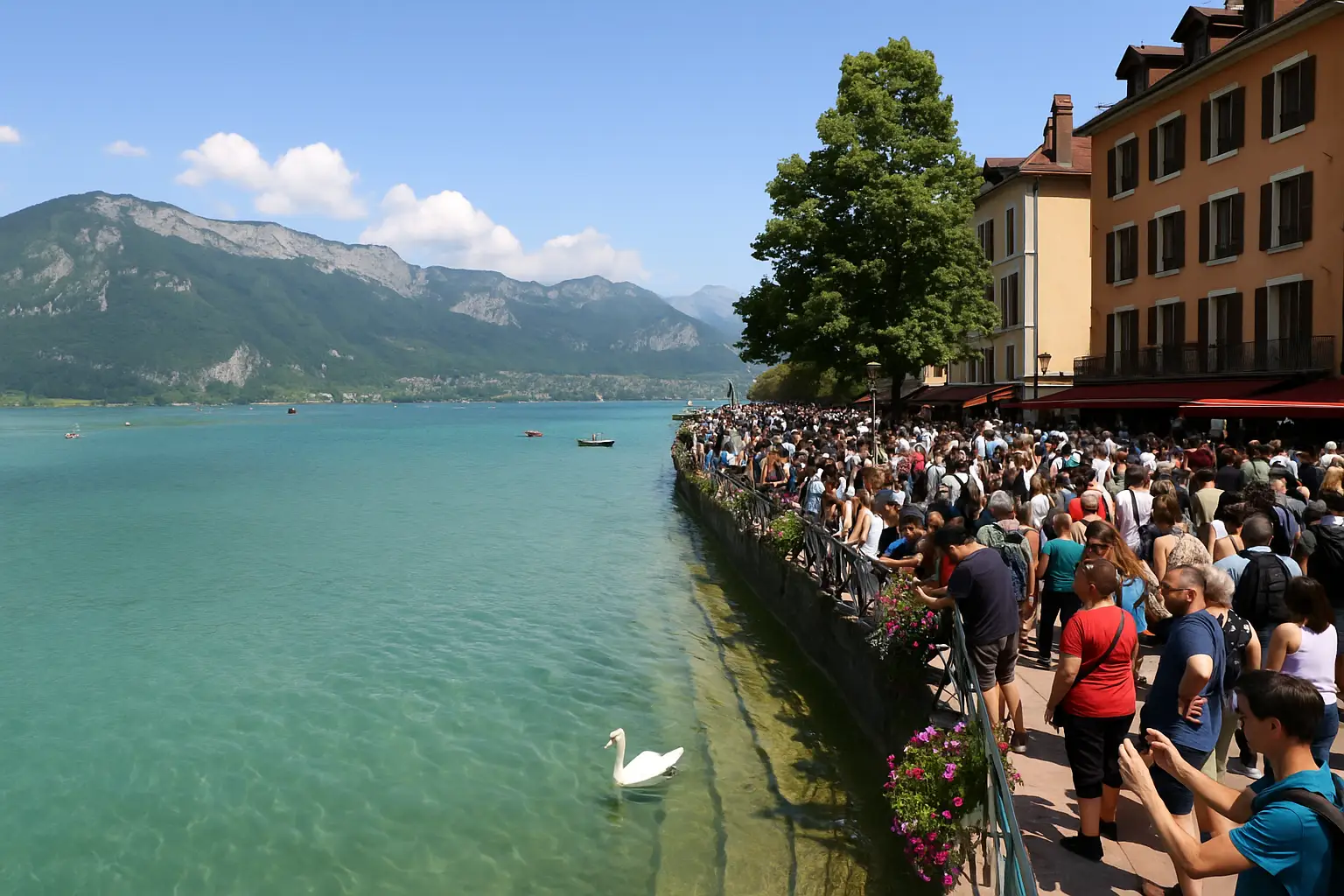
Three million visitors, streets that get crowded, the Love Bridge renamed “Bridge of Dislove” by residents at their wits’ end: in Annecy, the frustration is openly displayed. The ARVVA and Les Glaisins de la colère collectives have put on the pressure, and the municipality is moving towards regulating Airbnb. The Dauphiné Libéré (August 14, 2025) sums up the mood well: between postcard-perfect and headache, the tipping point is visible to the naked eye.
Why the old town is grinding its teeth
If you’ve ever tried to cross the old town on a sunny Saturday, you know the picture: strollers stuck by the Thiou riverbank, the smell of sugar crepes competing with that of grilled diots sausages, and that feeling that the city barely breathes. Let’s not lie, it’s beautiful — almost too much. I myself have already slowed down to snap a photo of a reflection on a pastel facade, then regretted it by blocking the entire line. Mea culpa.
The word that stirs anger is over-tourism Annecy. Behind it, ordinary lives are shaken. Neighbors who can no longer find parking, tenants evicted at the end of a lease, historic shops replaced by yet another quick sandwich shop. And in the evening, the “noise-osity” (yes, I’m inventing a bit) rises as rolling suitcases clatter on the cobblestones until midnight. Do you live here? You know what it’s like to time your nap around check-in schedules.
Airbnb, symptoms and blind spots
No one says everything stems from furnished tourist rentals. Annecy’s success plays on several fronts: Instagram, remote work allowing a quick hop for a long weekend, easy flights to Geneva. But the multiplication of Airbnb is the stumbling block. It accelerates seasonal gentrification, creates a form of mono-activity in certain blocks, and makes long-term rentals scarcer. A simple logic: more profitable per night than per month, so we switch.
What the city is putting into the pipeline
The national framework is set: 120 nights per year for a primary residence, declaration and registration number. In Annecy, a new phase of regulation is coming on the agenda, following the trend of cities tightening the screws. The message is clear: rebalance without breaking the local economy. Not easy, but doable if the rule is clear and controlled.
The options on the table — some already used elsewhere — resemble a toolbox. The idea is not to stigmatize the host renting out their room in summer, but rather to slow down the industrialization of furnished rentals.
- Registration number and reinforced control, with penalties for false declarations.
- Different night ceilings in the city center to lower pressure where it is bursting.
- Rule of change of use and compensation to convert a dwelling into a furnished tourist rental.
- Adjusted tourist tax and surtax on secondary residences to finance housing and public services.
- Targeted moratoriums on new furnished rentals in already saturated streets.
the limits of the short-stay model
A city that loses its year-round residents loses its services, its schools, its everyday culture. Capacity isn’t just beds: it’s an urban gauge made of sidewalks, buses, schools, bakers who stay open in November. When this gauge cracks, the destination loses its charm — and by the way, its economy from Monday to Friday.
Ideas to breathe without spoiling the party

We’re not going to turn Annecy into a museum under glass. The challenge is to smooth out flows, preserve housing, and give residents some breathing room. This is what often comes back from the field, cafes included (and yes, between two sips of espresso, a lot is heard).
- Spread attendance: events outside the high season, autumn cultural offers, less emphasis on the “summer postcard.”
- Better manage pedestrian flows: direction of circulation in narrow alleys, clear signage, wayfinding towards alternative routes.
- Smart transport: lake shuttles, park-and-ride lots, incentives for cycling around the Lake Annecy.
- Hospitality charter: simple guidelines for hosts and travelers (quiet after 10 pm, no late check-ins without agreement, waste sorting… basic but effective).
- Public furnished rentals observatory: open data, transparency, and decisions based on facts, not intuitions.
I’ll add a personal obsession: a “summer gauge” for the old town with adaptive measures — not a turnstile, let’s calm down — but soft limits when it overflows, communicated in real time. Who has never given up on a bakery when the line winded around the corner?
and now, what do we do?
Annecy is not risking its skin, it is playing its coherence. If we want residents still to want to raise children there, start a neighborhood business, stay in winter when the lake steams in the morning, the rule must protect everyday life. And yes, a happy tourist also exists when the city breathes.
Are you a host, traveler, third-floor neighbor, or elected official? Tell me: where would you place the cursor between hospitality and public tranquility? Would a cap of 90 nights in the city center seem fair? Or rather a strict compensation system for each dwelling converted? We fumble, cut, then adjust. Like in any well-run kitchen.
“Stop over-tourism” signs are not there for decoration — they speak of a city that wants to stay livable, without losing its smile.